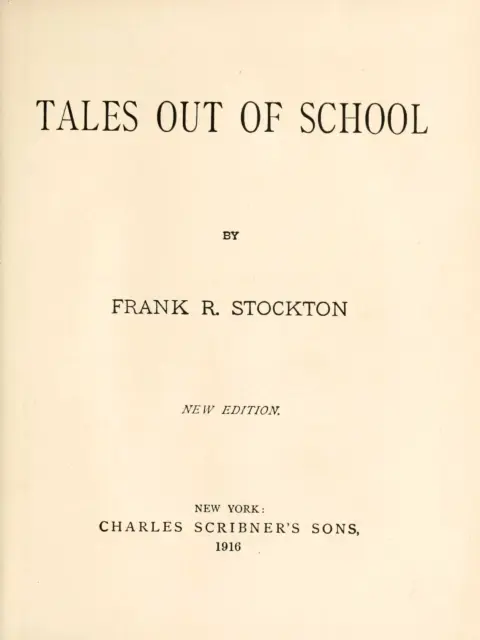
Pomona’s Travels A Series of Letters to the Mistress of Rudder Grange from her Former Handmaiden
Frank R. Stockton
THE CLASSIC COLLECTION · 1892
"My Terminal Moraine" by Frank R. Stockton is a novel written in the late 19th century. The story centers around Walter Cuthbert, a young man who, after the death of his father, finds himself in a state of melancholy, unable to take much interest in life until he falls in love with Agnes Havelot. His delicate situation becomes complicated, as he feels trapped by his lack of wealth and Agnes's father's disapproval. Ultimately, the book addresses themes of love, ambition, and unexpected fortune as Walter discovers a remarkable ice deposit beneath his land. The narrative follows Walter's journey of transformation, beginning with his idle and despondent life as a landowner. After being inspired by his friend Tom Burton, a geologist, Walter decides to improve his estate in hopes of winning Agnes's father's approval. When he accidentally uncovers a massive deposit of ice, initially considered a bizarre curiosity, it opens the door to wealth and success. The story unfolds as Walter grapples with his new fortune, ultimately leading to a dramatic incident where he becomes trapped in the ice mine. His salvation by Agnes and the subsequent acceptance of their love culminate in both a romantic and social resolution, illustrating how fortunes can change in the most unexpected ways.
Introduction adapted from the source catalogue; source summaries may be automatically generated.
Free to read · English · 14,870 words · No account needed
MAKE TIME FOR A GOOD BOOK
On by default. Untick to stop anonymous reading totals. Each page counts after 10 seconds in view. How this works.
Anonymous counting is on unless you have switched it off.
“But you see, father,” said Agnes, earnestly, “the reason I did that was because when I roasted them in anything shallow they popped into the fire, but they could not jump out of the diploma case.”
“Well, something else seems to have jumped out of it,” said the old gentleman, “and something with which I am not satisfied. I have been looking over these books, sir, and have read the articles on ice, glaciers and caves, and I find no record of anything in the whole history of the world which in the least resembles the cock-and-bull story I am told about the butt-end of a glacier which tumbled into a cave in your ground, and has been lying there through all the geological ages, and the eras of formation, and periods of animate existence down to the days of Noah, and Moses, and Methuselah, and Rameses II, and Alexander the Great, and Martin Luther, and John Wesley, to this day, for you to dig out and sell to the Williamstown Ice Co.”
“But that's what happened, sir,” said I.
“And besides, father,” added Agnes, “the gold and silver that people take out of mines may have been in the ground as long as that ice has been.”
“Bosh!” said Mr. Havelot. “The cases are not at all similar. It is simply impossible that a piece of a glacier should have fallen into a cave and been preserved in that way. The temperature of caves is always above the freezing-point, and that ice would have melted a million years before you were born.”
“But, father,” said Agnes, “the temperature of caves filled with ice must be very much lower than that of common caves.”
“And apart from that,” I added, “the ice is still there, sir.”
“That doesn't make the slightest difference,” he replied. “It's against all reason and commonsense that such a thing could have happened. Even if there ever was a glacier in this part of the country and if the lower portion of it did stick out over an immense hole in the ground, that protruding end would never have broken off and tumbled in. Glaciers are too thick and massive for that.”
“But the glacier is there, sir,” said I, “in spite of your own
reasoning.”
“And then again,” continued the old gentleman, “if there had been a cave and a projecting spur the ice would have gradually melted and dripped into the cave, and we would have had a lake and not an ice-mine. It is an absurdity.”
“But it's there, notwithstanding,” said I.
“And you can not subvert facts, you know, father,” added Agnes.
Your reading position is saved on this browser. Take it to another device with a library code. Reading pages adapt to text, rather than matching a printed edition.
Frank R. Stockton

Frank R. Stockton

Frank R. Stockton
Frank R. Stockton
BEHIND THE BOOK
This eBook is for the use of anyone anywhere in the United States and most other parts of the world at no cost and with almost no restrictions whatsoever. You may copy it, give it away or re-use it under the terms of the Project Gutenberg License included with this eBook or online at www.gutenberg.org. If you are not located in the United States, you will have to check the laws of the country where you are located before using this eBook. Read the source licence.
The original source file, including credits and licence, is retained by this library. Request an original-format copy at no charge. Please include the book title and Project Gutenberg identifier #23175.
KEEP YOUR CURIOSITY GOING
Coulson Kernahan

Maurice Baring
Frances Wright
Cécile Tormay

Frederic Jesup Stimson

W. H. P. (William Henry Pope) Jarvis