THE CLASSIC COLLECTION✦The old English dramatistsCLASSIC FREE BOOKS
The old English dramatists
James Russell Lowell

THE CLASSIC COLLECTION · 1899
"My Study Windows" by James Russell Lowell is a collection of essays written in the late 19th century. The work draws from the author's reflections and experiences over a span of years, presenting a range of topics that encompass nature, literature, and personal musings. It hints at a thoughtful exploration of the beauty of the natural world, alongside cultural commentary, making it appealing for readers interested in nuanced observations about life and the environment. The opening of the book sets the stage with a prefatory note where Lowell introduces the collection, explaining that the essays included were composed over the last fifteen years. He expresses his intention to compile these writings as a means of 'shutting them between two covers' to make space for new thoughts. The initial essay, "My Garden Acquaintance," begins with the author reminiscing about the joy he found in reading Gilbert White's "Natural History of Selborne," drawing parallels between White's observations of nature and his own experiences. Lowell invokes a vivid portrayal of his garden and its inhabitants, offering insights into the interplay between humanity and nature, which will be a recurring theme throughout the collection.
Introduction adapted from the source catalogue; source summaries may be automatically generated.
Free to read · English · 137,668 words · No account needed
MAKE TIME FOR A GOOD BOOK
On by default. Untick to stop anonymous reading totals. Each page counts after 10 seconds in view. How this works.
Anonymous counting is on unless you have switched it off.
Friedrich was doubtless a remarkable man, but surely very far below any lofty standard of heroic greatness. He was the last of the European kings who could look upon his kingdom as his private patrimony; and it was this estate of his, this piece of property, which he so obstinately and successfully defended. He had no idea of country as it was understood by an ancient Greek or Roman, as it is understood by a modern Englishman or American; and there is something almost pitiful in seeing a man of genius like Mr. Carlyle fighting painfully over again those battles of the last century which settled nothing but the continuance of the Prussian monarchy, while he saw only the “burning of a dirty chimney” in the war which a great people was waging under his very eyes for the idea of nationality and orderly magistrature, and which fixed, let us hope forever, a boundary-line on the map of history and man’s advancement toward self-conscious and responsible freedom. The true historical genius, to our thinking, is that which can see the nobler meaning of events that are near him, as the true poet is he who detects the divine in the casual; and we somewhat suspect the depth of his insight into the past, who cannot recognize the godlike of to-day under that disguise in which it always visits us. Shall we hint to Mr. Carlyle that a man may look on an heroic age, as well as an heroic master, with the eyes of a valet, as misappreciative certainly, though not so ignoble?
What Goethe says of a great poet, that he must be a citizen of his age as well as of his country, may be said inversely of a great king. He should be a citizen of his country as well as of his age. Friedrich was certainly the latter in its fullest sense; whether he was, or could have been, the former, in any sense, may be doubted. The man who spoke and wrote French in preference to his mother-tongue, who, dying when Goethe was already drawing toward his fortieth year, Schiller toward his thirtieth, and Lessing had been already five years in his grave, could yet see nothing but barbarism in German literature, had little of the old Teutonic fibre in his nature. The man who pronounced the Nibelungen Lied not worth a pinch of priming, had little conception of the power of heroic traditions in making heroic men, and especially in strengthening that instinct made up of so many indistinguishable associations which we call love of country. Charlemagne, when he caused the old songs of his people to be gathered and written down, showed a truer sense of the sources of national feeling and a deeper political insight. This want of sympathy points to the somewhat narrow limits of Friedrich’s nature. In spite of Mr. Carlyle’s adroit statement of the case, and the whole book has an air of being the plea of a masterly advocate in mitigation of sentence, we feel that his hero was essentially hard, narrow, and selfish. His popularity will go for little with any one who has studied the trifling and often fabulous elements that make up that singular compound. A bluntness of speech, a shabby uniform, a frugal camp equipage, a timely familiarity, may make a man the favorite of an army or a nation,--above all, if he have the knack of success. Moreover, popularity is much more easily won from above downward, and is bought at a better bargain by kings and generals than by other men. We doubt if Friedrich would have been liked as a private person, or even as an unsuccessful king. He apparently attached very few people to himself, fewer even than his brutal old Squire Western of a father. His sister Wilhelmina is perhaps an exception. We say perhaps, for we do not know how much the heroic part he was called on to play had to do with the matter, and whether sisterly pride did not pass even with herself for sisterly affection. Moreover she was far from him; and Mr. Carlyle waves aside, in his generous fashion, some rather keen comments of hers on her brother’s character when she visited Berlin after he had become king. Indeed, he is apt to deal rather contemptuously with all adverse criticism of his hero. We sympathize with his impulse in this respect, agreeing heartily as we do in Chaucer’s scorn of those who “gladlie demen to the baser end” in such matters. But we are not quite sure if this be a safe method with the historian. He must doubtless be the friend of his hero if he would understand him, but he must be more the friend of truth if he would understand history. Mr. Carlyle’s passion for truth is intense, as befits his temper, but it is that of a lover for his mistress. He would have her all to himself, and has a lover’s conviction that no one is able, or even fit, to appreciate her but himself. He does well to despise the tittle-tattle of vulgar minds, but surely should not ignore all testimony on the other side. For ourselves, we think it not unimportant that Goethe’s friend Knebel, a man not incapable of admiration, and who had served a dozen years or so as an officer of Friedrich’s guard, should have bluntly called him “the tyrant.”
Your reading position is saved on this browser. Take it to another device with a library code. Reading pages adapt to text, rather than matching a printed edition.
James Russell Lowell
James Russell Lowell

James Russell Lowell
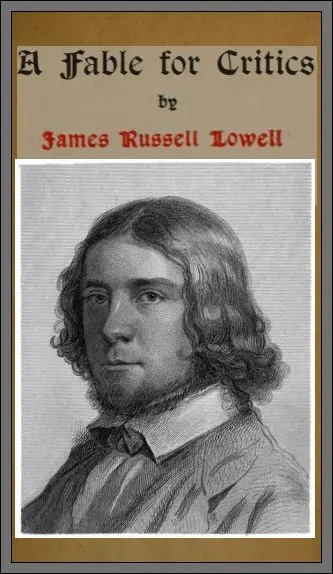
James Russell Lowell
BEHIND THE BOOK
This eBook is for the use of anyone anywhere in the United States and most other parts of the world at no cost and with almost no restrictions whatsoever. You may copy it, give it away or re-use it under the terms of the Project Gutenberg License included with this eBook or online at www.gutenberg.org. If you are not located in the United States, you will have to check the laws of the country where you are located before using this eBook. Read the source licence.
The original source file, including credits and licence, is retained by this library. Request an original-format copy at no charge. Please include the book title and Project Gutenberg identifier #73710.
KEEP YOUR CURIOSITY GOING

David Patterson (Spirit) Hatch

David Patterson (Spirit) Hatch

David Patterson (Spirit) Hatch

Ralph Waldo Emerson

Maurice Baring

Oscar Wilde & James McNeill Whistler