THE CLASSIC COLLECTION✦The old English dramatistsCLASSIC FREE BOOKS
The old English dramatists
James Russell Lowell

THE CLASSIC COLLECTION · 1899
"My Study Windows" by James Russell Lowell is a collection of essays written in the late 19th century. The work draws from the author's reflections and experiences over a span of years, presenting a range of topics that encompass nature, literature, and personal musings. It hints at a thoughtful exploration of the beauty of the natural world, alongside cultural commentary, making it appealing for readers interested in nuanced observations about life and the environment. The opening of the book sets the stage with a prefatory note where Lowell introduces the collection, explaining that the essays included were composed over the last fifteen years. He expresses his intention to compile these writings as a means of 'shutting them between two covers' to make space for new thoughts. The initial essay, "My Garden Acquaintance," begins with the author reminiscing about the joy he found in reading Gilbert White's "Natural History of Selborne," drawing parallels between White's observations of nature and his own experiences. Lowell invokes a vivid portrayal of his garden and its inhabitants, offering insights into the interplay between humanity and nature, which will be a recurring theme throughout the collection.
Introduction adapted from the source catalogue; source summaries may be automatically generated.
Free to read · English · 137,668 words · No account needed
MAKE TIME FOR A GOOD BOOK
On by default. Untick to stop anonymous reading totals. Each page counts after 10 seconds in view. How this works.
Anonymous counting is on unless you have switched it off.
In the earlier part of his literary career, Mr. Carlyle was the denouncer of shams, the preacher up of sincerity, manliness, and of a living faith, instead of a droning ritual. He had intense convictions, and he made disciples. With a compass of diction unequalled by any other public performer of the time, ranging as it did from the unbooked freshness of the Scottish peasant to the most far-sought phrase of literary curiosity, with humor, pathos, and eloquence at will, it was no wonder that he found eager listeners in a world longing for a sensation, and forced to put up with the West-End gospel of “Pelham.” If not a profound thinker, he had what was next best,--he felt profoundly, and his cry came out of the depths. The stern Calvinism of his early training was rekindled by his imagination to the old fervor of Wishart and Brown, and became a new phenomenon as he reproduced it subtilized by German transcendentalism and German culture. Imagination, if it lays hold of a Scotchman, possesses him in the old demoniac sense of the word, and that hard logical nature, if the Hebrew fire once gets fair headway in it, burns unquenchable as an anthracite coal-mine. But to utilize these sacred heats, to employ them, as a literary man is always tempted, to keep the domestic pot a-boiling,--is such a thing possible? Only too possible, we fear; and Mr. Carlyle is an example of it. If the languid public long for a sensation, the excitement of making one becomes also a necessity of the successful author, as the intellectual nerves grow duller and the old inspiration that came unbidden to the bare garret grows shier and shier of the comfortable parlor. As he himself said thirty years ago of Edward Irving, “Unconsciously, for the most part in deep unconsciousness, there was now the impossibility to live neglected,--to walk on the quiet paths where alone it is well with us. Singularity must henceforth succeed singularity. O foulest Circean draught, thou poison of Popular Applause! madness is in thee and death; thy end is Bedlam and the grave.” Mr. Carlyle won his first successes as a kind of preacher in print. His fervor, his oddity of manner, his pugnacious paradox, drew the crowd; the truth, or, at any rate, the faith that underlay them all, brought also the fitter audience, though fewer. But the curse was upon him; he must attract, he must astonish. Thenceforth he has done nothing but revamp his telling things; but the oddity has become always odder, the paradoxes more paradoxical. No very large share of truth falls to the apprehension of any one man; let him keep it sacred, and beware of repeating it till it turn to falsehood on his lips by becoming ritual. Truth always has a bewitching savor of newness in it, and novelty at the first taste recalls that original sweetness to the tongue; but alas for him who would make the one a substitute for the other! We seem to miss of late in Mr. Carlyle the old sincerity. He has become the purely literary man, less concerned about what he says than about how he shall say it to best advantage. The Muse should be the companion, not the guide, says he whom Mr. Carlyle has pronounced “the wisest of this generation.” What would be a virtue in the poet is a vice of the most fatal kind in the teacher, and, alas that we should say it! the very Draco of shams, whose code contained no penalty milder than capital for the most harmless of them, has become at last something very like a sham himself. Mr. Carlyle continues to be a voice crying in the wilderness, but no longer a voice with any earnest conviction behind it. Hearing him rebuke us for being humbugs and impostors, we are inclined to answer, with the ambassador of Philip II., when his master reproached him with forgetting substance in ceremony, “Your Majesty forgets that you are only a ceremony yourself.” And Mr. Carlyle’s teaching, moreover,--if teaching we may call it,--belongs to what the great German, whose disciple he is, condemned as the “literature of despair.” An apostle to the gentiles might hope for some fruit of his preaching; but of what avail an apostle who shouts his message down the mouth of the pit to poor lost souls, whom he can positively assure only that it is impossible to get out? Mr. Carlyle lights up the lanterns of his Pharos after the ship is already rolling between the tongue of the sea and the grinders of the reef. It is very brilliant, and its revolving flashes touch the crests of the breakers with an awful picturesqueness; but in so desperate a state of things, even Dr. Syntax might be pardoned for being forgetful of the picturesque. The Toryism of Scott sprang from love of the past; that of Carlyle is far more dangerously infectious, for it is logically deduced from a deep disdain of human nature.
Your reading position is saved on this browser. Take it to another device with a library code. Reading pages adapt to text, rather than matching a printed edition.
James Russell Lowell
James Russell Lowell

James Russell Lowell
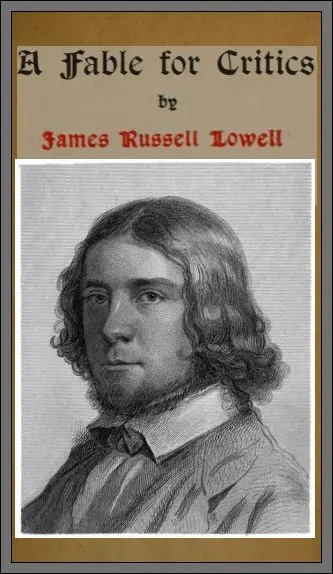
James Russell Lowell
BEHIND THE BOOK
This eBook is for the use of anyone anywhere in the United States and most other parts of the world at no cost and with almost no restrictions whatsoever. You may copy it, give it away or re-use it under the terms of the Project Gutenberg License included with this eBook or online at www.gutenberg.org. If you are not located in the United States, you will have to check the laws of the country where you are located before using this eBook. Read the source licence.
The original source file, including credits and licence, is retained by this library. Request an original-format copy at no charge. Please include the book title and Project Gutenberg identifier #73710.
KEEP YOUR CURIOSITY GOING

David Patterson (Spirit) Hatch

David Patterson (Spirit) Hatch

David Patterson (Spirit) Hatch

Ralph Waldo Emerson

Maurice Baring

Oscar Wilde & James McNeill Whistler