THE CLASSIC COLLECTION✦The old English dramatistsCLASSIC FREE BOOKS
The old English dramatists
James Russell Lowell

THE CLASSIC COLLECTION · 1899
"My Study Windows" by James Russell Lowell is a collection of essays written in the late 19th century. The work draws from the author's reflections and experiences over a span of years, presenting a range of topics that encompass nature, literature, and personal musings. It hints at a thoughtful exploration of the beauty of the natural world, alongside cultural commentary, making it appealing for readers interested in nuanced observations about life and the environment. The opening of the book sets the stage with a prefatory note where Lowell introduces the collection, explaining that the essays included were composed over the last fifteen years. He expresses his intention to compile these writings as a means of 'shutting them between two covers' to make space for new thoughts. The initial essay, "My Garden Acquaintance," begins with the author reminiscing about the joy he found in reading Gilbert White's "Natural History of Selborne," drawing parallels between White's observations of nature and his own experiences. Lowell invokes a vivid portrayal of his garden and its inhabitants, offering insights into the interplay between humanity and nature, which will be a recurring theme throughout the collection.
Introduction adapted from the source catalogue; source summaries may be automatically generated.
Free to read · English · 137,668 words · No account needed
MAKE TIME FOR A GOOD BOOK
On by default. Untick to stop anonymous reading totals. Each page counts after 10 seconds in view. How this works.
Anonymous counting is on unless you have switched it off.
Mr. Carlyle’s historical compositions are wonderful prose poems, full of picture, incident, humor, and character, where we grow familiar with his conception of certain leading personages, and even of subordinate ones, if they are necessary to the scene, so that they come out living upon the stage from the dreary limbo of names; but this is no more history than the historical plays of Shakespeare. There is nothing in imaginative literature superior in its own way to the episode of Voltaire in the Fritziad. It is delicious in humor, masterly in minute characterization. We feel as if the principal victim (for we cannot help feeling all the while that he is so) of this mischievous genius had been put upon the theatre before us by some perfect mimic like Foote, who had studied his habitual gait, gestures, tones, turn of thought, costume, trick of feature, and rendered them with the slight dash of caricature needful to make the whole composition tell. It is in such things that Mr. Carlyle is beyond all rivalry, and that we must go back to Shakespeare for a comparison. But the mastery of Shakespeare is shown perhaps more strikingly in his treatment of the ordinary than of the exceptional. His is the gracious equality of Nature herself. Mr. Carlyle’s gift is rather in the representation than in the evolution of character; and it is a necessity of his art, therefore, to exaggerate slightly his heroic, and to caricature in like manner his comic parts. His appreciation is less psychological than physical and external. Grimm relates that Garrick, riding once with Préville, proposed to him that they should counterfeit drunkenness. They rode through Passy accordingly, deceiving all who saw them. When beyond the town Préville asked how he had succeeded. “Excellently,” said Garrick, “as to your body; but your legs were not tipsy.” Mr. Carlyle would be as exact in his observation of nature as the great actor, and would make us see a drunken man as well; but we doubt whether he could have conceived that unmatchable scene in Antony and Cleopatra, where the tipsiness of Lepidus pervades the whole metaphysical no less than the physical part of the triumvir. If his sympathies bore any proportion to his instinct for catching those traits which are the expression of character, but not character itself, we might have had a great historian in him instead of a history-painter. But that which is a main element in Mr. Carlyle’s talent, and does perhaps more than anything else to make it effective, is a defect of his nature. The cynicism, which renders him so entertaining precludes him from any just conception of men and their motives, and from any sane estimate of the relative importance of the events which concern them. We remember a picture of Hamon’s, where before a Punch’s theatre are gathered the wisest of mankind in rapt attention. Socrates sits on a front bench, absorbed in the spectacle, and in the corner stands Dante making entries in his note-book. Mr. Carlyle as an historian leaves us in somewhat such a mood. The world is a puppet-show, and when we have watched the play out, we depart with a half-comic consciousness of the futility of all human enterprise, and the ludicrousness of all man’s action and passion on the stage of the world. Simple, kindly, blundering Oliver Goldsmith was after all wiser, and his Vicar, ideal as Hector and not less immortal, is a demonstration of the perennial beauty and heroism of the homeliest human nature. The cynical view is congenial to certain moods, and is so little inconsistent with original nobleness of mind, that it is not seldom the acetous fermentation of it; but it is the view of the satirist, not of the historian, and takes in but a narrow arc in the circumference of truth. Cynicism in itself is essentially disagreeable. It is the intellectual analogue of the truffle; and though it may be very well in giving a relish to thought for certain palates, it cannot supply the substance of it. Mr. Carlyle’s cynicism is not that polished weariness of the outsides of life which we find in Ecclesiastes. It goes much deeper than that to the satisfactions, not of the body or the intellect, but of the very soul itself. It vaunts itself; it is noisy and aggressive. What the wise master puts into the mouth of desperate ambition, thwarted of the fruit of its crime, as the fitting expression of passionate sophistry, seems to have become an article of his creed. With him
Your reading position is saved on this browser. Take it to another device with a library code. Reading pages adapt to text, rather than matching a printed edition.
James Russell Lowell
James Russell Lowell

James Russell Lowell
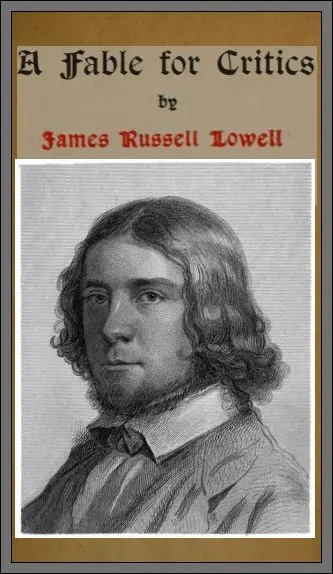
James Russell Lowell
BEHIND THE BOOK
This eBook is for the use of anyone anywhere in the United States and most other parts of the world at no cost and with almost no restrictions whatsoever. You may copy it, give it away or re-use it under the terms of the Project Gutenberg License included with this eBook or online at www.gutenberg.org. If you are not located in the United States, you will have to check the laws of the country where you are located before using this eBook. Read the source licence.
The original source file, including credits and licence, is retained by this library. Request an original-format copy at no charge. Please include the book title and Project Gutenberg identifier #73710.
KEEP YOUR CURIOSITY GOING

David Patterson (Spirit) Hatch

David Patterson (Spirit) Hatch

David Patterson (Spirit) Hatch

Ralph Waldo Emerson

Maurice Baring

Oscar Wilde & James McNeill Whistler