THE CLASSIC COLLECTION✦The old English dramatistsCLASSIC FREE BOOKS
The old English dramatists
James Russell Lowell

THE CLASSIC COLLECTION · 1899
"My Study Windows" by James Russell Lowell is a collection of essays written in the late 19th century. The work draws from the author's reflections and experiences over a span of years, presenting a range of topics that encompass nature, literature, and personal musings. It hints at a thoughtful exploration of the beauty of the natural world, alongside cultural commentary, making it appealing for readers interested in nuanced observations about life and the environment. The opening of the book sets the stage with a prefatory note where Lowell introduces the collection, explaining that the essays included were composed over the last fifteen years. He expresses his intention to compile these writings as a means of 'shutting them between two covers' to make space for new thoughts. The initial essay, "My Garden Acquaintance," begins with the author reminiscing about the joy he found in reading Gilbert White's "Natural History of Selborne," drawing parallels between White's observations of nature and his own experiences. Lowell invokes a vivid portrayal of his garden and its inhabitants, offering insights into the interplay between humanity and nature, which will be a recurring theme throughout the collection.
Introduction adapted from the source catalogue; source summaries may be automatically generated.
Free to read · English · 137,668 words · No account needed
MAKE TIME FOR A GOOD BOOK
On by default. Untick to stop anonymous reading totals. Each page counts after 10 seconds in view. How this works.
Anonymous counting is on unless you have switched it off.
In the biography of Mr. Quincy by his son there is something of the provincialism of which we have spoken as inherent in most American works of the kind. His was a Boston life in the strictest sense. But provincialism is relative, and where it has a flavor of its own, as in Scotland, it is often agreeable in proportion to its very intensity. The Massachusetts in which Mr. Quincy’s habits of thought were acquired was a very different Massachusetts from that in which we of later generations have been bred. Till after he had passed middle life, Boston was more truly a capital than any other city in America, before or since, except possibly Charleston. The acknowledged head of New England, with a population of wellnigh purely English descent, mostly derived from the earlier emigration, with ancestral traditions and inspiring memories of its own, it had made its name familiar in both worlds, and was both historically and politically more important than at any later period. The Revolution had not interrupted, but rather given a freer current to the tendencies of its past. Both by its history and position, the town had what the French call a solidarity, an almost personal consciousness, rare anywhere, rare especially in America, and more than ever since our enormous importation of fellow-citizens to whom America means merely shop, or meat three times a day. Boston has been called the “American Athens.” Æsthetically, the comparison is ludicrous, but politically it was more reasonable. Its population was homogeneous, and there were leading families; while the form of government by town-meeting, and the facility of social and civic intercourse, gave great influence to popular personal qualities and opportunity to new men. A wide commerce, while it had insensibly softened the asperities of Puritanism and imported enough foreign refinement to humanize, not enough foreign luxury to corrupt, had not essentially qualified the native tone of the town. Retired sea-captains (true brothers of Chaucer’s Shipman), whose exploits had kindled the imagination of Burke, added a not unpleasant savor of salt to society. They belonged to the old school of Gilbert, Hawkins, Frobisher, and Drake, parcel-soldiers all of them, who had commanded armed ships and had tales to tell of gallant fights with privateers or pirates, truest representatives of those Vikings who, if trade in lumber or peltry was dull, would make themselves Dukes of Dublin or Earls of Orkney. If trade pinches the mind, commerce liberalizes it; and Boston was also advantaged with the neighborhood of the country’s oldest College, which maintained the wholesome traditions of culture,--where Homer and Horace are familiar there is a certain amount of cosmopolitanism,--and would not allow bigotry to become despotism. Manners were more self-respectful, and therefore more respectful of others, and personal sensitiveness was fenced with more of that ceremonial with which society armed itself when it surrendered the ruder protection of the sword. We had not then seen a Governor in his chamber at the State-House with his hat on, a cigar in his mouth, and his feet upon the stove. Domestic service, in spite of the proverb, was not seldom an inheritance, nor was household peace dependent on the whim of a foreign armed neutrality in the kitchen. Servant and master were of one stock; there was decent authority and becoming respect; the tradition of the Old World lingered after its superstition had passed away. There was an aristocracy such as is healthful in a well-ordered community, founded on public service, and hereditary so long as the virtue which was its patent was not escheated. The clergy, no longer hedged by the reverence exacted by sacerdotal caste, were more than repaid by the consideration willingly paid to superior culture. What changes, many of them for the better, some of them surely for the worse, and all of them inevitable, did not Josiah Quincy see in that wellnigh secular life which linked the war of independence to the war of nationality! We seemed to see a type of them the other day in a colored man standing with an air of comfortable self-possession while his boots were brushed by a youth of catholic neutral tint, but whom nature had planned for white. The same eyes that had looked on Gage’s red-coats, saw Colonel Shaw’s negro regiment march out of Boston in the national blue. Seldom has a life, itself actively associated with public affairs, spanned so wide a chasm for the imagination. Oglethorpe’s offers a parallel,--the aide-de-camp of Prince Eugene calling on John Adams, American Ambassador to England. Most long lives resemble those threads of gossamer, the nearest approach to nothing unmeaningly prolonged, scarce visible pathway of some worm from his cradle to his grave; but Quincy’s was strung with seventy active years, each one a rounded bead of usefulness and service.
Your reading position is saved on this browser. Take it to another device with a library code. Reading pages adapt to text, rather than matching a printed edition.
James Russell Lowell
James Russell Lowell

James Russell Lowell
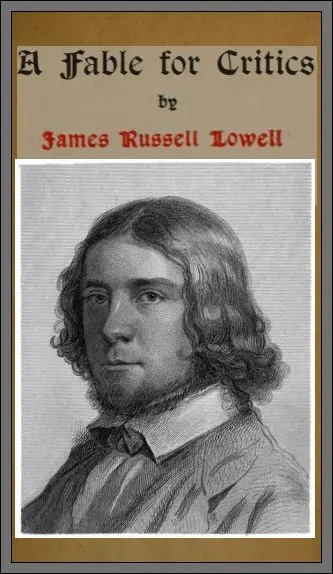
James Russell Lowell
BEHIND THE BOOK
This eBook is for the use of anyone anywhere in the United States and most other parts of the world at no cost and with almost no restrictions whatsoever. You may copy it, give it away or re-use it under the terms of the Project Gutenberg License included with this eBook or online at www.gutenberg.org. If you are not located in the United States, you will have to check the laws of the country where you are located before using this eBook. Read the source licence.
The original source file, including credits and licence, is retained by this library. Request an original-format copy at no charge. Please include the book title and Project Gutenberg identifier #73710.
KEEP YOUR CURIOSITY GOING

David Patterson (Spirit) Hatch

David Patterson (Spirit) Hatch

David Patterson (Spirit) Hatch

Ralph Waldo Emerson

Maurice Baring

Oscar Wilde & James McNeill Whistler