THE CLASSIC COLLECTION✦The old English dramatistsCLASSIC FREE BOOKS
The old English dramatists
James Russell Lowell

THE CLASSIC COLLECTION · 1899
"My Study Windows" by James Russell Lowell is a collection of essays written in the late 19th century. The work draws from the author's reflections and experiences over a span of years, presenting a range of topics that encompass nature, literature, and personal musings. It hints at a thoughtful exploration of the beauty of the natural world, alongside cultural commentary, making it appealing for readers interested in nuanced observations about life and the environment. The opening of the book sets the stage with a prefatory note where Lowell introduces the collection, explaining that the essays included were composed over the last fifteen years. He expresses his intention to compile these writings as a means of 'shutting them between two covers' to make space for new thoughts. The initial essay, "My Garden Acquaintance," begins with the author reminiscing about the joy he found in reading Gilbert White's "Natural History of Selborne," drawing parallels between White's observations of nature and his own experiences. Lowell invokes a vivid portrayal of his garden and its inhabitants, offering insights into the interplay between humanity and nature, which will be a recurring theme throughout the collection.
Introduction adapted from the source catalogue; source summaries may be automatically generated.
Free to read · English · 137,668 words · No account needed
MAKE TIME FOR A GOOD BOOK
On by default. Untick to stop anonymous reading totals. Each page counts after 10 seconds in view. How this works.
Anonymous counting is on unless you have switched it off.
I know not whether it is because I am pigeon-livered and lack gall, or whether it is from an overmastering sense of drollery, but I am apt to submit to such bastings with a patience which afterwards surprises me, being not without my share of warmth in the blood. Perhaps it is because I so often meet with young persons who know vastly more than I do, and especially with so many foreigners whose knowledge of this country is superior to my own. However it may be, I listened for some time with tolerable composure as my self-appointed lecturer gave me in detail his opinions of my country and its people. America, he informed me, was without arts, science, literature, culture, or any native hope of supplying them. We were a people wholly given to money-getting, and who, having got it, knew no other use for it than to hold it fast. I am fain to confess that I felt a sensible itching of the biceps, and that my fingers closed with such a grip as he had just informed me was one of the effects of our unhappy climate. But happening just then to be where I could avoid temptation by dodging down a by-street, I hastily left him to finish his diatribe to the lamp-post, which could stand it better than I. That young man will never know how near he came to being assaulted by a respectable gentleman of middle age, at the corner of Church Street. I have never felt quite satisfied that I did all my duty by him in not knocking him down. But perhaps he might have knocked me down, and then?
The capacity of indignation makes an essential part of the outfit of every honest man, but I am inclined to doubt whether he is a wise one who allows himself to act upon its first hints. It should be rather, I suspect, a latent heat in the blood, which makes itself felt in character, a steady reserve for the brain, warming the ovum of thought to life, rather than cooking it by a too hasty enthusiasm in reaching the boiling-point. As my pulse gradually fell back to its normal beat, I reflected that I had been uncomfortably near making a fool of myself,--a handy salve of euphuism for our vanity, though it does not always make a just allowance to Nature for her share in the business. What possible claim had my Teutonic friend to rob me of my composure? I am not, I think, specially thin-skinned as to other people’s opinions of myself, having, as I conceive, later and fuller intelligence on that point than anybody else can give me. Life is continually weighing us in very sensitive scales, and telling every one of us precisely what his real weight is to the last grain of dust. Whoever at fifty does not rate himself quite as low as most of his acquaintance would be likely to put him, must be either a fool or a great man, and I humbly disclaim being either. But if I was not smarting in person from any scattering shot of my late companion’s commination, why should I grow hot at any implication of my country therein? Surely her shoulders are broad enough, if yours or mine are not, to bear up under a considerable avalanche of this kind. It is the bit of truth in every slander, the hint of likeness in every caricature, that makes us smart. “Art thou there, old Truepenny?” How did your blade know its way so well to that one loose rivet in our armor? I wondered whether Americans were over-sensitive in this respect, whether they were more touchy than other folks. On the whole, I thought we were not. Plutarch, who at least had studied philosophy, if he had not mastered it, could not stomach something Herodotus had said of Bœotia, and devoted an essay to showing up the delightful old traveller’s malice and ill-breeding. French editors leave out of Montaigne’s “Travels” some remarks of his about France, for reasons best known to themselves. Pachydermatous Deutschland, covered with trophies from every field of letters, still winces under that question which Père Bouhours put two centuries ago, Si un Allemand peut être bel-esprit? John Bull grew apoplectic with angry amazement at the audacious persiflage of Pückler-Muskau. To be sure, he was a prince,--but that was not all of it, for a chance phrase of gentle Hawthorne sent a spasm through all the journals of England. Then this tenderness is not peculiar to us? Console yourself, dear man and brother, whatever you may be sure of, be sure at least of this, that you are dreadfully like other people. Human nature has a much greater genius for sameness than for originality, or the world would be at a sad pass shortly. The surprising thing is that men have such a taste for this somewhat musty flavor, that an Englishman, for example, should feel himself defrauded, nay, even outraged, when he comes over here and finds a people speaking what he admits to be something like English, and yet so very different from (or, as he would say, to) those he left at home. Nothing, I am sure, equals my thankfulness when I meet an Englishman who is not like every other, or, I may add, an American of the same odd turn.
Your reading position is saved on this browser. Take it to another device with a library code. Reading pages adapt to text, rather than matching a printed edition.
James Russell Lowell
James Russell Lowell

James Russell Lowell
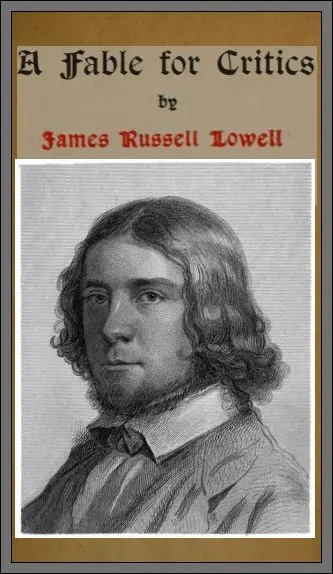
James Russell Lowell
BEHIND THE BOOK
This eBook is for the use of anyone anywhere in the United States and most other parts of the world at no cost and with almost no restrictions whatsoever. You may copy it, give it away or re-use it under the terms of the Project Gutenberg License included with this eBook or online at www.gutenberg.org. If you are not located in the United States, you will have to check the laws of the country where you are located before using this eBook. Read the source licence.
The original source file, including credits and licence, is retained by this library. Request an original-format copy at no charge. Please include the book title and Project Gutenberg identifier #73710.
KEEP YOUR CURIOSITY GOING

David Patterson (Spirit) Hatch

David Patterson (Spirit) Hatch

David Patterson (Spirit) Hatch

Ralph Waldo Emerson

Maurice Baring

Oscar Wilde & James McNeill Whistler