THE CLASSIC COLLECTION✦The old English dramatistsCLASSIC FREE BOOKS
The old English dramatists
James Russell Lowell

THE CLASSIC COLLECTION · 1899
"My Study Windows" by James Russell Lowell is a collection of essays written in the late 19th century. The work draws from the author's reflections and experiences over a span of years, presenting a range of topics that encompass nature, literature, and personal musings. It hints at a thoughtful exploration of the beauty of the natural world, alongside cultural commentary, making it appealing for readers interested in nuanced observations about life and the environment. The opening of the book sets the stage with a prefatory note where Lowell introduces the collection, explaining that the essays included were composed over the last fifteen years. He expresses his intention to compile these writings as a means of 'shutting them between two covers' to make space for new thoughts. The initial essay, "My Garden Acquaintance," begins with the author reminiscing about the joy he found in reading Gilbert White's "Natural History of Selborne," drawing parallels between White's observations of nature and his own experiences. Lowell invokes a vivid portrayal of his garden and its inhabitants, offering insights into the interplay between humanity and nature, which will be a recurring theme throughout the collection.
Introduction adapted from the source catalogue; source summaries may be automatically generated.
Free to read · English · 137,668 words · No account needed
MAKE TIME FOR A GOOD BOOK
On by default. Untick to stop anonymous reading totals. Each page counts after 10 seconds in view. How this works.
Anonymous counting is on unless you have switched it off.
[15] I think he tried one now and then, like “eyen columbine.”
[16] Commonly printed hath.
[17] Froissart’s description of the book of traités amoureux et de moralité, which he had had engrossed for presentation to Richard II. in 1394, is enough to bring tears to the eyes of a modern author. “Et lui plut très grandement; et plaire bien lui devoit car il é’tait enluminé, écrit et historié et couvert de vermeil velours à dis cloux d’argent dorés d’or, et roses d’or au milieu, et à deux grands fremaulx dorés et richement ouvrés au milieu de rosiers d’or.” How lovingly he lingers over it, hooking it together with et after et! But two centuries earlier, while the jongleurs were still in full song, poems were also read aloud.
“Pur remembrer des ancessours
Les faits et les dits et les mours,
Deit l’en les livres et les gestes
Et les estoires lire a festes.”--Roman du Rou.
But Chaucer wrote for the private reading of the closet.
[18] One of the very worst, be it said in passing.
[19] Whence came, pray, the Elizabethan commandëment, chapëlain, surëly, and a score of others? Whence the Scottish bonny, and so many English words of Romance derivation ending in y?
[20] Poésies de Marie de France, Tome I. p. 168.
[21] Le Roman de la Rose, Tome II. p. 890.
[22] Rutebeuf, Tome I. pp. 203 seqq. 304 seqq.
[23] From the “Craft of Lovers,” attributed by Ritson to Lydgate, but
too bad even for him.
[24] Here the received texts give “So pray I to God.” Cf. “But Reason said him.” T. & C.
[25] Corrected from Kissner, p. 18.
[26] Compare this with the Mumbo-Jumbo Revenge in Collins’s Ode.
[27] London: John Russell Smith. 1856-64.
[28] Literary Remains, Vol. I. pp. 259, 260.
[29] Chapman himself was evidently pleased with this, for he cites it as a sample of his version.
[30] Early Popular Poetry. Edited by W. Carew Hazlitt.
[31] The careless Ritson would have printed this twynkling.
[32] For example:--
“And in the arber was a tre
A fairer in the world might none be,”
should certainly read,
“None fairer in the world might be.”
[33] The to is, we need not say, an addition of Mr. Hazlitt’s. What faith can we put in the text of a man who so often copies even his quotations inaccurately?
[34] This was Thomas Warton’s opinion.
[35] Milton, a London boy, was in his eighth, seventeenth, and twenty-ninth years, respectively, when Shakespeare (1616), Fletcher (1625), and B. Jonson (1637) died.
[36] In his Tractate on Education.
[37] Milton, Collins, and Gray, our three great masters of harmony were
all musicians.
Your reading position is saved on this browser. Take it to another device with a library code. Reading pages adapt to text, rather than matching a printed edition.
James Russell Lowell
James Russell Lowell

James Russell Lowell
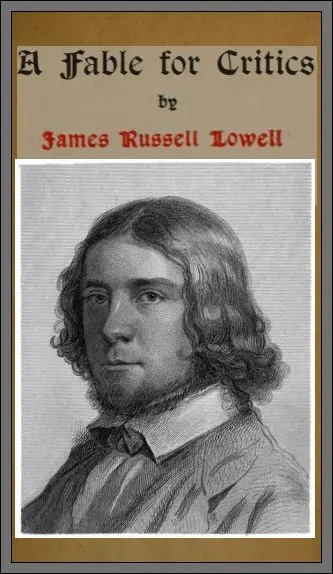
James Russell Lowell
BEHIND THE BOOK
This eBook is for the use of anyone anywhere in the United States and most other parts of the world at no cost and with almost no restrictions whatsoever. You may copy it, give it away or re-use it under the terms of the Project Gutenberg License included with this eBook or online at www.gutenberg.org. If you are not located in the United States, you will have to check the laws of the country where you are located before using this eBook. Read the source licence.
The original source file, including credits and licence, is retained by this library. Request an original-format copy at no charge. Please include the book title and Project Gutenberg identifier #73710.
KEEP YOUR CURIOSITY GOING

David Patterson (Spirit) Hatch

David Patterson (Spirit) Hatch

David Patterson (Spirit) Hatch

Ralph Waldo Emerson

Maurice Baring

Oscar Wilde & James McNeill Whistler