THE CLASSIC COLLECTION✦The old English dramatistsCLASSIC FREE BOOKS
The old English dramatists
James Russell Lowell

THE CLASSIC COLLECTION · 1899
"My Study Windows" by James Russell Lowell is a collection of essays written in the late 19th century. The work draws from the author's reflections and experiences over a span of years, presenting a range of topics that encompass nature, literature, and personal musings. It hints at a thoughtful exploration of the beauty of the natural world, alongside cultural commentary, making it appealing for readers interested in nuanced observations about life and the environment. The opening of the book sets the stage with a prefatory note where Lowell introduces the collection, explaining that the essays included were composed over the last fifteen years. He expresses his intention to compile these writings as a means of 'shutting them between two covers' to make space for new thoughts. The initial essay, "My Garden Acquaintance," begins with the author reminiscing about the joy he found in reading Gilbert White's "Natural History of Selborne," drawing parallels between White's observations of nature and his own experiences. Lowell invokes a vivid portrayal of his garden and its inhabitants, offering insights into the interplay between humanity and nature, which will be a recurring theme throughout the collection.
Introduction adapted from the source catalogue; source summaries may be automatically generated.
Free to read · English · 137,668 words · No account needed
MAKE TIME FOR A GOOD BOOK
On by default. Untick to stop anonymous reading totals. Each page counts after 10 seconds in view. How this works.
Anonymous counting is on unless you have switched it off.
Joseph Warton, in summing up at the end of his essay on the genius and writings of Pope, says that the largest part of his works “is of the didactic, moral, and satiric; and, consequently, not of the most poetic species of poetry; whence it is manifest that good sense and judgment were his characteristical excellences rather than fancy and invention.” It is plain that in any strict definition there can be only one kind of poetry, and that what Warton really meant to say was that Pope was not a poet at all. This, I think, is shown by what Johnson says in his “Life of Pope,” though he does not name Warton. The dispute on this point went on with occasional lulls for more than a half-century after Warton’s death. It was renewed with peculiar acrimony when the Rev. W. L. Bowles diffused and confused Warton’s critical opinions in his own peculiarly helpless way in editing a new edition of Pope in 1806. Bowles entirely mistook the functions of an editor, and maladroitly entangled his judgment of the poetry with his estimate of the author’s character.[46] Thirteen years later, Campbell, in his “Specimens,” controverted Mr. Bowles’s estimate of Pope’s character and position, both as man and poet. Mr. Bowles replied in a letter to Campbell on what he called “the invariable principles of poetry.” This letter was in turn somewhat sharply criticised by Gilchrist in the Quarterly Review. Mr. Bowles made an angry and unmannerly retort, among other things charging Gilchrist with the crime of being a tradesman’s son, whereupon the affair became what they call on the frontier a free fight, in which Gilchrist, Roscoe, the elder Disraeli, and Byron took part with equal relish, though with various fortune. The last shot, in what had grown into a thirty years’ war, between the partisans of what was called the Old School of poetry and those of the New, was fired by Bowles in 1826. Bowles, in losing his temper, lost also what little logic he had. and though, in a vague way, æsthetically right, contrived always to be argumentatively wrong. Anger made worse confusion in a brain never very clear, and he had neither the scholarship nor the critical faculty for a vigorous exposition of his own thesis. Never was wilder hitting than his, and he laid himself open to dreadful punishment, especially from Byron, whose two letters are masterpieces of polemic prose. Bowles most happily exemplified in his own pamphlets what was really the turning-point of the whole controversy (though all the combatants more or less lost sight of it or never saw it), namely, that without clearness and terseness there could be no good writing, whether in prose or verse; in other words that, while precision of phrase presupposes lucidity of thought, yet good writing is an art as well as a gift. Byron alone saw clearly that here was the true knot of the question, though, as his object was mainly mischief, he was not careful to loosen it. The sincerity of Byron’s admiration of Pope has been, it seems to me, too hastily doubted. What he admired in him was that patience in careful finish which he felt to be wanting in himself and in most of his contemporaries. Pope’s assailants went so far as to make a defect of what, rightly considered, was a distinguished merit, though the amount of it was exaggerated. The weak point in the case was that his nicety concerned itself wholly about the phrase, leaving the thought to be as faulty as it would, and that it seldom extended beyond the couplet, often not beyond a single verse. His serious poetry, therefore, at its best, is a succession of loosely strung epigrams, and no poet more often than he makes the second line of the couplet a mere trainbearer to the first. His more ambitious works may be defined as careless thinking carefully versified. Lessing was one of the first to see this, and accordingly he tells us that “his great, I will not say greatest, merit lay in what we call the mechanic of poetry.”[47] Lessing, with his usual insight, parenthetically qualifies his statement; for where Pope, as in the “Rape of the Lock,” found a subject exactly level with his genius, he was able to make what, taken for all in all, is the most perfect poem in the language.
Your reading position is saved on this browser. Take it to another device with a library code. Reading pages adapt to text, rather than matching a printed edition.
James Russell Lowell
James Russell Lowell

James Russell Lowell
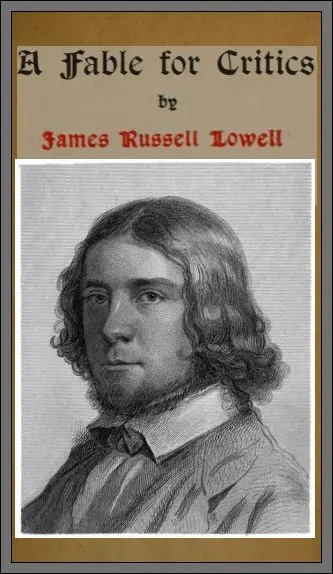
James Russell Lowell
BEHIND THE BOOK
This eBook is for the use of anyone anywhere in the United States and most other parts of the world at no cost and with almost no restrictions whatsoever. You may copy it, give it away or re-use it under the terms of the Project Gutenberg License included with this eBook or online at www.gutenberg.org. If you are not located in the United States, you will have to check the laws of the country where you are located before using this eBook. Read the source licence.
The original source file, including credits and licence, is retained by this library. Request an original-format copy at no charge. Please include the book title and Project Gutenberg identifier #73710.
KEEP YOUR CURIOSITY GOING

David Patterson (Spirit) Hatch

David Patterson (Spirit) Hatch

David Patterson (Spirit) Hatch

Ralph Waldo Emerson

Maurice Baring

Oscar Wilde & James McNeill Whistler