THE CLASSIC COLLECTION✦The old English dramatistsCLASSIC FREE BOOKS
The old English dramatists
James Russell Lowell

THE CLASSIC COLLECTION · 1899
"My Study Windows" by James Russell Lowell is a collection of essays written in the late 19th century. The work draws from the author's reflections and experiences over a span of years, presenting a range of topics that encompass nature, literature, and personal musings. It hints at a thoughtful exploration of the beauty of the natural world, alongside cultural commentary, making it appealing for readers interested in nuanced observations about life and the environment. The opening of the book sets the stage with a prefatory note where Lowell introduces the collection, explaining that the essays included were composed over the last fifteen years. He expresses his intention to compile these writings as a means of 'shutting them between two covers' to make space for new thoughts. The initial essay, "My Garden Acquaintance," begins with the author reminiscing about the joy he found in reading Gilbert White's "Natural History of Selborne," drawing parallels between White's observations of nature and his own experiences. Lowell invokes a vivid portrayal of his garden and its inhabitants, offering insights into the interplay between humanity and nature, which will be a recurring theme throughout the collection.
Introduction adapted from the source catalogue; source summaries may be automatically generated.
Free to read · English · 137,668 words · No account needed
MAKE TIME FOR A GOOD BOOK
On by default. Untick to stop anonymous reading totals. Each page counts after 10 seconds in view. How this works.
Anonymous counting is on unless you have switched it off.
The use of the word “applies” is perfectly un-English; and it seems that people who look in this remarkable glass see their pictures and not their reflections. Often, also, when Pope attempts the sublime, his epithets become curiously unpoetical, as where he says, in the Dunciad,
“As, one by one, at dread Medea’s strain, The sickening stars fade off the ethereal plain.”
And not seldom he is satisfied with the music of the verse without much regard to fitness of imagery; in the “Essay on Man,” for example:--
“Passions, like elements, though born to fight, Yet, mixed and softened, in his work unite; These ’tis enough to temper and employ; But what composes man can man destroy? Suffice that Reason keep to Nature’s road, Subject, compound them, follow her and God. Love, Hope, and Joy, fair Pleasure’s smiling train, Hate, Fear, and Grief, the family of Pain, These, mixed with Art, and to due bounds confined, Make and maintain the balance of the mind.”
Here reason is represented as an apothecary compounding pills of “pleasure’s smiling train” and the “family of pain.” And in the Moral Essays,
“Know God and Nature only are the same;
In man the judgment shoots at flying game,
A bird of passage, gone as soon as found,
Now in the moon, perhaps, now under ground.”
The “judgment shooting at flying game” is an odd image enough; but I think a bird of passage, now in the moon and now under ground, could be found nowhere--out of Goldsmith’s Natural History, perhaps. An epigrammatic expression will also tempt him into saying something without basis in truth, as where he ranks together “Macedonia’s madman and the Swede,” and says that neither of them “looked forward farther than his nose,” a slang phrase which may apply well enough to Charles XII., but certainly not to the pupil of Aristotle, who showed himself capable of a large political forethought. So, too, the rhyme, if correct, is a sufficient apology for want of propriety in phrase, as where he makes “Socrates bleed.”
But it is in his Moral Essays and parts of his Satires that Pope deserves the praise which he himself desired:--
“Happily to steer
From grave to gay, from lively to severe,
Correct with spirit, eloquent with ease,
Intent to reason, or polite to please.”
Here Pope must be allowed to have established a style of his own, in
which he is without a rival. One can open upon wit and epigram at any
page.
Your reading position is saved on this browser. Take it to another device with a library code. Reading pages adapt to text, rather than matching a printed edition.
James Russell Lowell
James Russell Lowell

James Russell Lowell
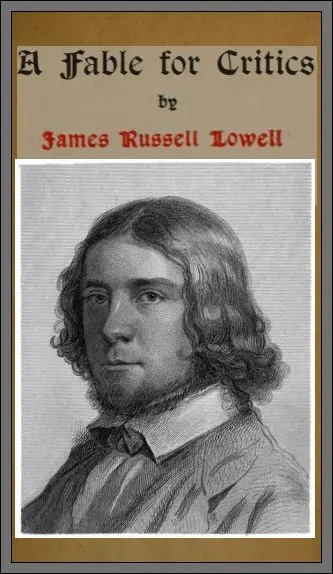
James Russell Lowell
BEHIND THE BOOK
This eBook is for the use of anyone anywhere in the United States and most other parts of the world at no cost and with almost no restrictions whatsoever. You may copy it, give it away or re-use it under the terms of the Project Gutenberg License included with this eBook or online at www.gutenberg.org. If you are not located in the United States, you will have to check the laws of the country where you are located before using this eBook. Read the source licence.
The original source file, including credits and licence, is retained by this library. Request an original-format copy at no charge. Please include the book title and Project Gutenberg identifier #73710.
KEEP YOUR CURIOSITY GOING

David Patterson (Spirit) Hatch

David Patterson (Spirit) Hatch

David Patterson (Spirit) Hatch

Ralph Waldo Emerson

Maurice Baring

Oscar Wilde & James McNeill Whistler