THE CLASSIC COLLECTION✦The old English dramatistsCLASSIC FREE BOOKS
The old English dramatists
James Russell Lowell

THE CLASSIC COLLECTION · 1899
"My Study Windows" by James Russell Lowell is a collection of essays written in the late 19th century. The work draws from the author's reflections and experiences over a span of years, presenting a range of topics that encompass nature, literature, and personal musings. It hints at a thoughtful exploration of the beauty of the natural world, alongside cultural commentary, making it appealing for readers interested in nuanced observations about life and the environment. The opening of the book sets the stage with a prefatory note where Lowell introduces the collection, explaining that the essays included were composed over the last fifteen years. He expresses his intention to compile these writings as a means of 'shutting them between two covers' to make space for new thoughts. The initial essay, "My Garden Acquaintance," begins with the author reminiscing about the joy he found in reading Gilbert White's "Natural History of Selborne," drawing parallels between White's observations of nature and his own experiences. Lowell invokes a vivid portrayal of his garden and its inhabitants, offering insights into the interplay between humanity and nature, which will be a recurring theme throughout the collection.
Introduction adapted from the source catalogue; source summaries may be automatically generated.
Free to read · English · 137,668 words · No account needed
MAKE TIME FOR A GOOD BOOK
On by default. Untick to stop anonymous reading totals. Each page counts after 10 seconds in view. How this works.
Anonymous counting is on unless you have switched it off.
Page 237, Mr. Hazlitt, explaining an illusion of Lovelace to the “east and west” in speaking of George Sandys, mentions Sandys’s Oriental travels, but seems not to know that he translated Ovid in Virginia.
Pages 251, 252:--
“And as that soldier conquest doubted not, Who but one splinter had of Castriot, But would assault ev’n death, so strongly charmed, And naked oppose rocks, with this bone armed.”
Mr. Hazlitt reads his for this in the last verse, and his note on
“bone” is:--
“And he found a new jawbone of an ass, and put forth his hand and took it, and slew a thousand men therewith. (Judges xv. 15.)”
Could the farce of “editing” go further? To make a “splinter of Castriot” an ass’s jawbone is a little too bad. We refer Mr. Hazlitt to “The Life of George Castriot, King of Epirus and Albania,” &c., &c., (Edinburgh, 1753,) p. 32, for an explanation of this profound difficulty. He will there find that the Turkish soldiers wore relics of Scanderbeg as charms.
Perhaps Mr. Hazlitt’s most astounding note is on the word pickear. (p.
203.)
“So within shot she doth pickear,
Now gall’s [galls] the flank and now the rear.”
“In the sense in which it is here used this word seems to be peculiar to Lovelace. To pickear, or pickeer, means to skirmish.” And, pray, what other possible meaning can it have here?
Of his corrections of the press we will correct a few samples.
Page 34, for “Love nee’re his standard,” read “neere.” Page 82, for “fall too,” read “fall to” (or, as we ought to print such words, “fall-to”). Page 83, for “star-made firmament,” read “star, made firmament.” Page 161, for “To look their enemies in their hearse,” read, both for sense and metre, into. Page 176, for “the gods have kneeled,” read had. Page 182, for “In beds they tumbled off their own,” read of. Page 184, for “in mine one monument I lie,” read owne. Page 212, for “Deucalion’s blackflung stone,” read “backflung.” Of the punctuation we shall give but one specimen, and that a fair average one:--
“Naso to his Tibullus flung the wreath,
He to Catullus thus did each bequeath.
This glorious circle, to another round,
At last the temples of a god it bound.”
Our readers over ten years of age will easily correct this for
themselves.
Your reading position is saved on this browser. Take it to another device with a library code. Reading pages adapt to text, rather than matching a printed edition.
James Russell Lowell
James Russell Lowell

James Russell Lowell
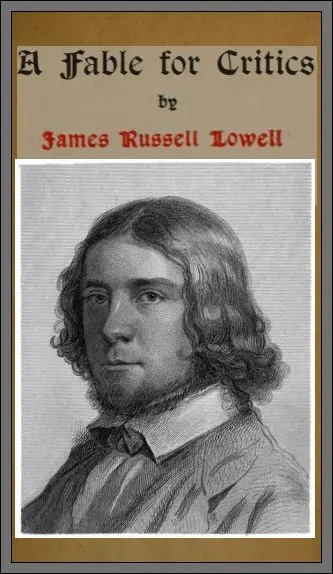
James Russell Lowell
BEHIND THE BOOK
This eBook is for the use of anyone anywhere in the United States and most other parts of the world at no cost and with almost no restrictions whatsoever. You may copy it, give it away or re-use it under the terms of the Project Gutenberg License included with this eBook or online at www.gutenberg.org. If you are not located in the United States, you will have to check the laws of the country where you are located before using this eBook. Read the source licence.
The original source file, including credits and licence, is retained by this library. Request an original-format copy at no charge. Please include the book title and Project Gutenberg identifier #73710.
KEEP YOUR CURIOSITY GOING

David Patterson (Spirit) Hatch

David Patterson (Spirit) Hatch

David Patterson (Spirit) Hatch

Ralph Waldo Emerson

Maurice Baring

Oscar Wilde & James McNeill Whistler