THE CLASSIC COLLECTION✦The old English dramatistsCLASSIC FREE BOOKS
The old English dramatists
James Russell Lowell

THE CLASSIC COLLECTION · 1899
"My Study Windows" by James Russell Lowell is a collection of essays written in the late 19th century. The work draws from the author's reflections and experiences over a span of years, presenting a range of topics that encompass nature, literature, and personal musings. It hints at a thoughtful exploration of the beauty of the natural world, alongside cultural commentary, making it appealing for readers interested in nuanced observations about life and the environment. The opening of the book sets the stage with a prefatory note where Lowell introduces the collection, explaining that the essays included were composed over the last fifteen years. He expresses his intention to compile these writings as a means of 'shutting them between two covers' to make space for new thoughts. The initial essay, "My Garden Acquaintance," begins with the author reminiscing about the joy he found in reading Gilbert White's "Natural History of Selborne," drawing parallels between White's observations of nature and his own experiences. Lowell invokes a vivid portrayal of his garden and its inhabitants, offering insights into the interplay between humanity and nature, which will be a recurring theme throughout the collection.
Introduction adapted from the source catalogue; source summaries may be automatically generated.
Free to read · English · 137,668 words · No account needed
MAKE TIME FOR A GOOD BOOK
On by default. Untick to stop anonymous reading totals. Each page counts after 10 seconds in view. How this works.
Anonymous counting is on unless you have switched it off.
We have quoted these examples only to justify us in saying that Mr. Smith must select his editors with more care if he wishes that his “Library of Old Authors” should deserve the confidence and thereby gain the good word of intelligent readers,--without which such a series can neither win nor keep the patronage of the public. It is impossible that men who cannot construct an English sentence correctly, and who do not know the value of clearness in writing, should be able to disentangle the knots which slovenly printers have tied in the thread of an old author’s meaning; and it is more than doubtful whether they who assert carelessly, cite inaccurately, and write loosely are not by nature disqualified for doing thoroughly what they undertake to do. If it were unreasonable to demand of every one who assumes to edit one of our early poets the critical acumen, the genial sense, the illimitable reading, the philological scholarship, which in combination would alone make the ideal editor, it is not presumptuous to expect some one of these qualifications singly, and we have the right to insist upon patience and accuracy, which are within the reach of every one, and without which all the others are wellnigh vain. Now to this virtue of accuracy Mr. Offor specifically lays claim in one of his remarkable sentences: “We are bound to admire,” he says, “the accuracy and beauty of this specimen of typography. Following in the path of my late friend William Pickering, our publisher rivals the Aldine and Elzevir presses, which have been so universally admired.” We should think that it was the product of those presses which had been admired, and that Mr. Smith presents a still worthier object of admiration when he contrives to follow a path and rival a press at the same time. But let that pass;--it is the claim to accuracy which we dispute; and we deliberately affirm, that, so far as we are able to judge by the volumes we have examined, no claim more unfounded was ever set up. In some cases, as we shall show presently, the blunders of the original work have been followed with painful accuracy in the reprint; but many others have been added by the carelessness of Mr. Smith’s printers or editors. In the thirteen pages of Mr. Offor’s own Introduction we have found as many as seven typographical errors,--unless some of them are to be excused on the ground that Mr. Offor’s studies have not yet led him into those arcana where we are taught such recondite mysteries of language as that verbs agree with their nominatives. In Mr. Farr’s Introduction to the “Hymns and Songs” nine short extracts from other poems of Wither are quoted, and in these we have found no less than seven misprints or false readings which materially affect the sense. Textual inaccuracy is a grave fault in the new edition of an old poet; and Mr. Farr is not only liable to this charge, but also to that of making blundering misstatements which are calculated to mislead the careless or uncritical reader. Infected by the absurd cant which has been prevalent for the last dozen years among literary sciolists, he says,--“The language used by Wither in all his various works--whether secular or sacred--is pure Saxon.” Taken literally, this assertion is manifestly ridiculous, and, allowing it every possible limitation, it is not only untrue of Wither, but of every English poet, from Chaucer down. The translators of our Bible made use of the German version, and a poet versifying the English Scriptures would therefore be likely to use more words of Teutonic origin than in his original compositions. But no English poet can write English poetry except in English,--that is, in that compound of Teutonic and Romanic which derives its heartiness and strength from the one and its canorous elegance from the other. The Saxon language does not sing, and, though its tough mortar serve to hold together the less compact Latin words, porous with vowels, it is to the Latin that our verse owes majesty, harmony, variety, and the capacity for rhyme. A quotation of six lines from Wither ends at the top of the very page on which Mr. Farr lays down his extraordinary dictum, and we will let this answer him, Italicizing the words of Romance derivation:--
Your reading position is saved on this browser. Take it to another device with a library code. Reading pages adapt to text, rather than matching a printed edition.
James Russell Lowell
James Russell Lowell

James Russell Lowell
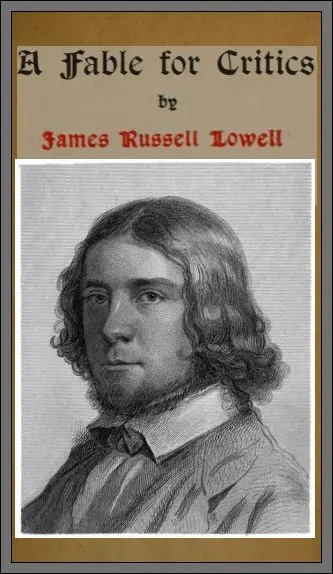
James Russell Lowell
BEHIND THE BOOK
This eBook is for the use of anyone anywhere in the United States and most other parts of the world at no cost and with almost no restrictions whatsoever. You may copy it, give it away or re-use it under the terms of the Project Gutenberg License included with this eBook or online at www.gutenberg.org. If you are not located in the United States, you will have to check the laws of the country where you are located before using this eBook. Read the source licence.
The original source file, including credits and licence, is retained by this library. Request an original-format copy at no charge. Please include the book title and Project Gutenberg identifier #73710.
KEEP YOUR CURIOSITY GOING

David Patterson (Spirit) Hatch

David Patterson (Spirit) Hatch

David Patterson (Spirit) Hatch

Ralph Waldo Emerson

Maurice Baring

Oscar Wilde & James McNeill Whistler