THE CLASSIC COLLECTION✦The old English dramatistsCLASSIC FREE BOOKS
The old English dramatists
James Russell Lowell
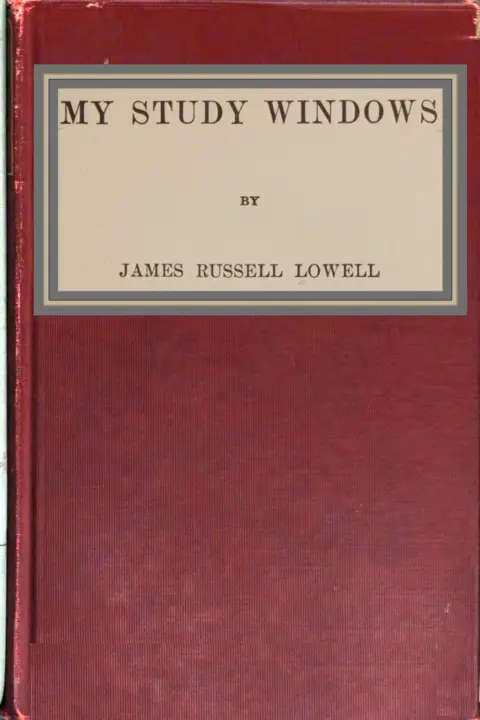
THE CLASSIC COLLECTION · 1899
"My Study Windows" by James Russell Lowell is a collection of essays written in the late 19th century. The work draws from the author's reflections and experiences over a span of years, presenting a range of topics that encompass nature, literature, and personal musings. It hints at a thoughtful exploration of the beauty of the natural world, alongside cultural commentary, making it appealing for readers interested in nuanced observations about life and the environment. The opening of the book sets the stage with a prefatory note where Lowell introduces the collection, explaining that the essays included were composed over the last fifteen years. He expresses his intention to compile these writings as a means of 'shutting them between two covers' to make space for new thoughts. The initial essay, "My Garden Acquaintance," begins with the author reminiscing about the joy he found in reading Gilbert White's "Natural History of Selborne," drawing parallels between White's observations of nature and his own experiences. Lowell invokes a vivid portrayal of his garden and its inhabitants, offering insights into the interplay between humanity and nature, which will be a recurring theme throughout the collection.
Introduction adapted from the source catalogue; source summaries may be automatically generated.
Free to read · English · 137,668 words · No account needed
MAKE TIME FOR A GOOD BOOK
On by default. Untick to stop anonymous reading totals. Each page counts after 10 seconds in view. How this works.
Anonymous counting is on unless you have switched it off.
“Men scarcely know how beautiful fire is,” says Shelley; and I am apt to think there are a good many other things concerning which their knowledge might be largely increased without becoming burdensome. Nor are they altogether reluctant to be taught,--not so reluctant, perhaps, as unable,--and education is sure to find one fulcrum ready to her hand by which to get a purchase on them. For most of us, I have noticed, are not without an amiable willingness to assist at any spectacle or entertainment (loosely so called) for which no fee is charged at the door. If special tickets are sent us, another element of pleasure is added in a sense of privilege and pre-eminence (pitiably scarce in a democracy) so deeply rooted in human nature that I have seen people take a strange satisfaction in being near of kin to the mute chief personage in a funeral. It gave them a moment’s advantage over the rest of us whose grief was rated at a lower place in the procession. But the words “admission free” at the bottom of a handbill, though holding out no bait of inequality, have yet a singular charm for many minds, especially in the country. There is something touching in the constancy with which men attend free lectures, and in the honest patience with which they listen to them. He who pays may yawn or shift testily in his seat, or even go out with an awful reverberation of criticism, for he has bought the right to do any or all of these and paid for it. But gratuitous hearers are anæsthetized to suffering by a sense of virtue. They are performing perhaps the noblest, as it is one of the most difficult, of human functions in getting Something (no matter how small) for Nothing. They are not pestered by the awful duty of securing their money’s worth. They are wasting time, to do which elegantly and without lassitude is the highest achievement of civilization. If they are cheated, it is, at worst, only of a superfluous hour which was rotting on their hands. Not only is mere amusement made more piquant, but instruction more palatable, by this universally relished sauce of gratuity. And if the philosophic observer finds an object of agreeable contemplation in the audience, as they listen to a discourse on the probability of making missionaries go down better with the Feejee-Islanders by balancing the hymn-book in one pocket with a bottle of Worcestershire in the other, or to a plea for arming the female gorilla with the ballot, he also takes a friendly interest in the lecturer, and admires the wise economy of Nature who thus contrives an ample field of honest labor for her bores. Even when the insidious hat is passed round after one of these eleemosynary feasts, the relish is but heightened by a conscientious refusal to disturb the satisfaction’s completeness with the rattle of a single contributory penny. So firmly persuaded am I of this gratis-instinct in our common humanity, that I believe I could fill a house by advertising a free lecture on Tupper considered as a philosophic poet, or on my personal recollections of the late James K. Polk. This being so, I have sometimes wondered that the peep-shows which Nature provides with such endless variety for her children, and to which we are admitted on the bare condition of having eyes, should be so generally neglected. To be sure, eyes are not so common as people think, or poets would be plentier, and perhaps also these exhibitions of hers are cheapened in estimation by the fact that in enjoying them we are not getting the better of anybody else. Your true lovers of nature, however, contrive to get even this solace; and Wordsworth looking upon mountains as his own peculiar sweethearts, was jealous of anybody else who ventured upon even the most innocent flirtation with them. As if such fellows, indeed, could pretend to that nicer sense of what-d’ye-call-it which was so remarkable in him! Marry come up! Mountains, no doubt, may inspire a profounder and more exclusive passion, but on the whole I am not sorry to have been born and bred among more domestic scenes, where I can be hospitable without a pang. I am going to ask you presently to take potluck with me at a board where Winter shall supply whatever there is of cheer.
Your reading position is saved on this browser. Take it to another device with a library code. Reading pages adapt to text, rather than matching a printed edition.
James Russell Lowell
James Russell Lowell
James Russell Lowell
James Russell Lowell
BEHIND THE BOOK
This eBook is for the use of anyone anywhere in the United States and most other parts of the world at no cost and with almost no restrictions whatsoever. You may copy it, give it away or re-use it under the terms of the Project Gutenberg License included with this eBook or online at www.gutenberg.org. If you are not located in the United States, you will have to check the laws of the country where you are located before using this eBook. Read the source licence.
The original source file, including credits and licence, is retained by this library. Request an original-format copy at no charge. Please include the book title and Project Gutenberg identifier #73710.
KEEP YOUR CURIOSITY GOING

David Patterson (Spirit) Hatch

David Patterson (Spirit) Hatch

David Patterson (Spirit) Hatch

Ralph Waldo Emerson

Maurice Baring

Oscar Wilde & James McNeill Whistler