THE CLASSIC COLLECTION✦The old English dramatistsCLASSIC FREE BOOKS
The old English dramatists
James Russell Lowell

THE CLASSIC COLLECTION · 1899
"My Study Windows" by James Russell Lowell is a collection of essays written in the late 19th century. The work draws from the author's reflections and experiences over a span of years, presenting a range of topics that encompass nature, literature, and personal musings. It hints at a thoughtful exploration of the beauty of the natural world, alongside cultural commentary, making it appealing for readers interested in nuanced observations about life and the environment. The opening of the book sets the stage with a prefatory note where Lowell introduces the collection, explaining that the essays included were composed over the last fifteen years. He expresses his intention to compile these writings as a means of 'shutting them between two covers' to make space for new thoughts. The initial essay, "My Garden Acquaintance," begins with the author reminiscing about the joy he found in reading Gilbert White's "Natural History of Selborne," drawing parallels between White's observations of nature and his own experiences. Lowell invokes a vivid portrayal of his garden and its inhabitants, offering insights into the interplay between humanity and nature, which will be a recurring theme throughout the collection.
Introduction adapted from the source catalogue; source summaries may be automatically generated.
Free to read · English · 137,668 words · No account needed
MAKE TIME FOR A GOOD BOOK
On by default. Untick to stop anonymous reading totals. Each page counts after 10 seconds in view. How this works.
Anonymous counting is on unless you have switched it off.
“Once more the ass did lengthen out
The hard, dry, seesaw of his horrible bray,”
you learn to dread, almost to respect, the powers of this indefatigable man. He is the undertaker of the fair mediæval legend, and his style has the hateful gloss, the seemingly unnatural length, of a coffin. Love, beauty, passion, nature, art, life, the natural and theological virtues,--there is nothing beyond his power to disenchant, nothing out of which the tremendous hydraulic press of his allegory (or whatever it is, for I am not sure if it be not something even worse) will not squeeze all feeling and freshness and leave it a juiceless pulp. It matters not where you try him, whether his story be Christian or pagan, borrowed from history or fable, you cannot escape him. Dip in at the middle or the end, dodge back to the beginning, the patient old man is there to take you by the button and go on with his imperturbable narrative. You may have left off with Clytemnestra, and you begin again with Samson; it makes no odds, for you cannot tell one from tother. His tediousness is omnipresent, and like Dogberry he could find in his heart to bestow it all (and more if he had it) on your worship. The word lengthy has been charged to our American account, but it must have been invented by the first reader of Gower’s works, the only inspiration of which they were ever capable. Our literature had to lie by and recruit for more than four centuries ere it could give us an equal vacuity in Tupper, so persistent a uniformity of commonplace in the “Recreations of a Country Parson.” Let us be thankful that the industrious Gower never found time for recreation!
But a fairer as well as more instructive comparison lies between Chaucer and the author of “Piers Ploughman.” Langland has as much tenderness, as much interest in the varied picture of life, as hearty a contempt for hypocrisy, and almost an equal sense of fun. He has the same easy abundance of matter. But what a difference! It is the difference between the poet and the man of poetic temperament. The abundance of the one is a continual fulness within the fixed limits of good taste; that of the other is squandered in overflow. The one can be profuse on occasion; the other is diffuse whether he will or no. The one is full of talk; the other is garrulous. What in one is the refined bonhomie of a man of the world, is a rustic shrewdness in the other. Both are kindly in their satire, and have not (like too many reformers) that vindictive love of virtue which spreads the stool of repentance with thistle-burrs before they invite the erring to seat themselves therein. But what in “Piers Ploughman” is sly fun, has the breadth and depth of humor in Chaucer; and it is plain that while the former was taken up by his moral purpose, the main interest of the latter turned to perfecting the form of his work. In short, Chaucer had that fine literary sense which is as rare as genius, and, united with it, as it was in him, assures an immortality of fame. It is not merely what he has to say, but even more the agreeable way he has of saying it, that captivates our attention and gives him an assured place in literature. Above all, it is not in detached passages that his charm lies, but in the entirety of expression and the cumulative effect of many particulars working toward a common end. Now though ex ungue leonem be a good rule in comparative anatomy, its application, except in a very limited way, in criticism is sure to mislead; for we should always bear in mind that the really great writer is great in the mass, and is to be tested less by his cleverness in the elaboration of parts than by that reach of mind which is incapable of random effort, which selects, arranges, combines, rejects, denies itself the cheap triumph of immediate effects, because it is absorbed by the controlling charm of proportion and unity. A careless good-luck of phrase is delightful; but criticism cleaves to the teleological argument, and distinguishes the creative intellect, not so much by any happiness of natural endowment as by the marks of design. It is true that one may sometimes discover by a single verse whether an author have imagination, or may make a shrewd guess whether he have style or no, just as by a few spoken words you may judge of a man’s accent; but the true artist in language is never spotty, and needs no guide-boards of admiring italics, a critical method introduced by Leigh Hunt, whose feminine temperament gave him acute perceptions at the expense of judgment. This is the Bœotian method, which offers us a brick as a sample of the house, forgetting that it is not the goodness of the separate bricks, but the way in which they are put together, that brings them within the province of art, and makes the difference between a heap and a house. A great writer does not reveal himself here and there, but everywhere. Langland’s verse runs mostly like a brook, with a beguiling and wellnigh slumberous prattle, but he, more often than any writer of his class, flashes into salient lines, gets inside our guard with the home-thrust of a forthright word, and he gains if taken piecemeal. His imagery is naturally and vividly picturesque, as where he says of Old Age,--
Your reading position is saved on this browser. Take it to another device with a library code. Reading pages adapt to text, rather than matching a printed edition.
James Russell Lowell
James Russell Lowell

James Russell Lowell
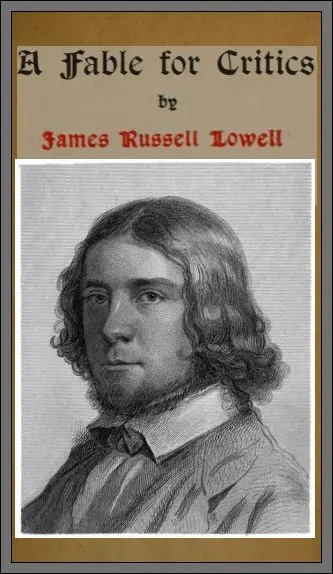
James Russell Lowell
BEHIND THE BOOK
This eBook is for the use of anyone anywhere in the United States and most other parts of the world at no cost and with almost no restrictions whatsoever. You may copy it, give it away or re-use it under the terms of the Project Gutenberg License included with this eBook or online at www.gutenberg.org. If you are not located in the United States, you will have to check the laws of the country where you are located before using this eBook. Read the source licence.
The original source file, including credits and licence, is retained by this library. Request an original-format copy at no charge. Please include the book title and Project Gutenberg identifier #73710.
KEEP YOUR CURIOSITY GOING

David Patterson (Spirit) Hatch

David Patterson (Spirit) Hatch

David Patterson (Spirit) Hatch

Ralph Waldo Emerson

Maurice Baring

Oscar Wilde & James McNeill Whistler