THE CLASSIC COLLECTION✦The old English dramatistsCLASSIC FREE BOOKS
The old English dramatists
James Russell Lowell

THE CLASSIC COLLECTION · 1899
"My Study Windows" by James Russell Lowell is a collection of essays written in the late 19th century. The work draws from the author's reflections and experiences over a span of years, presenting a range of topics that encompass nature, literature, and personal musings. It hints at a thoughtful exploration of the beauty of the natural world, alongside cultural commentary, making it appealing for readers interested in nuanced observations about life and the environment. The opening of the book sets the stage with a prefatory note where Lowell introduces the collection, explaining that the essays included were composed over the last fifteen years. He expresses his intention to compile these writings as a means of 'shutting them between two covers' to make space for new thoughts. The initial essay, "My Garden Acquaintance," begins with the author reminiscing about the joy he found in reading Gilbert White's "Natural History of Selborne," drawing parallels between White's observations of nature and his own experiences. Lowell invokes a vivid portrayal of his garden and its inhabitants, offering insights into the interplay between humanity and nature, which will be a recurring theme throughout the collection.
Introduction adapted from the source catalogue; source summaries may be automatically generated.
Free to read · English · 137,668 words · No account needed
MAKE TIME FOR A GOOD BOOK
On by default. Untick to stop anonymous reading totals. Each page counts after 10 seconds in view. How this works.
Anonymous counting is on unless you have switched it off.
It is no improbable surmise that the sudden and surprising development of the more strictly epical poetry in the North of France, and especially its growing partiality for historical in preference to mythical subjects, were due to the Normans. The poetry of the Danes was much of it authentic history, or what was believed to be so; the heroes of their Sagas were real men, with wives and children, with relations public and domestic, on the common levels of life, and not mere creatures of imagination, who dwell apart like stars from the vulgar cares and interests of men. If we compare Havelok with the least idealized figures of Carlovingian or Arthurian romance, we shall have a keen sense of this difference. Manhood has taken the place of caste, and homeliness of exaggeration. Havelok says,--
“Godwot, I will with thee gang
For to learn some good to get;
Swinken would I for my meat;
It is no shame for to swinken.”
This Dane, we see, is of our own make and stature, a being much nearer our kindly sympathies than his compatriot Ogier, of whom we are told,
“Dix piès de lonc avoit le chevalier.”
But however large or small share we may allow to the Danes in changing the character of French poetry and supplanting the Romance with the Fabliau, there can be little doubt either of the kind or amount of influence which the Normans must have brought with them into England. I am not going to attempt a definition of the Anglo-Saxon element in English literature, for generalizations are apt to be as dangerous as they are tempting. But as a painter may draw a cloud so that we recognize its general truth, though the boundaries of real clouds never remain the same for two minutes together, so amid the changes of feature and complexion brought about by commingling of race, there still remains a certain cast of physiognomy which points back to some one ancestor of marked and peculiar character. It is toward this type that there is always a tendency to revert, to borrow Mr. Darwin’s phrase, and I think the general belief is not without some adequate grounds which in France traces this predominant type to the Kelt, and in England to the Saxon. In old and stationary communities, where tradition has a chance to take root, and where several generations are present to the mind of each inhabitant, either by personal recollection or transmitted anecdote, everybody’s peculiarities, whether of strength or weakness, are explained and, as it were, justified upon some theory of hereditary bias. Such and such qualities he got from a grandfather on the spear or a great-uncle on the spindle side. This gift came in a right line from So-and-so; that failing came in by the dilution of the family blood with that of Such-a-one. In this way a certain allowance is made for every aberration from some assumed normal type, either in the way of reinforcement or defect, and that universal desire of the human mind to have everything accounted for--which makes the moon responsible for the whimsies of the weathercock--is cheaply gratified. But as mankind in the aggregate is always wiser than any single man, because its experience is derived from a larger range of observation and experience, and because the springs that feed it drain a wider region both of time and space, there is commonly some greater or smaller share of truth in all popular prejudices. The meteorologists are beginning to agree with the old women that the moon is an accessary before the fact in our atmospheric fluctuations. Now, although to admit this notion of inherited good or ill to its fullest extent would be to abolish personal character, and with it, all responsibility, to abdicate freewill, and to make every effort at self-direction futile, there is no inconsiderable alloy of truth in it, nevertheless. No man can look into the title-deeds of what may be called his personal estate, his faculties, his predilections, his failings,--whatever, in short, sets him apart as a capital I,--without something like a shock of dread to find how much of him is held in mortmain by those who, though long ago mouldered away to dust, are yet fatally alive and active in him for good or ill. What is true of individual men is true also of races, and the prevailing belief in a nation as to the origin of certain of its characteristics has something of the same basis in facts of observation as the village estimate of the traits of particular families. Interdum vulgus rectum videt.
Your reading position is saved on this browser. Take it to another device with a library code. Reading pages adapt to text, rather than matching a printed edition.
James Russell Lowell
James Russell Lowell

James Russell Lowell
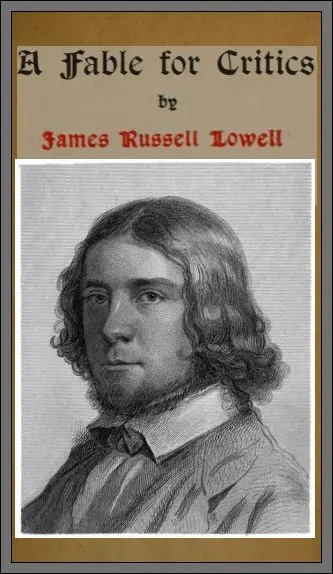
James Russell Lowell
BEHIND THE BOOK
This eBook is for the use of anyone anywhere in the United States and most other parts of the world at no cost and with almost no restrictions whatsoever. You may copy it, give it away or re-use it under the terms of the Project Gutenberg License included with this eBook or online at www.gutenberg.org. If you are not located in the United States, you will have to check the laws of the country where you are located before using this eBook. Read the source licence.
The original source file, including credits and licence, is retained by this library. Request an original-format copy at no charge. Please include the book title and Project Gutenberg identifier #73710.
KEEP YOUR CURIOSITY GOING

David Patterson (Spirit) Hatch

David Patterson (Spirit) Hatch

David Patterson (Spirit) Hatch

Ralph Waldo Emerson

Maurice Baring

Oscar Wilde & James McNeill Whistler