THE CLASSIC COLLECTION✦The old English dramatistsCLASSIC FREE BOOKS
The old English dramatists
James Russell Lowell

THE CLASSIC COLLECTION · 1899
"My Study Windows" by James Russell Lowell is a collection of essays written in the late 19th century. The work draws from the author's reflections and experiences over a span of years, presenting a range of topics that encompass nature, literature, and personal musings. It hints at a thoughtful exploration of the beauty of the natural world, alongside cultural commentary, making it appealing for readers interested in nuanced observations about life and the environment. The opening of the book sets the stage with a prefatory note where Lowell introduces the collection, explaining that the essays included were composed over the last fifteen years. He expresses his intention to compile these writings as a means of 'shutting them between two covers' to make space for new thoughts. The initial essay, "My Garden Acquaintance," begins with the author reminiscing about the joy he found in reading Gilbert White's "Natural History of Selborne," drawing parallels between White's observations of nature and his own experiences. Lowell invokes a vivid portrayal of his garden and its inhabitants, offering insights into the interplay between humanity and nature, which will be a recurring theme throughout the collection.
Introduction adapted from the source catalogue; source summaries may be automatically generated.
Free to read · English · 137,668 words · No account needed
MAKE TIME FOR A GOOD BOOK
On by default. Untick to stop anonymous reading totals. Each page counts after 10 seconds in view. How this works.
Anonymous counting is on unless you have switched it off.
“Atalanta in Calydon” shows that poverty of thought and profusion of imagery which are at once the defect and the compensation of all youthful poetry, even of Shakespeare’s. It seems a paradox to say that there can be too much poetry in a poem, and yet this is a fault with which all poets begin, and which some never get over. But “Atalanta” is hopefully distinguished, in a rather remarkable way, from most early attempts, by a sense of form and proportion, which, if seconded by a seasonable ripening of other faculties, as we may fairly expect, gives promise of rare achievement hereafter. Mr. Swinburne’s power of assimilating style, which is, perhaps, not so auspicious a symptom, strikes us as something marvellous. The argument of his poem, in its quaint archaism, would not need the change of a word or in the order of a period to have been foisted on Sir Thomas Malory as his own composition. The choosing a theme which Æschylus had handled in one of his lost tragedies is justified by a certain Æschylean flavor in the treatment. The opening, without deserving to be called a mere imitation, recalls that of the “Agamemnon,” and the chorus has often an imaginative lift in it, an ethereal charm of phrase, of which it is the highest praise to say that it reminds us of him who soars over the other Greek tragedians like an eagle.
But in spite of many merits, we cannot help asking ourselves, as we close the book, whether “Atalanta” can be called a success, and if so, whether it be a success in the right direction. The poem reopens a question which in some sort touches the very life of modern literature. We do not mean to renew the old quarrel of Fontenelle’s day as to the comparative merits of ancients and moderns. That is an affair of taste, which does not admit of any authoritative settlement. Our concern is about a principle which certainly demands a fuller discussion, and which is important enough to deserve it. Do we show our appreciation of the Greeks most wisely in attempting the mechanical reproduction of their forms, or by endeavoring to comprehend the thoughtful spirit of full-grown manhood in which they wrought, to kindle ourselves by the emulation of it, and to bring it to bear with all its plastic force upon our wholly new conditions of life and thought? It seems to us that the question is answered by the fact, patent in the history of all the fine arts, that every attempt at reproducing a bygone excellence by external imitation of it, or even by applying the rules which analytic criticism has formulated from the study of it, has resulted in producing the artificial, and not the artistic. That most subtile of all essences in physical organization, which eludes chemist, anatomist, and microscopist, the life, is in æsthetics not less shy of the critic, and will not come forth in obedience to his most learned spells, for the very good reason that it cannot, because in all works of art it is the joint product of the artist and of the time. Faust may believe he is gazing on “the face that launched a thousand ships,” but Mephistopheles knows very well that it is only shadows that he has the skill to conjure. He is not merely the spirit that ever denies, but the spirit also of discontent with the present, that material in which every man shall work who will achieve realities and not their hollow semblance. The true anachronism, in our opinion, is not in Shakespeare’s making Ulysses talk as Lord Bacon might, but in attempting to make him speak in a dialect of thought utterly dead to all present comprehension. Ulysses was the type of long-headedness; and the statecraft of an Ithacan cateran would have seemed as childish to the age of Elizabeth and Burleigh as it was naturally sufficing to the first hearers of Homer. Ulysses, living in Florence during the fifteenth century, might have been Macchiavelli; in France, during the seventeenth, Cardinal Richelieu; in America, during the nineteenth, Abraham Lincoln, but not Ulysses. Truth to nature can be reached ideally, never historically; it must be a study from the life, and not from the scholiasts. Theocritus lets us into the secret of his good poetry, when he makes Daphnis tell us that he preferred his rock with a view of the Siculian Sea to the kingdom of Pelops.
Your reading position is saved on this browser. Take it to another device with a library code. Reading pages adapt to text, rather than matching a printed edition.
James Russell Lowell
James Russell Lowell

James Russell Lowell
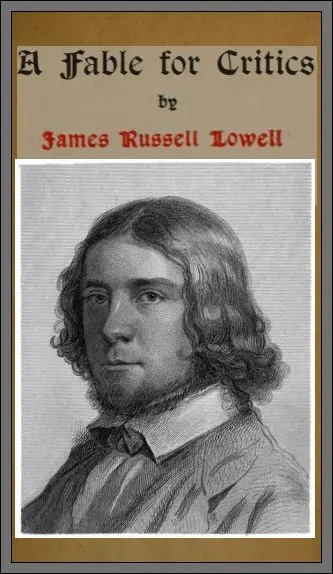
James Russell Lowell
BEHIND THE BOOK
This eBook is for the use of anyone anywhere in the United States and most other parts of the world at no cost and with almost no restrictions whatsoever. You may copy it, give it away or re-use it under the terms of the Project Gutenberg License included with this eBook or online at www.gutenberg.org. If you are not located in the United States, you will have to check the laws of the country where you are located before using this eBook. Read the source licence.
The original source file, including credits and licence, is retained by this library. Request an original-format copy at no charge. Please include the book title and Project Gutenberg identifier #73710.
KEEP YOUR CURIOSITY GOING

David Patterson (Spirit) Hatch

David Patterson (Spirit) Hatch

David Patterson (Spirit) Hatch

Ralph Waldo Emerson

Maurice Baring

Oscar Wilde & James McNeill Whistler