THE CLASSIC COLLECTION✦The old English dramatistsCLASSIC FREE BOOKS
The old English dramatists
James Russell Lowell

THE CLASSIC COLLECTION · 1899
"My Study Windows" by James Russell Lowell is a collection of essays written in the late 19th century. The work draws from the author's reflections and experiences over a span of years, presenting a range of topics that encompass nature, literature, and personal musings. It hints at a thoughtful exploration of the beauty of the natural world, alongside cultural commentary, making it appealing for readers interested in nuanced observations about life and the environment. The opening of the book sets the stage with a prefatory note where Lowell introduces the collection, explaining that the essays included were composed over the last fifteen years. He expresses his intention to compile these writings as a means of 'shutting them between two covers' to make space for new thoughts. The initial essay, "My Garden Acquaintance," begins with the author reminiscing about the joy he found in reading Gilbert White's "Natural History of Selborne," drawing parallels between White's observations of nature and his own experiences. Lowell invokes a vivid portrayal of his garden and its inhabitants, offering insights into the interplay between humanity and nature, which will be a recurring theme throughout the collection.
Introduction adapted from the source catalogue; source summaries may be automatically generated.
Free to read · English · 137,668 words · No account needed
MAKE TIME FOR A GOOD BOOK
On by default. Untick to stop anonymous reading totals. Each page counts after 10 seconds in view. How this works.
Anonymous counting is on unless you have switched it off.
On the day of his death, this simple Western attorney, who according to one party was a vulgar joker, and whom the doctrinaires among his own supporters accused of wanting every element of statesmanship, was the most absolute ruler in Christendom, and this solely by the hold his good-humored sagacity had laid on the hearts and understandings of his countrymen. Nor was this all, for it appeared that he had drawn the great majority, not only of his fellow-citizens, but of mankind also, to his side. So strong and so persuasive is honest manliness without a single quality of romance or unreal sentiment to help it! A civilian during times of the most captivating military achievement, awkward, with no skill in the lower technicalities of manners, he left behind him a fame beyond that of any conqueror, the memory of a grace higher than that of outward person, and of a gentlemanliness deeper than mere breeding. Never before that startled April morning did such multitudes of men shed tears for the death of one they had never seen, as if with him a friendly presence had been taken away from their lives, leaving them colder and darker. Never was funeral panegyric so eloquent as the silent look of sympathy which strangers exchanged when they met on that day. Their common manhood had lost a kinsman.
This is an interesting and in many respects instructive book. Mr. Ward has done his work, as is fitting, in a loving spirit; and if he over-estimates both what Percival was and what he did, he enables us to form our own judgment by letting him so far as possible speak for himself. The book gives a rather curious picture of what the life of a man of letters is likely to be in a country not yet ripe for literary production, especially if he be not endowed with the higher qualities which command and can wait for that best of all successes which comes slowly. In a generation where everybody can write verses, and where certain modes of thought and turns of phrase have become so tyrannous that it is as hard to distinguish between the productions of one minor poet and another as among those of so many Minnesingers or Troubadours, there is a demand for only two things,--for what chimes with the moment’s whim of popular sentiment and is forgotten when that has changed, or for what is never an anachronism, because it slakes or seems to slake the eternal thirst of our nature for those ideal waters that glimmer before us and still before us in ever-renewing mirage. Percival met neither of these conditions. With a nature singularly unplastic, unsympathetic, and self-involved, he was incapable of receiving into his own mind the ordinary emotions of men and giving them back in music; and with a lofty conception of the object and purposes of poesy, he had neither the resolution nor the power which might have enabled him to realize it. He offers as striking an example as could be found of the poetic temperament unballasted with those less obvious qualities which make the poetic faculty. His verse carries every inch of canvas that diction and sentiment can crowd, but the craft is cranky, and we miss that deep-grasping keel of reason which alone can steady and give direction. His mind drifts, too waterlogged to answer the helm, and in his longer poems, like “Prometheus,” half the voyage is spent in trying to make up for a leeway which becomes at last irretrievable. If he had a port in view when he set out, he seems soon to give up all hope of ever reaching it; and wherever we open the log-book, we find him running for nowhere in particular, as the wind happens to lead, or lying-to in the merest gale of verbiage. The truth is, that Percival was led to the writing of verse by a sentimental desire of the mind, and not by that concurring instinct of all the faculties which is a self-forgetting passion of the entire man. Too excitable to possess his subject fully, as a man of mere talent may often do, he is not possessed by it as the man of genius is, and seems helplessly striving, the greater part of the time, to make out what, in the name of common or uncommon sense, he is after. With all the stock properties of verse whirling and dancing about his ears puffed out to an empty show of life, the reader of much of his blank verse feels as if a mob of well-draperied clothes-lines were rioting about him in all the unwilling ecstasy of a thunder-gust.
Your reading position is saved on this browser. Take it to another device with a library code. Reading pages adapt to text, rather than matching a printed edition.
James Russell Lowell
James Russell Lowell

James Russell Lowell
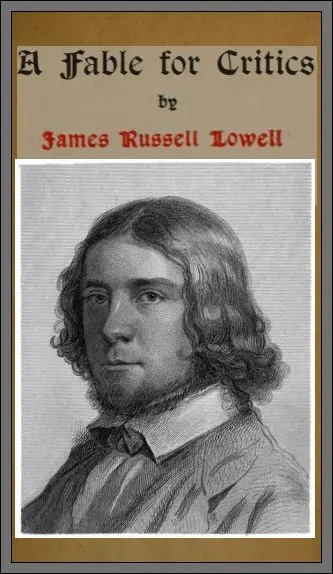
James Russell Lowell
BEHIND THE BOOK
This eBook is for the use of anyone anywhere in the United States and most other parts of the world at no cost and with almost no restrictions whatsoever. You may copy it, give it away or re-use it under the terms of the Project Gutenberg License included with this eBook or online at www.gutenberg.org. If you are not located in the United States, you will have to check the laws of the country where you are located before using this eBook. Read the source licence.
The original source file, including credits and licence, is retained by this library. Request an original-format copy at no charge. Please include the book title and Project Gutenberg identifier #73710.
KEEP YOUR CURIOSITY GOING

David Patterson (Spirit) Hatch

David Patterson (Spirit) Hatch

David Patterson (Spirit) Hatch

Ralph Waldo Emerson

Maurice Baring

Oscar Wilde & James McNeill Whistler