THE CLASSIC COLLECTION✦The old English dramatistsCLASSIC FREE BOOKS
The old English dramatists
James Russell Lowell

THE CLASSIC COLLECTION · 1899
"My Study Windows" by James Russell Lowell is a collection of essays written in the late 19th century. The work draws from the author's reflections and experiences over a span of years, presenting a range of topics that encompass nature, literature, and personal musings. It hints at a thoughtful exploration of the beauty of the natural world, alongside cultural commentary, making it appealing for readers interested in nuanced observations about life and the environment. The opening of the book sets the stage with a prefatory note where Lowell introduces the collection, explaining that the essays included were composed over the last fifteen years. He expresses his intention to compile these writings as a means of 'shutting them between two covers' to make space for new thoughts. The initial essay, "My Garden Acquaintance," begins with the author reminiscing about the joy he found in reading Gilbert White's "Natural History of Selborne," drawing parallels between White's observations of nature and his own experiences. Lowell invokes a vivid portrayal of his garden and its inhabitants, offering insights into the interplay between humanity and nature, which will be a recurring theme throughout the collection.
Introduction adapted from the source catalogue; source summaries may be automatically generated.
Free to read · English · 137,668 words · No account needed
MAKE TIME FOR A GOOD BOOK
On by default. Untick to stop anonymous reading totals. Each page counts after 10 seconds in view. How this works.
Anonymous counting is on unless you have switched it off.
Even so long ago as when Mr. Lincoln, not yet convinced of the danger and magnitude of the crisis, was endeavoring to persuade himself of Union majorities at the South, and to carry on a war that was half peace in the hope of a peace that would have been all war,--while he was still enforcing the Fugitive Slave Law, under some theory that Secession, however it might absolve States from their obligations, could not escheat them of their claims under the Constitution, and that slaveholders in rebellion had alone among mortals the privilege of having their cake and eating it at the same time,--the enemies of free government were striving to persuade the people that the war was an Abolition crusade. To rebel without reason was proclaimed as one of the rights of man, while it was carefully kept out of sight that to suppress rebellion is the first duty of government. All the evils that have come upon the country have been attributed to the Abolitionists, though it is hard to see how any party can become permanently powerful except in one of two ways,--either by the greater truth of its principles, or the extravagance of the party opposed to it. To fancy the ship of state, riding safe at her constitutional moorings, suddenly engulfed by a huge kraken of Abolitionism, rising from unknown depths and grasping it with slimy tentacles, is to look at the natural history of the matter with the eyes of Pontoppidan. To believe that the leaders in the Southern treason feared any danger from Abolitionism, would be to deny them ordinary intelligence, though there can be little doubt that they made use of it to stir the passions and excite the fears of their deluded accomplices. They rebelled, not because they thought slavery weak, but because they believed it strong enough, not to overthrow the government, but to get possession of it; for it becomes daily clearer that they used rebellion only as a means of revolution, and if they got revolution, though not in the shape they looked for, is the American people to save them from its consequences at the cost of its own existence? The election of Mr. Lincoln, which it was clearly in their power to prevent had they wished, was the occasion merely, and not the cause, of their revolt. Abolitionism, till within a year or two, was the despised heresy of a few earnest persons, without political weight enough to carry the election of a parish constable; and their cardinal principle was disunion, because they were convinced that within the Union the position of slavery was impregnable. In spite of the proverb, great effects do not follow from small causes,--that is, disproportionately small,--but from adequate causes acting under certain required conditions. To contrast the size of the oak with that of the parent acorn, as if the poor seed had paid all costs from its slender strong-box, may serve for a child’s wonder; but the real miracle lies in that divine league which bound all the forces of nature to the service of the tiny germ in fulfilling its destiny. Everything has been at work for the past ten years in the cause of antislavery, but Garrison and Phillips have been far less successful propagandists than the slaveholders themselves, with the constantly-growing arrogance of their pretensions and encroachments. They have forced the question upon the attention of every voter in the Free States, by defiantly putting freedom and democracy on the defensive. But, even after the Kansas outrages, there was no wide-spread desire on the part of the North to commit aggressions, though there was a growing determination to resist them. The popular unanimity in favor of the war three years ago was but in small measure the result of antislavery sentiment, far less of any zeal for abolition. But every month of the war, every movement of the allies of slavery in the Free States, has been making Abolitionists by the thousand. The masses of any people, however intelligent, are very little moved by abstract principles of humanity and justice, until those principles are interpreted for them by the stinging commentary of some infringement upon their own rights, and then their instincts and passions, once aroused, do indeed derive an incalculable reinforcement of impulse and intensity from those higher ideas, those sublime traditions, which have no motive political force till they are allied with a sense of immediate personal wrong or imminent peril. Then at last the stars in their courses begin to fight against Sisera. Had any one doubted before that the rights of human nature are unitary, that oppression is of one hue the world over, no matter what the color of the oppressed,--had any one failed to see what the real essence of the contest was,--the efforts of the advocates of slavery among ourselves to throw discredit upon the fundamental axioms of the Declaration of Independence and the radical doctrines of Christianity, could not fail to sharpen his eyes.
Your reading position is saved on this browser. Take it to another device with a library code. Reading pages adapt to text, rather than matching a printed edition.
James Russell Lowell
James Russell Lowell

James Russell Lowell
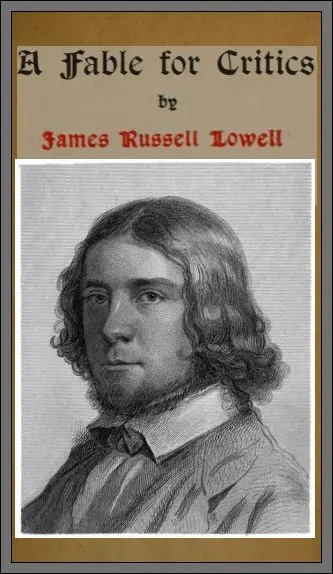
James Russell Lowell
BEHIND THE BOOK
This eBook is for the use of anyone anywhere in the United States and most other parts of the world at no cost and with almost no restrictions whatsoever. You may copy it, give it away or re-use it under the terms of the Project Gutenberg License included with this eBook or online at www.gutenberg.org. If you are not located in the United States, you will have to check the laws of the country where you are located before using this eBook. Read the source licence.
The original source file, including credits and licence, is retained by this library. Request an original-format copy at no charge. Please include the book title and Project Gutenberg identifier #73710.
KEEP YOUR CURIOSITY GOING

David Patterson (Spirit) Hatch

David Patterson (Spirit) Hatch

David Patterson (Spirit) Hatch

Ralph Waldo Emerson

Maurice Baring

Oscar Wilde & James McNeill Whistler