Death to the Inquisitive! A story of sinful love
Lurana Sheldon
THE CLASSIC COLLECTION · 1900
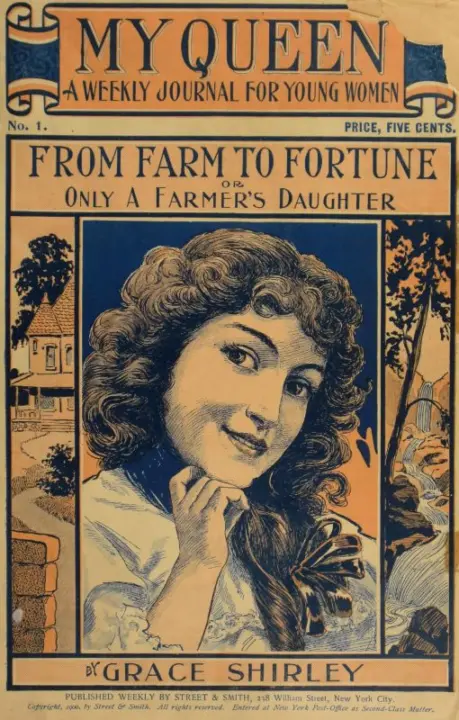
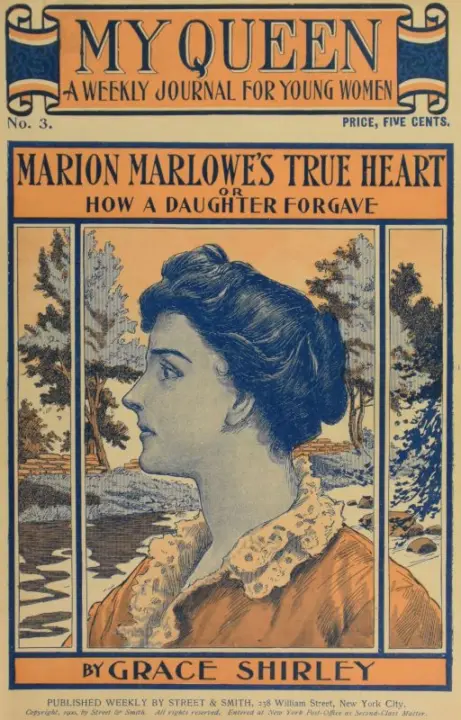
"My Queen: A Weekly Journal for Young Women. Issue 1. September 29, 1900" by Sheldon is a periodical aimed at young women, written in the late 19th century. The journal presents fiction stories and advice relevant to the lives of young women in that time, featuring themes of personal aspiration and the complexities of social roles. The narrative unfolds through the story of Marion Marlowe, a determined farmer's daughter who seeks a life beyond the limitations of her rural upbringing. At the start of this issue, the story introduces Marion as she wistfully reflects on her life while creating a daisy chain. Discontent with her circumstances and the expectations of her rural life, she dreams of making a name for herself and escaping the mundane duties prescribed for a farmer's daughter. Her determination is tested when she intervenes to help a boy from the Poor Farm, revealing her fierce spirit and empathy. Marion grapples with her yearning for freedom and personal fulfillment amidst a backdrop of family obligations and societal constraints, setting the stage for a poignant exploration of a young woman's search for identity and autonomy in a world that seeks to confine her.
Introduction adapted from the source catalogue; source summaries may be automatically generated.
Free to read · English · 25,063 words · No account needed
MAKE TIME FOR A GOOD BOOK
On by default. Untick to stop anonymous reading totals. Each page counts after 10 seconds in view. How this works.
Anonymous counting is on unless you have switched it off.
Miss Gray watched her with the sharp glance of an eagle as she talked. There was an intensity in her gaze that puzzled Marion.
“And you have come to New York alone to search for your sister,” she said finally. “Without funds or friends you have entered upon this mission?”
“I have fifty dollars,” said Marion reluctantly, “and, oh, Miss Gray, do you not think uncle will help me? He must be rich to live in such luxury!”
Before she answered the question the woman rose and looked around, moving every drapery and curtain and looking behind it cautiously. At the last she tiptoed to the front room and listened a minute, when she returned she moved her chair as closely as possible to Marion’s.
“See here, girl, you look brave,” she said, very softly. “Can you face a serious matter without flinching, do you think? I have something to tell you, but you must promise to be perfectly calm when you hear it.”
As she spoke Marion noticed that her hands were trembling; she clinched them tightly, as though she resented this trace of weakness.
“I promise,” said Marion, staring wide-eyed at the woman. “I am not a child, Miss Gray—you must see that you can trust me.”
“I see that I can,” was the quiet answer, then the woman leaned forward and whispered rapidly:
“You have made a terrible mistake, my child, but you are not to blame. You are in the wrong place—your host is not your uncle!”
Marion caught her breath sharply but did not utter a sound.
“Who is he, then?” she said softly, clasping her hands tightly together.
The woman shrugged her shoulders and glanced quickly around the room.
“Never mind who he is,” she said, almost roughly. “He is not your uncle, and he is not married. Now tell me, who is your uncle, and how did you come here?”
Marion replied with eager promptness:
“My uncle is Frederic Stanton, and he lives at ‘The Norwood.’ I wrote him at that address and he answered my letter. He married my mother’s sister, and he is very rich, so rich that he has never recognized any of his wife’s relatives in the country. When Dollie was abducted my father disowned her and I was obliged to write to uncle, then I came to him,” she finished simply.
“There are a dozen apartment houses in the city by that name,” said the woman thoughtfully. “He probably lives at the biggest one, uptown on Fifth avenue.”
Your reading position is saved on this browser. Take it to another device with a library code. Reading pages adapt to text, rather than matching a printed edition.
Lurana Sheldon
Lurana Sheldon
Lurana Sheldon
Lurana Sheldon
BEHIND THE BOOK
This eBook is for the use of anyone anywhere in the United States and most other parts of the world at no cost and with almost no restrictions whatsoever. You may copy it, give it away or re-use it under the terms of the Project Gutenberg License included with this eBook or online at www.gutenberg.org. If you are not located in the United States, you will have to check the laws of the country where you are located before using this eBook. Read the source licence.
The original source file, including credits and licence, is retained by this library. Request an original-format copy at no charge. Please include the book title and Project Gutenberg identifier #57249.
KEEP YOUR CURIOSITY GOING
Coulson Kernahan

Maurice Baring
Frances Wright
Cécile Tormay

Frederic Jesup Stimson

W. H. P. (William Henry Pope) Jarvis