THE CLASSIC COLLECTION✦The Great War As I Saw ItCLASSIC FREE BOOKS
The Great War As I Saw It
Frederick George Scott
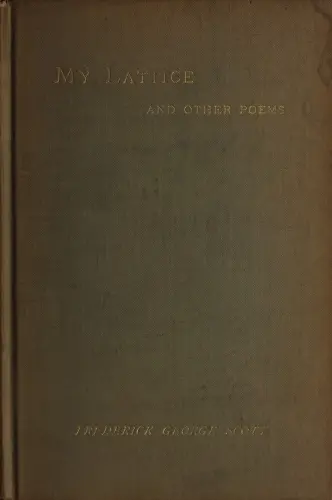
THE CLASSIC COLLECTION · 1894
"My Lattice, and Other Poems" by Frederick George Scott is a collection of poetry written during the late 19th century. This anthology encapsulates various emotions, themes, and reflections on life, nature, and the human condition, showcasing Scott's lyrical prowess and philosophical introspection. The poems convey deep sentiments about love, mortality, nature, and the struggles of existence, enriching the literary landscape of the time. The collection opens with "My Lattice," where the poet reflects on the beauty of nature and the solace it brings. It transitions through notable works like "Samson," which deals with themes of strength and captivity, and "In Via Mortis," a meditation on death and the passage of life. Each poem presents a rich tapestry of Scott's experiences and observations, melding personal anguish with broader existential questions. The latter sections, featuring pieces such as "Dion" and "Calvary," explore historical and biblical narratives, tying in profound philosophical inquiries about human greatness and divine providence. Ultimately, Scott's poems offer both a personal and universal exploration of life's depth, making it a poignant read for fans of poetry and philosophical inquiry alike.
Introduction adapted from the source catalogue; source summaries may be automatically generated.
Free to read · English · 13,324 words · No account needed
MAKE TIME FOR A GOOD BOOK
On by default. Untick to stop anonymous reading totals. Each page counts after 10 seconds in view. How this works.
Anonymous counting is on unless you have switched it off.
The Abbot passed into the gloom,
The moonlight flooded all the room,
The boy sat stark from hour to hour,
Chained by unearthly power.
But lo, when, in the matin time,
The bells rang out the hour of prime,
From cloistered aisle and chapel stair
A wild cry rent the air.
Not yet quite cold, dead in his blood,
With face averted from the Rood,
The Abbot lay on chapel stone,
His eyes still woe-begone.
No bell was rung, no mass was said,
They buried the dishonoured dead
Out in the road which crossed the wood,
In dark and solitude.
They marked the spot with never a stone,
Tree-shadows fell on it alone,
And moss and vines and thin wood grass
Grew where no feet would pass.
Nathless, it seemed to one fair boy,
The birds did sing with fuller joy,
And angels swung wood incense faint,
As round the grave of saint.
The tiny altar-lamp burnt dim,
And lit the sculptured seraphim,
And tombs where monks in garments cere
Were gathered year by year.
But when an old monk came to die,
He spake thus to those standing by:
“Out in that spot my grave be set,
Marked by wood violet.
“No man can judge another’s sin,
God only sees without and in,
Wherefore, my brethren, be ye kind,
That was our Master’s mind.
“For many are crowned as saints by God
Whose graves unheeding feet have trod;
Man judges by the outer life,
God by the inner strife.
“Out there the forest tree-roots creep
Round one sad heart’s forgotten sleep,
A heart which broke in giving all
To save a soul from thrall.”
Dion, of Syracuse (408-353 B.C.), philosopher, was a near relative, through his wife Arete, of the tyrant Dionysius the Second, by whom he was banished. He took up his residence at Athens, but on hearing that the tyrant had seized his son and given Arete in marriage to another, with a small and faithful force he returned to Syracuse, captured the place and drove Dionysius into Ortygia, a fortress within the city walls. As soon as their oppression was relieved, the suspicious Syracusans began to fear the power of Dion, although he had nobly refused to make concessions to Dionysius when urged thereto by the passionate appeals of Arete and her son, held captive in Ortygia. On hearing of a plot formed against him among the citizens, by Heracleides, without taking revenge on the thankless city, Dion withdrew to Leontini, but only to be speedily recalled to rescue the people a second time from the ravages of Dionysius, who had charged out upon the town as soon as Dion had withdrawn. Again Dion returned to Syracuse, and this time succeeded in routing the tyrant from his stronghold and restoring peace. With a magnanimity equal to his valour he pardoned Heracleides and his confreres. On breaking into the deserted fortress at the head of his troops, Dion, after years of separation, found his wife Arete. Dion naturally succeeded to the throne of the deposed monarch, but his reforms and the severity of his manners and rule rendered him unpopular with his fickle fellow-townsmen, and plots were formed for his assassination. He scorned to take precautions against attack, and so fell a victim to his valour. He was surrounded on the day of the festival of the Koreia, in his apartment in the palace, by a band of youths of distinguished muscular strength, who endeavoured to throw and strangle him. But the old warrior proving too strong for them, they were obliged to send out one of their number through a back door to procure a sword. With this, Dion, a man in many ways too great for his age and circumstances, was despatched.
Your reading position is saved on this browser. Take it to another device with a library code. Reading pages adapt to text, rather than matching a printed edition.
BEHIND THE BOOK
This eBook is for the use of anyone anywhere in the United States and most other parts of the world at no cost and with almost no restrictions whatsoever. You may copy it, give it away or re-use it under the terms of the Project Gutenberg License included with this eBook or online at www.gutenberg.org. If you are not located in the United States, you will have to check the laws of the country where you are located before using this eBook. Read the source licence.
The original source file, including credits and licence, is retained by this library. Request an original-format copy at no charge. Please include the book title and Project Gutenberg identifier #55318.
KEEP YOUR CURIOSITY GOING

Eric Mackay
Edmund Gosse
Sophia Margaretta Hensley
Gilbert Parker
George MacDonald

Elizabeth Bibesco