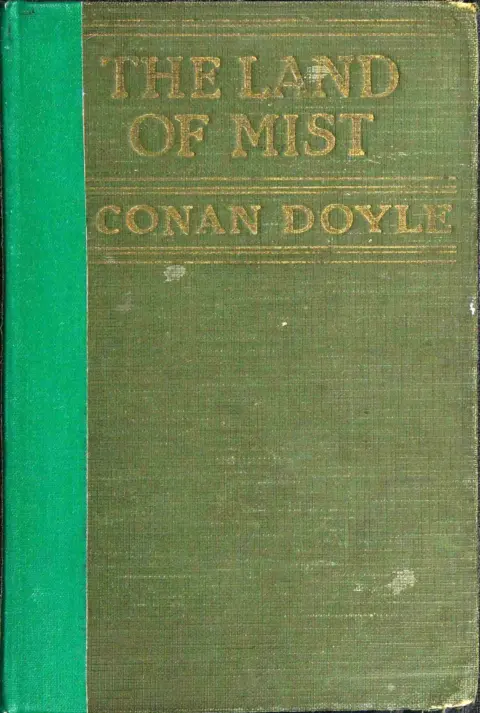
The Stark Munro Letters Being series of twelve letters written by J. Stark Munro, M.B., to his friend and former fellow-student, Herbert Swanborough, of Lowell, Massachusetts, during the years 1881-1884
Arthur Conan Doyle
THE CLASSIC COLLECTION · 1890
"My Friend the Murderer" by Arthur Conan Doyle is a collection of short stories written in the late 19th century. The series introduces the notorious Wolf Tone Maloney, a convicted murderer who has turned Queen's evidence in exchange for his life, unfolding tales that delve into the complexities of morality, guilt, and justice. The opening of the collection sets the stage with a character-driven narrative featuring the protagonist, a doctor in a prison, who is approached by a warder about getting to know Maloney. As the doctor reluctantly agrees to visit Maloney's cell, they engage in a conversation that unravels the convict's brash personality and his morally ambiguous past related to a series of gruesome murders. The dialogue vividly portrays Maloney's complex character and invites the reader into the world of crime and punishment, offering a glimpse into the aftermath of his testimony against his former gang mates and the societal repercussions he faces as a result.
Introduction adapted from the source catalogue; source summaries may be automatically generated.
Free to read · English · 84,831 words · No account needed
MAKE TIME FOR A GOOD BOOK
On by default. Untick to stop anonymous reading totals. Each page counts after 10 seconds in view. How this works.
Anonymous counting is on unless you have switched it off.
“It is a night to be comfortable indoors,” said Otto von Schlegel, looking out at the snowy landscape, “for ’tis bleak and bitter enough outside. Good health, Leopold!”
“Lebe hoch!” replied his companion. “It is a comfort, indeed, to forget sphenoid bones and ethmoid bones, if it be but for a moment. And what is the news of the corps, Otto? Has Graube fought the Swabian?”
“They fight to-morrow,” said Von Schlegel. “I fear that our man will lose his beauty, for he is short in the arm. Yet activity and skill may do much for him. They say his hanging guard is perfection.”
“And what else is the news among the students?” asked Strauss.
“They talk, I believe, of nothing but the murders. But I have worked hard of late, as you know, and hear little of the gossip.”
“Have you had time,” inquired Strauss, “to look over the books and the weapons which our dear old Professor was so concerned about the very day he met his death? They say they are well worth a visit.”
“I saw them to-day,” said Schlegel, lighting his pipe. “Reinmaul, the janitor, showed me over the store-room, and I helped to label many of them from the original catalogue of Graf Schulling’s museum. As far as we can see, there is but one article missing of all the collection.”
“One missing!” exclaimed Strauss. “That would grieve old Von Hopstein’s ghost. Is it anything of value?”
“It is described as an antique hatchet, with a head of steel and a handle of chased silver. We have applied to the railway company, and no doubt it will be found.”
“I trust so,” echoed Strauss; and the conversation drifted off into other channels. The fire was burning low and the bottle of Rhenish was empty before the two friends rose from their chairs and Von Schlegel prepared to depart.
“Ugh! It’s a bitter night!” he said, standing on the doorstep and folding his cloak round him. “Why, Leopold, you have your cap on. You are not going out, are you?”
“Yes, I am coming with you,” said Strauss, shutting the door behind him. “I feel heavy,” he continued, taking his friend’s arm, and walking down the street with him. “I think a walk as far as your lodgings, in the crisp frosty air, is just the thing to set me right.”
The two students went down Stephen Strasse together and across Julien Platz, talking on a variety of topics. As they passed the corner of the Grand Platz, however, where Schiffer had been found dead, the conversation turned naturally upon the murder.
Your reading position is saved on this browser. Take it to another device with a library code. Reading pages adapt to text, rather than matching a printed edition.
Arthur Conan Doyle
Arthur Conan Doyle
Arthur Conan Doyle

Arthur Conan Doyle
BEHIND THE BOOK
This eBook is for the use of anyone anywhere in the United States and most other parts of the world at no cost and with almost no restrictions whatsoever. You may copy it, give it away or re-use it under the terms of the Project Gutenberg License included with this eBook or online at www.gutenberg.org. If you are not located in the United States, you will have to check the laws of the country where you are located before using this eBook. Read the source licence.
The original source file, including credits and licence, is retained by this library. Request an original-format copy at no charge. Please include the book title and Project Gutenberg identifier #69260.
KEEP YOUR CURIOSITY GOING

Herman W. Mudgett

James Holbrook

William Le Queux

Edgar Wallace
Hilaire Belloc
Marie Belloc Lowndes