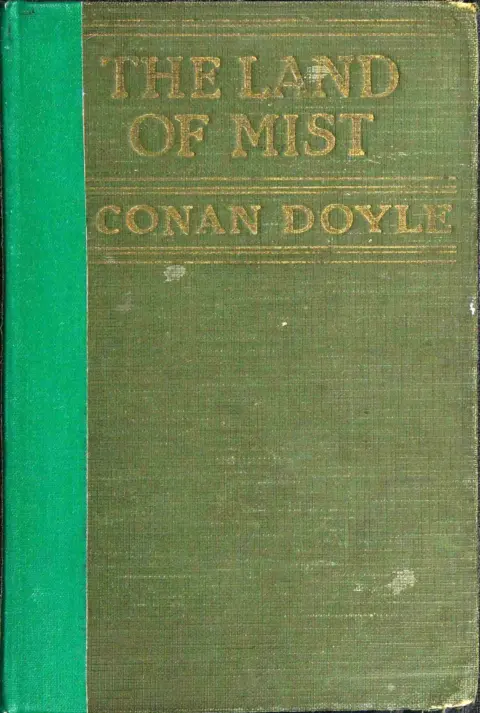
The Stark Munro Letters Being series of twelve letters written by J. Stark Munro, M.B., to his friend and former fellow-student, Herbert Swanborough, of Lowell, Massachusetts, during the years 1881-1884
Arthur Conan Doyle
THE CLASSIC COLLECTION · 1890
"My Friend the Murderer" by Arthur Conan Doyle is a collection of short stories written in the late 19th century. The series introduces the notorious Wolf Tone Maloney, a convicted murderer who has turned Queen's evidence in exchange for his life, unfolding tales that delve into the complexities of morality, guilt, and justice. The opening of the collection sets the stage with a character-driven narrative featuring the protagonist, a doctor in a prison, who is approached by a warder about getting to know Maloney. As the doctor reluctantly agrees to visit Maloney's cell, they engage in a conversation that unravels the convict's brash personality and his morally ambiguous past related to a series of gruesome murders. The dialogue vividly portrays Maloney's complex character and invites the reader into the world of crime and punishment, offering a glimpse into the aftermath of his testimony against his former gang mates and the societal repercussions he faces as a result.
Introduction adapted from the source catalogue; source summaries may be automatically generated.
Free to read · English · 84,831 words · No account needed
MAKE TIME FOR A GOOD BOOK
On by default. Untick to stop anonymous reading totals. Each page counts after 10 seconds in view. How this works.
Anonymous counting is on unless you have switched it off.
“We have heard,” said Alexis, “that you were sent to inspect the Livadia. Can you give us any particulars about it?”
“Anything you ask I will endeavor to answer,” I replied, in desperation.
“Have any orders been made in Birmingham concerning it?”
“None when I left England.”
“Well, well, there’s plenty of time yet,” said the man with the beard--“many months. Will the bottom be of wood or iron?”
“Of wood,” I answered at random.
“’Tis well!” said another voice. “And what is the breadth of the Clyde below Greenock?”
“It varies much,” I replied; “on an average about eighty yards.”
“How many men does she carry?” asked an anæmic-looking youth at the foot of the table, who seemed more fit for a public school than this den of murder.
“About three hundred,” said I.
“A floating coffin!” said the young Nihilist, in a sepulchral voice.
“Are the store-rooms on a level with or underneath the state-cabins?”
asked Petrokine.
“Underneath,” said I decisively, though I need hardly say I had not the
smallest conception.
“And now, most honored sir,” said Alexis, “tell us what was the reply of Bauer, the German socialist, to Ravinsky’s proclamation.”
Here was a deadlock with a vengeance. Whether my cunning would have extricated me from it or not was never decided, for Providence hurried me from one dilemma into another and a worse one.
A door slammed downstairs, and rapid footsteps were heard approaching. Then came a loud tap outside, followed by two smaller ones.
“The sign of the society!” said Petrokine; “and yet we are all present;
who can it be?”
The door was thrown open, and a man entered, dusty and travel-stained, but with an air of authority and power stamped on every feature of his harsh but expressive face. He glanced round the table, scanning each countenance carefully. There was a start of surprise in the room. He was evidently a stranger to them all.
“What means this intrusion, sir?” said my friend with the beard.
“Intrusion!” said the stranger. “I was given to understand that I was expected, and had looked forward to a warmer welcome from my fellow-associates. I am personally unknown to you, gentlemen, but I am proud to think that my name should command some respect among you. I am Gustave Berger, the agent from England, bearing letters from the chief commissioner to his well-beloved brothers of Solteff.”
One of their own bombs could hardly have created greater surprise had it been fired in the midst of them. Every eye was fixed alternately on me and upon the newly arrived agent.
“If you are indeed Gustave Berger,” said Petrokine, “who is this?”
Your reading position is saved on this browser. Take it to another device with a library code. Reading pages adapt to text, rather than matching a printed edition.
Arthur Conan Doyle
Arthur Conan Doyle
Arthur Conan Doyle

Arthur Conan Doyle
BEHIND THE BOOK
This eBook is for the use of anyone anywhere in the United States and most other parts of the world at no cost and with almost no restrictions whatsoever. You may copy it, give it away or re-use it under the terms of the Project Gutenberg License included with this eBook or online at www.gutenberg.org. If you are not located in the United States, you will have to check the laws of the country where you are located before using this eBook. Read the source licence.
The original source file, including credits and licence, is retained by this library. Request an original-format copy at no charge. Please include the book title and Project Gutenberg identifier #69260.
KEEP YOUR CURIOSITY GOING

Herman W. Mudgett

James Holbrook

William Le Queux

Edgar Wallace
Hilaire Belloc
Marie Belloc Lowndes