Letters to a Friend, Written to Mrs. Ezra S. Carr, 1866-1879
John Muir
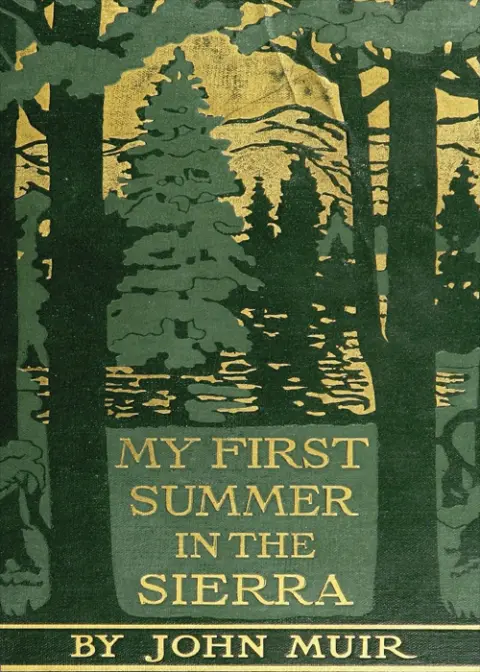
THE CLASSIC COLLECTION · 1911
"My First Summer in the Sierra" by John Muir is a memoir written in the early 20th century. The text recounts Muir's experiences as he travels through the Sierra Nevada mountains, exploring the flora and fauna while working with a flock of sheep. This work highlights Muir's profound connection to nature and his passion for wilderness exploration, making it a captivating read for anyone interested in natural history or the great outdoors. The opening of the memoir introduces Muir's longing for the mountains and his precarious financial situation, which leads him to accept a job with a flock of sheep as they are driven to higher pastures in the Sierra. Alongside a shepherd named Billy, a Chinaman, and an Indian, Muir embarks on this journey, eagerly anticipating his time to study the region's plants, animals, and landscapes. As the group makes their way through the foothills, Muir describes the sights and sounds of nature, his interactions with the flock, and the occasional challenges they face, all of which set the stage for a summer of discovery and appreciation of the natural world.
Introduction adapted from the source catalogue; source summaries may be automatically generated.
Free to read · English · 59,530 words · No account needed
MAKE TIME FOR A GOOD BOOK
On by default. Untick to stop anonymous reading totals. Each page counts after 10 seconds in view. How this works.
Anonymous counting is on unless you have switched it off.
Wrote to my mother and a few friends, mountain hints to each. They seem as near as if within voice-reach or touch. The deeper the solitude the less the sense of loneliness, and the nearer our friends. Now bread and tea, fir bed and good-night to Carlo, a look at the sky lilies, and death sleep until the dawn of another Sierra to-morrow.
July 21. Sketching on the Dome—no rain; clouds at noon about quarter filled the sky, casting shadows with fine effect on the white mountains at the heads of the streams, and a soothing cover over the gardens during the warm hours.
Saw a common house-fly and a grasshopper and a brown bear. The fly and grasshopper paid me a merry visit on the top of the Dome, and I paid a visit to the bear in the middle of a small garden meadow between the Dome and the camp where he was standing alert among the flowers as if willing to be seen to advantage. I had not gone more than half a mile from camp this morning, when Carlo, who was trotting on a few yards ahead of me, came to a sudden, cautious standstill. Down went tail and ears, and forward went his knowing nose, while he seemed to be saying, “Ha, what’s this? A bear, I guess.” Then a cautious advance of a few steps, setting his feet down softly like a hunting cat, and questioning the air as to the scent he had caught until all doubt vanished. Then he came back to me, looked me in the face, and with his speaking eyes reported a bear near by; then led on softly, careful, like an experienced hunter, not to make the slightest noise; and frequently looking back as if whispering, “Yes, it’s a bear; come and I’ll show you.” Presently we came to where the sunbeams were streaming through between the purple shafts of the firs, which showed that we were nearing an open spot, and here Carlo came behind me, evidently sure that the bear was very near. So I crept to a low ridge of moraine boulders on the edge of a narrow garden meadow, and in this meadow I felt pretty sure the bear must be. I was anxious to get a good look at the sturdy mountaineer without alarming him; so drawing myself up noiselessly back of one of the largest of the trees I peered past its bulging buttresses, exposing only a part of my head, and there stood neighbor Bruin within a stone’s throw, his hips covered by tall grass and flowers, and his front feet on the trunk of a fir that had fallen out into the meadow, which raised his head so high that he seemed to be standing erect. He had not yet seen me, but was looking and listening attentively, showing that in some way he was aware of our approach. I watched his gestures and tried to make the most of my opportunity to learn what I could about him, fearing he would catch sight of me and run away. For I had been told that this sort of bear, the cinnamon, always ran from his bad brother man, never showing fight unless wounded or in defense of young. He made a telling picture standing alert in the sunny forest garden. How well he played his part, harmonizing in bulk and color and shaggy hair with the trunks of the trees and lush vegetation, as natural a feature as any other in the landscape. After examining at leisure, noting the sharp muzzle thrust inquiringly forward, the long shaggy hair on his broad chest, the stiff, erect ears nearly buried in hair, and the slow, heavy way he moved his head, I thought I should like to see his gait in running, so I made a sudden rush at him, shouting and swinging my hat to frighten him, expecting to see him make haste to get away. But to my dismay he did not run or show any sign of running. On the contrary, he stood his ground ready to fight and defend himself, lowered his head, thrust it forward, and looked sharply and fiercely at me. Then I suddenly began to fear that upon me would fall the work of running; but I was afraid to run, and therefore, like the bear, held my ground. We stood staring at each other in solemn silence within a dozen yards or thereabouts, while I fervently hoped that the power of the human eye over wild beasts would prove as great as it is said to be. How long our awfully strenuous interview lasted, I don’t know; but at length in the slow fullness of time he pulled his huge paws down off the log, and with magnificent deliberation turned and walked leisurely up the meadow, stopping frequently to look back over his shoulder to see whether I was pursuing him, then moving on again, evidently neither fearing me very much nor trusting me. He was probably about five hundred pounds in weight, a broad, rusty bundle of ungovernable wildness, a happy fellow whose lines have fallen in pleasant places. The flowery glade in which I saw him so well, framed like a picture, is one of the best of all I have yet discovered, a conservatory of Nature’s precious plant people. Tall lilies were swinging their bells over that bear’s back, with geraniums, larkspurs, columbines, and daisies brushing against his sides. A place for angels, one would say, instead of bears.
Your reading position is saved on this browser. Take it to another device with a library code. Reading pages adapt to text, rather than matching a printed edition.
BEHIND THE BOOK
This eBook is for the use of anyone anywhere in the United States and most other parts of the world at no cost and with almost no restrictions whatsoever. You may copy it, give it away or re-use it under the terms of the Project Gutenberg License included with this eBook or online at www.gutenberg.org. If you are not located in the United States, you will have to check the laws of the country where you are located before using this eBook. Read the source licence.
The original source file, including credits and licence, is retained by this library. Request an original-format copy at no charge. Please include the book title and Project Gutenberg identifier #32540.
KEEP YOUR CURIOSITY GOING
Wilfrid Scawen Blunt
Wilfrid Scawen Blunt

E. W. (Edgar Watson) Howe
Cécile Tormay

Moritz Busch
John L. Ransom