Letters to a Friend, Written to Mrs. Ezra S. Carr, 1866-1879
John Muir
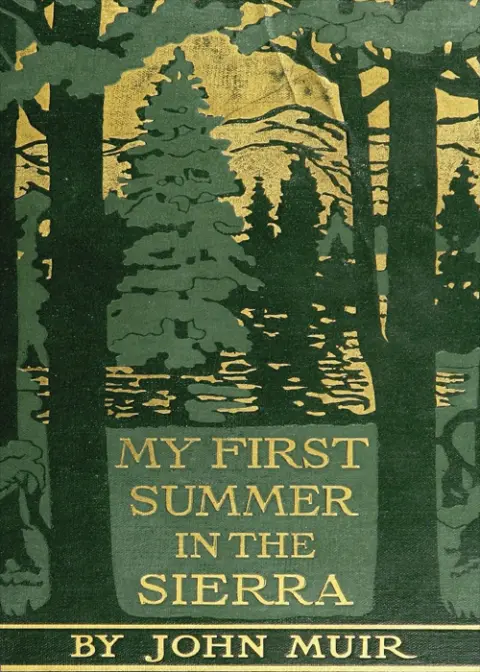
THE CLASSIC COLLECTION · 1911
"My First Summer in the Sierra" by John Muir is a memoir written in the early 20th century. The text recounts Muir's experiences as he travels through the Sierra Nevada mountains, exploring the flora and fauna while working with a flock of sheep. This work highlights Muir's profound connection to nature and his passion for wilderness exploration, making it a captivating read for anyone interested in natural history or the great outdoors. The opening of the memoir introduces Muir's longing for the mountains and his precarious financial situation, which leads him to accept a job with a flock of sheep as they are driven to higher pastures in the Sierra. Alongside a shepherd named Billy, a Chinaman, and an Indian, Muir embarks on this journey, eagerly anticipating his time to study the region's plants, animals, and landscapes. As the group makes their way through the foothills, Muir describes the sights and sounds of nature, his interactions with the flock, and the occasional challenges they face, all of which set the stage for a summer of discovery and appreciation of the natural world.
Introduction adapted from the source catalogue; source summaries may be automatically generated.
Free to read · English · 59,530 words · No account needed
MAKE TIME FOR A GOOD BOOK
On by default. Untick to stop anonymous reading totals. Each page counts after 10 seconds in view. How this works.
Anonymous counting is on unless you have switched it off.
Have been busy planning, and baking bread for at least one more good wild excursion among the high peaks, and surely none, however hopefully aiming at fortune or fame, ever felt so gloriously happily excited by the outlook.
September 7. Left camp at daybreak and made direct for Cathedral Peak, intending to strike eastward and southward from that point among the peaks and ridges at the heads of the Tuolumne, Merced, and San Joaquin Rivers. Down through the pine woods I made my way, across the Tuolumne River and meadows, and up the heavily timbered slope forming the south boundary of the upper Tuolumne basin, along the east side of Cathedral Peak, and up to its topmost spire, which I reached at noon, having loitered by the way to study the fine trees—two-leaved pine, mountain pine, albicaulis pine, silver fir, and the most charming, most graceful of all the evergreens, the mountain hemlock. High, cool, late-flowering meadows also detained me, and lakelets and avalanche tracks and huge quarries of moraine rocks above the forests.
All the way up from the Big Meadows to the base of the Cathedral the ground is covered with moraine material, the left lateral moraine of the great glacier that must have completely filled this upper Tuolumne basin. Higher there are several small terminal moraines of residual glaciers shoved forward at right angles against the grand simple lateral of the main Tuolumne Glacier. A fine place to study mountain sculpture and soil making. The view from the Cathedral Spires is very fine and telling in every direction. Innumerable peaks, ridges, domes, meadows, lakes, and woods; the forests extending in long curving lines and broad fields wherever the glaciers have left soil for them to grow on, while the sides of the highest mountains show a straggling dwarf growth clinging to rifts in the rocks apparently independent of soil. The dark heath-like growth on the Cathedral roof I found to be dwarf snow-pressed albicaulis pine, about three or four feet high, but very old looking. Many of them are bearing cones, and the noisy Clarke crow is eating the seeds, using his long bill like a woodpecker in digging them out of the cones. A good many flowers are still in bloom about the base of the peak, and even on the roof among the little pines, especially a woody yellow-flowered eriogonum and a handsome aster. The body of the Cathedral is nearly square, and the roof slopes are wonderfully regular and symmetrical, the ridge trending northeast and southwest. This direction has apparently been determined by structure joints in the granite. The gable on the northeast end is magnificent in size and simplicity, and at its base there is a big snow-bank protected by the shadow of the building. The front is adorned with many pinnacles and a tall spire of curious workmanship. Here too the joints in the rock are seen to have played an important part in determining their forms and size and general arrangement. The Cathedral is said to be about eleven thousand feet above the sea, but the height of the building itself above the level of the ridge it stands on is about fifteen hundred feet. A mile or so to the westward there is a handsome lake, and the glacier-polished granite about it is shining so brightly it is not easy in some places to trace the line between the rock and water, both shining alike. Of this lake with its silvery basin and bits of meadow and groves I have a fine view from the spires; also of Lake Tenaya, Cloud’s Rest and the South Dome of Yosemite, Mount Starr King, Mount Hoffman, the Merced peaks, and the vast multitude of snowy fountain peaks extending far north and south along the axis of the range. No feature, however, of all the noble landscape as seen from here seems more wonderful than the Cathedral itself, a temple displaying Nature’s best masonry and sermons in stones. How often I have gazed at it from the tops of hills and ridges, and through openings in the forests on my many short excursions, devoutly wondering, admiring, longing! This I may say is the first time I have been at church in California, led here at last, every door graciously opened for the poor lonely worshiper. In our best times everything turns into religion, all the world seems a church and the mountains altars. And lo, here at last in front of the Cathedral is blessed cassiope, ringing her thousands of sweet-toned bells, the sweetest church music I ever enjoyed. Listening, admiring, until late in the afternoon I compelled myself to hasten away eastward back of rough, sharp, spiry, splintery peaks, all of them granite like the Cathedral, sparkling with crystals—feldspar, quartz, hornblende, mica, tourmaline. Had a rather difficult walk and creep across an immense snow and ice cliff which gradually increased in steepness as I advanced until it was almost impassable. Slipped on a dangerous place, but managed to stop by digging my heels into the thawing surface just on the brink of a yawning ice gulf. Camped beside a little pool and a group of crinkled dwarf pines; and as I sit by the fire trying to write notes the shallow pool seems fathomless with the infinite starry heavens in it, while the onlooking rocks and trees, tiny shrubs and daisies and sedges, brought forward in the fire-glow, seem full of thought as if about to speak aloud and tell all their wild stories. A marvelously impressive meeting in which every one has something worth while to tell. And beyond the fire-beams out in the solemn darkness, how impressive is the music of a choir of rills singing their way down from the snow to the river! And when we call to mind that thousands of these rejoicing rills are assembled in each one of the main streams, we wonder the less that our Sierra rivers are songful all the way to the sea.
Your reading position is saved on this browser. Take it to another device with a library code. Reading pages adapt to text, rather than matching a printed edition.
BEHIND THE BOOK
This eBook is for the use of anyone anywhere in the United States and most other parts of the world at no cost and with almost no restrictions whatsoever. You may copy it, give it away or re-use it under the terms of the Project Gutenberg License included with this eBook or online at www.gutenberg.org. If you are not located in the United States, you will have to check the laws of the country where you are located before using this eBook. Read the source licence.
The original source file, including credits and licence, is retained by this library. Request an original-format copy at no charge. Please include the book title and Project Gutenberg identifier #32540.
KEEP YOUR CURIOSITY GOING
Wilfrid Scawen Blunt
Wilfrid Scawen Blunt

E. W. (Edgar Watson) Howe
Cécile Tormay

Moritz Busch
John L. Ransom