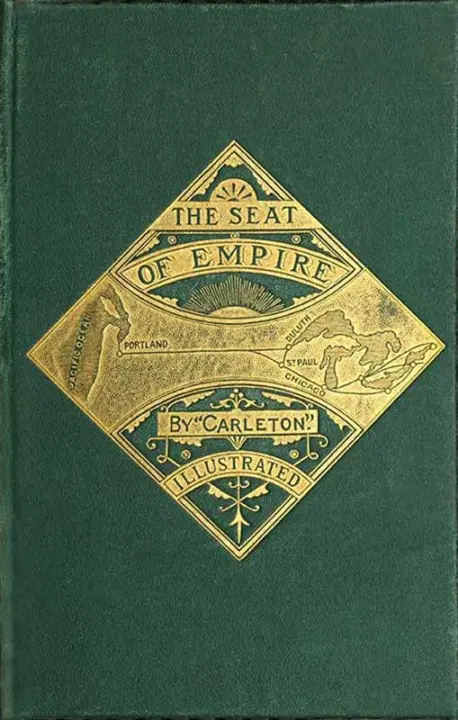
The Seat of Empire
Charles Carleton Coffin
THE CLASSIC COLLECTION · 1887
"My Days and Nights on the Battle-Field" by Charles Carleton Coffin is a historical account written in the late 19th century. The book chronicles the author's experiences and observations during the American Civil War, aiming to reflect upon the events that led to the conflict, the battles fought, and the sentiments of those involved in the war. Coffin's narrative seeks to educate young readers about the struggles and sacrifices made to preserve the Union, highlighting the importance of freedom and the sacrifices of American soldiers. The opening of the book serves as an introduction aimed at young readers, wherein Coffin reflects on his childhood memories of listening to his grandfather's tales of battles from the American Revolution. He establishes a connection between past struggles for independence and the present turmoil of the Civil War, as he sets out to explain how the rebellion arose. Coffin discusses the socioeconomic and historical factors that contributed to the South's secession and paints a picture of how various elements, including social classes and the rise of slavery, created a divided nation. The initial chapters detail the unfolding of events leading to the Civil War, preparing the reader for the subsequent battles and personal narratives that will follow.
Introduction adapted from the source catalogue; source summaries may be automatically generated.
Free to read · English · 65,891 words · No account needed
MAKE TIME FOR A GOOD BOOK
On by default. Untick to stop anonymous reading totals. Each page counts after 10 seconds in view. How this works.
Anonymous counting is on unless you have switched it off.
General Prentiss also sent an officer to Generals Hurlburt and Wallace, commanding the divisions in his rear, near the Landing, informing them that the Rebels were attacking his pickets in force. The firing increased. The Twenty-first Missouri gave a volley or two, but were obliged to fall back.
There had been a great deal of practising at target in the regiments, and every morning the pickets, on their return from the front, discharged their guns, and so accustomed had the soldiers become to the constant firing, that these volleys, so early in the morning, did not alarm the camp.
The orders which General Prentiss had issued were tardily acted upon. Many of the officers had not risen when the Twenty-first Missouri came back upon the double-quick, with Colonel Moore and several others wounded. They came in with wild cries. The Rebels were close upon their heels.
General Johnston had, as you have already seen, four lines of troops. The third corps was in front, commanded by Major-General Hardee, the second corps next, commanded by General Bragg; the first corps next, commanded by Major-General Polk, followed by the reserves under General Breckenridge.
General Hardee had three brigades, Hindman's, Cleburn's, and Wood's. General Bragg had two divisions, containing six brigades. The first division was commanded by General Ruggles, and contained Gibson's, Anderson's, and Pond's brigades. The second division was commanded by General Withers, and contained Gladden's, Chalmers's, and Jackson's brigades.
General Polk had two divisions, containing four brigades. The first division was commanded by General Clark, and contained Russell's and Stewart's brigades. The second division was commanded by Major-General Cheatham, and contained Johnson's and Stephens's brigades.
Breckenridge had Tabue's, Bowen's and Statham's brigades. General Gladden's brigade of Withers's division was placed on the right of Hardee's line. It was composed of the Twenty-first, Twenty-fifth, Twenty-sixth Alabama, and First Louisiana, with Robertson's battery. Hindman's brigade joined upon Gladden's. Gladden followed Colonel Moore's force, and fell upon Prentiss's camp.
Instantly there was a great commotion in the camp,--shouting, hallooing, running to and fro, saddling horses, seizing guns and cartridge-boxes, and forming in ranks. Gladden advanced rapidly, sending his bullets into the encampment. Men who had not yet risen were shot while lying in their tents.
But General Prentiss was all along his lines, issuing his orders, inspiring the men who, just awakened from sleep, were hardly in condition to act coolly. He ordered his whole force forward, with the exception of the Sixteenth Iowa, which had no ammunition, having arrived from Cairo on Saturday evening.
Your reading position is saved on this browser. Take it to another device with a library code. Reading pages adapt to text, rather than matching a printed edition.
Charles Carleton Coffin
Charles Carleton Coffin
Charles Carleton Coffin
Charles Carleton Coffin
BEHIND THE BOOK
This eBook is for the use of anyone anywhere in the United States and most other parts of the world at no cost and with almost no restrictions whatsoever. You may copy it, give it away or re-use it under the terms of the Project Gutenberg License included with this eBook or online at www.gutenberg.org. If you are not located in the United States, you will have to check the laws of the country where you are located before using this eBook. Read the source licence.
The original source file, including credits and licence, is retained by this library. Request an original-format copy at no charge. Please include the book title and Project Gutenberg identifier #28571.
KEEP YOUR CURIOSITY GOING
Cécile Tormay

Moritz Busch
John L. Ransom
Frances Wright
Cécile Tormay

Mabel Potter Daggett