THE CLASSIC COLLECTION✦An outlaw’s diary: the CommuneCLASSIC FREE BOOKS
An outlaw’s diary: the Commune
Cécile Tormay
THE CLASSIC COLLECTION · 1921
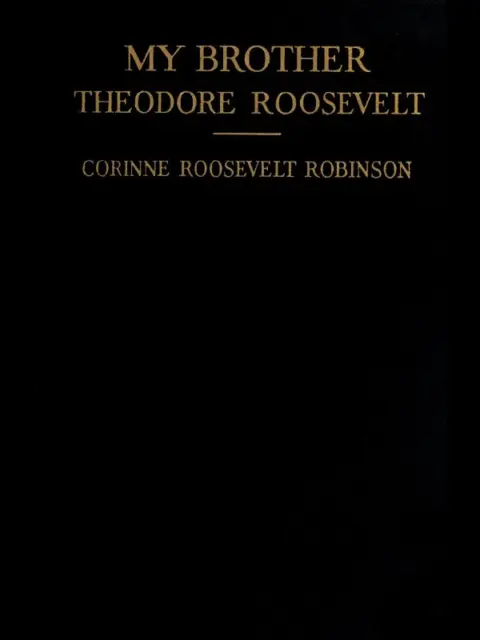
"My Brother, Theodore Roosevelt" by Corinne Roosevelt Robinson is a historical account written in the early 20th century. This work presents an intimate portrayal of Theodore Roosevelt, focusing on his childhood and early years, as shared through the personal reminiscences of his sister. The narrative is likely to appeal to readers interested in the influential figures of American history, particularly those who wish to understand the familial and personal aspects that shaped a President known for his vigor and unique personality. At the start of the memoir, the author reflects on her early memories of growing up in New York City with her brothers Theodore and Elliott. She describes their nurturing home life, their loving parents, and the significance of their shared childhood experiences in the nursery. Corinne highlights Theodore's fragility as a child, battling asthma while simultaneously displaying a vivid imagination and a capacity for leadership through storytelling. The early chapters set the stage for exploring Theodore Roosevelt's formative years and the lasting influence of family on his character and values.
Introduction adapted from the source catalogue; source summaries may be automatically generated.
Free to read · English · 128,366 words · No account needed
MAKE TIME FOR A GOOD BOOK
On by default. Untick to stop anonymous reading totals. Each page counts after 10 seconds in view. How this works.
Anonymous counting is on unless you have switched it off.
“By the way,--Mr. Garfield, next to the Colonel, is the most likeable, lovable man I met on this trip. He has a face that you like to watch silently, and contemplate, because you know how fine and corking he must be. I never heard such a long demonstration as the one which greeted the Colonel as he stepped out before 18,000 men and women, each of whom seemed to have a small flag. It began at three minutes before eight and it stopped at thirty-two minutes past eight. In that long interim you could hear nothing but one continuous roar of cheering shouts and stamping feet. There was nothing articulate, no special cries distinguishable from others, just one blast as though some Titan engineer had tied down the heavy chain which released the whistle of 100,000 voice power. All efforts to stop it were futile. There was nothing to do but to let it run down. The band played ‘Gary Owen’ and the ‘Star Spangled Banner’ and other selections,--T. R. beating time with a large replica of a ‘Big Stick’ which had been handed to him. Meanwhile, in this bedlam, Cronin and I were writing new ‘leads’ to our story on pads in our laps. A Western Union man was sneaking up to the platform every ten minutes to get copy which was placed on wires on the pavilion. By writing this way, we got the story into New York before eleven o’clock, that is, when the meeting was over, by ten o’clock in Chicago; then there was the rapid shooting ride back to the hotel, a little grub and bath, and to bed. I was tired.
“We left Chicago at 6.25 A. M., the Colonel’s car being hitched behind a regular train on the New York Central. The Colonel is fifty-eight years old today, as you will know, doubtless, before this letter reaches New Britain. I discovered the fact in reading his autobiography. He has been so fine to all of us; he has gone out of his way to make sure that we were treated like members of his own family; he has entertained us, as correspondents never were entertained; because what can excel the most interesting American, if not the greatest, telling anecdotes by the dozen of one of the most interesting, democratic, dynamic, forcible careers in American History? A thought that we ought to give him something to remember us by sprang simultaneously into the minds of Yoder and myself.... Our suggestions included a fountain-pen, pocket knife, or silver pencil--something that he could use. We elected Yoder to scout through the Colonel’s pocket. He went out on the observation platform and casually asked the Colonel if he could borrow his knife. ‘Yes--Yoder,’ T. R. said, digging into his pocket, ‘but I am ashamed of it. The blades are rusty, the handle is cracked. By George, I must get a new one.’ We decided after hearing Yoder’s report, that a knife was the thing. A handsome, little, flat, gold knife was picked out and the presentation came at luncheon today. Odell, in his solemn way, said that I had found out that he was born on October 27th. ‘Now, Colonel, you have been telling us of many desperate characters you met in the Southwest.... We decided, therefore, that you should have a weapon. We have taken counsel and have determined to give you a little reminder of our pleasure on this trip....’ The Colonel took the little box, pulled forth the knife, and smiling a more than Roosevelt smile, ‘By George, isn’t that fine!’ he exclaimed. ‘I have never had a good pocket knife in all my life, and I was going to buy one tomorrow. I shall always cherish this gift,--I shall always carry it with me,’ whereupon he attached it to the chain with his Phi Beta Kappa key and his little pencil;--‘and I want to say that I have enjoyed immensely having you with me, and the trip has been a pleasure to me mainly because you young men have been such good company. I am too old at the political game to enjoy making speeches. I do not like it, but we have had a bully good time on this tour, and we have met a lot of my old friends,--and now, gentlemen, remember this, if Mr. Hughes is elected on November 7th, I shall never be seen in politics again. I am through.’ I felt rather sorry to hear the Colonel say this. He is so energetic and courageous, so full of the fighting spirit that we need to tone up the national affairs, that it seems a pity to contemplate his retirement before he attains 60. Of course, he will write his views for the benefit of the reading public, but if he follows his inclination, he will become a quiet figure in the background, leaving younger men to carry through the ideas he created. We do not believe that the American people, however, will ever permit him to retire. Just as sure as Wilson is re-elected, there will be a demand for Theodore Roosevelt in 1920. He knows it and he is trying to start the talk now through us to show that it is the last thing on earth he cares to do. He would, I think, have liked to run this year; he would have liked to grapple with the problems which will arise after the war is over, but he took his licking at the hands of the old-line Republicans, and he really wants to see their candidate elected.”
Your reading position is saved on this browser. Take it to another device with a library code. Reading pages adapt to text, rather than matching a printed edition.
BEHIND THE BOOK
This eBook is for the use of anyone anywhere in the United States and most other parts of the world at no cost and with almost no restrictions whatsoever. You may copy it, give it away or re-use it under the terms of the Project Gutenberg License included with this eBook or online at www.gutenberg.org. If you are not located in the United States, you will have to check the laws of the country where you are located before using this eBook. Read the source licence.
The original source file, including credits and licence, is retained by this library. Request an original-format copy at no charge. Please include the book title and Project Gutenberg identifier #51831.
KEEP YOUR CURIOSITY GOING
Cécile Tormay

Moritz Busch
John L. Ransom
Frances Wright
Cécile Tormay

Mabel Potter Daggett