THE CLASSIC COLLECTION✦An outlaw’s diary: the CommuneCLASSIC FREE BOOKS
An outlaw’s diary: the Commune
Cécile Tormay
THE CLASSIC COLLECTION · 1921
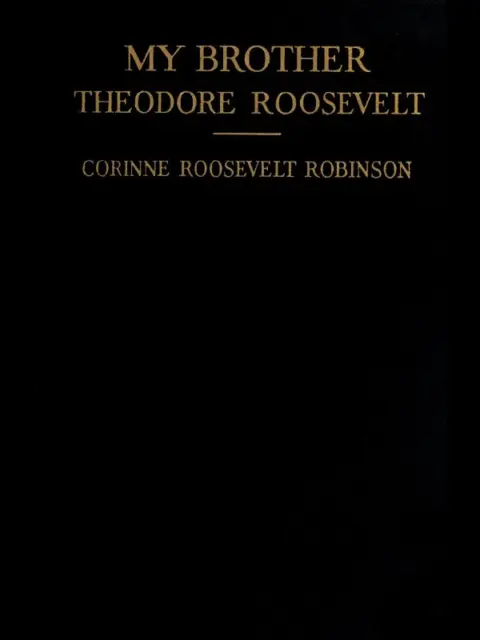
"My Brother, Theodore Roosevelt" by Corinne Roosevelt Robinson is a historical account written in the early 20th century. This work presents an intimate portrayal of Theodore Roosevelt, focusing on his childhood and early years, as shared through the personal reminiscences of his sister. The narrative is likely to appeal to readers interested in the influential figures of American history, particularly those who wish to understand the familial and personal aspects that shaped a President known for his vigor and unique personality. At the start of the memoir, the author reflects on her early memories of growing up in New York City with her brothers Theodore and Elliott. She describes their nurturing home life, their loving parents, and the significance of their shared childhood experiences in the nursery. Corinne highlights Theodore's fragility as a child, battling asthma while simultaneously displaying a vivid imagination and a capacity for leadership through storytelling. The early chapters set the stage for exploring Theodore Roosevelt's formative years and the lasting influence of family on his character and values.
Introduction adapted from the source catalogue; source summaries may be automatically generated.
Free to read · English · 128,366 words · No account needed
MAKE TIME FOR A GOOD BOOK
On by default. Untick to stop anonymous reading totals. Each page counts after 10 seconds in view. How this works.
Anonymous counting is on unless you have switched it off.
In spite of my daughter’s experience, however, I can say with truth that there never were such luncheons as those luncheons at the White House during my brother’s life there. The secretary of state, Mr. Elihu Root, with his unusual knowledge, his pregnant wit, and quiet, brilliant sarcasm; the secretary of war, Mr. Taft, with his gay smile and ready response; Mr. Moody, the attorney-general with his charming culture and universal kindliness, and Senator Henry Cabot Lodge, the brilliant scholar and statesman, my brother’s most intimate friend and constant companion, were frequent members of the luncheon-parties, and always, the most distinguished visitor to Washington, from whatever country or from whatever State of our own country, would be brought in with the same informal hospitality and received for the time being by President and Mrs. Roosevelt into the intimacy of family life. The whole cabinet would occasionally adjourn from one of their most important meetings to the lunch-table, and then the President and Mr. Root would cap each other’s stories of the way in which this or that question had been discussed during the cabinet meeting. I doubt also if ever there were quite such cabinet meetings as were held during those same years!
That spring Mr. Robinson and I took my daughter to Porto Rico to visit Governor and Mrs. Beekman Winthrop. My brother believed strongly in young men, and having admired the intelligence of young Beekman Winthrop (he came of a fine old New York family) as circuit judge in the Philippines, he decided to make him governor of Porto Rico. He was only twenty-nine, and his charming wife still younger, but they made a most ideal couple as administrators of the beautiful island. After having been with them in the old palace for about a week, and having enjoyed beyond measure all that was so graciously arranged for us, I was approached one day by Governor Winthrop, who told me that he was much distressed at the behavior of a certain official and that he felt sure that the President would not wish the man to remain in office, for he was actually a disgrace to the United States. “Mrs. Robinson,” he said, “will you not go to the President on your return, and tell him that I am quite sure he would not wish to retain this man in office? I know the President likes us to work with the tools which have been given us, and I dislike beyond measure to seem not to be able to do so, but I am convinced that this man should not represent the United States in this island.” “Have you your proofs, Beekman?” I asked. “I should not be willing to approach my brother with any such criticism without accurate proofs.” “I most assuredly have them,” he answered, and sure enough he did have them, and I shortly afterward sailed with them back to New York. Immediately upon my arrival I telegraphed my brother as follows: “Would like to see you on Porto Rican business. When shall I come?” One of Theodore Roosevelt’s most striking characteristics was the rapidity with which he answered letters or telegrams. One literally felt that one had not posted a letter or sent the telegram rushing along the wire before the rapid answer came winging back again, and that particular telegram was no exception to the rule. I had rather hoped for a week’s quiet in which to get settled after my trip to Porto Rico, but that was not to be. The rapid-fire answer read as follows: “Come tomorrow.” Of course there was nothing for me to do but go “tomorrow.” It was late in April, and as I drove up to the White House from the station, I thought how lovely a city was Washington in the springtime. The yellow forsythias gave a golden glow to the squares, and the soft hanging petals of the fringe-trees waved in the scented air. I never drove under the White House porte-cochère without a romantic feeling of excitement at the realization that it was my brother, lover of Lincoln, lover of America, who lived under the roof which symbolized all that America means to her children. As I went up the White House steps, he blew out of the door, dressed for his ride on horseback. His horse and that of a companion were waiting for him. He came smilingly toward me, welcomed me, and said: “Edie has had to go to Philadelphia for the night to visit Nellie Tyler, so we are all alone, and I have ordered dinner out on the back porch, for it is so warm and lovely, and there is a full moon, and I thought we could be so quiet there. I have so much to tell you. All sorts of political things have happened during your absence, and besides that I have learned several new poems of Kipling and Swinburne, and I feel like reciting them to you in the moonlight!” “How perfectly lovely,” I replied, “and when shall I see you about Porto Rico?” A slight frown came on his brow, and he said, “Certainly not to-night,” and then rather sternly: “You have your appointment at nine o’clock to-morrow morning in the office to discuss business matters.” Then with a returning smile: “I will be back pretty soon. Good-by.” And he jumped on his horse and clattered away toward Rock Creek.
Your reading position is saved on this browser. Take it to another device with a library code. Reading pages adapt to text, rather than matching a printed edition.
BEHIND THE BOOK
This eBook is for the use of anyone anywhere in the United States and most other parts of the world at no cost and with almost no restrictions whatsoever. You may copy it, give it away or re-use it under the terms of the Project Gutenberg License included with this eBook or online at www.gutenberg.org. If you are not located in the United States, you will have to check the laws of the country where you are located before using this eBook. Read the source licence.
The original source file, including credits and licence, is retained by this library. Request an original-format copy at no charge. Please include the book title and Project Gutenberg identifier #51831.
KEEP YOUR CURIOSITY GOING
Cécile Tormay

Moritz Busch
John L. Ransom
Frances Wright
Cécile Tormay

Mabel Potter Daggett