THE CLASSIC COLLECTION✦An outlaw’s diary: the CommuneCLASSIC FREE BOOKS
An outlaw’s diary: the Commune
Cécile Tormay
THE CLASSIC COLLECTION · 1921
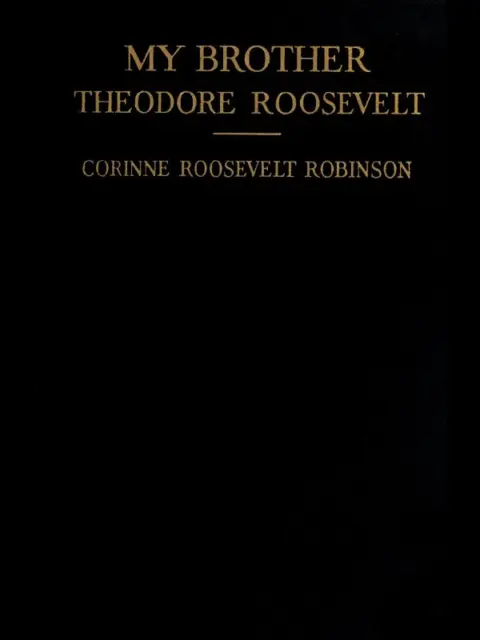
"My Brother, Theodore Roosevelt" by Corinne Roosevelt Robinson is a historical account written in the early 20th century. This work presents an intimate portrayal of Theodore Roosevelt, focusing on his childhood and early years, as shared through the personal reminiscences of his sister. The narrative is likely to appeal to readers interested in the influential figures of American history, particularly those who wish to understand the familial and personal aspects that shaped a President known for his vigor and unique personality. At the start of the memoir, the author reflects on her early memories of growing up in New York City with her brothers Theodore and Elliott. She describes their nurturing home life, their loving parents, and the significance of their shared childhood experiences in the nursery. Corinne highlights Theodore's fragility as a child, battling asthma while simultaneously displaying a vivid imagination and a capacity for leadership through storytelling. The early chapters set the stage for exploring Theodore Roosevelt's formative years and the lasting influence of family on his character and values.
Introduction adapted from the source catalogue; source summaries may be automatically generated.
Free to read · English · 128,366 words · No account needed
MAKE TIME FOR A GOOD BOOK
On by default. Untick to stop anonymous reading totals. Each page counts after 10 seconds in view. How this works.
Anonymous counting is on unless you have switched it off.
I would have my readers remember that when Theodore Roosevelt pleaded for such a peace it was in 1905, nine years before peace was broken by the armies of the Huns, and during those long years he never once failed to preach that doctrine, and to the last moment of his life abhorred and denounced the peace of the coward.
Following quickly on his inaugural speech came the luncheon at the White House, at which friends from New York were as cordially welcomed as were Bill Sewall’s large family from the Maine woods and Will Merrifield, who, now a marshal, brought the greetings of the State of Montana. After luncheon we all went out on the reviewing-stand. The President stood at the front of the box, his hat always off in response to the salutes. The great procession lasted for hours--West Pointers and naval cadets followed by endless state organizations, governors on horseback, cowboys waving their lassos and shouting favorite slogans (they even lassoed a couple of men, en passant), Chief Joseph, the grand old man of the Nez Percé tribe, gorgeously caparisoned, his brilliant head-dress waving in the wind, followed by a body of Indians only a shade less superb in costume, and then a hundred and fifty Harvard fellows in black gowns and caps--and how they cheered for the President as they passed the stand! Surely there was never before such an inauguration of any President in Washington. Never was there such a feeling of personal devotion in so many hearts. Other Presidents have had equal admiration, equal loyalty perhaps, but none has had that loyalty and admiration given by so liberal and varied a number of his fellow countrymen.
It was dark before we left the stand, and soon inside of the White House there followed a reception to the Rough Riders. What a happy time the President had with them recalling bygone adventures, while the Roosevelt and Robinson children ran merrily about listening to the wonderful stories and feeding the voracious Rough Riders. Later the President went bareheaded to the steps under the porte-cochère and received the cowboys, who rode past one after another, joyfully shaking hands with their old chief, ready with some joke for his special benefit, to which there was always a repartee. It was a unique scene as they cheered the incoming magnate under the old porte-cochère, and one never to be repeated. And then the Harvard men filed past to shake hands. Needless to say, dinner was rather late, though very merry, and we were all soon off to the inaugural ball. It was a beautiful sight, the hall enormous, with two rows of arches and pillars, one above the other, along each side. The floor was absolutely crowded with moving people, all with their faces straining up at our box. Ten thousand people bought tickets. Mr. Matthew Hale, then tutor to my nephew Theodore Roosevelt, Jr., has described the scene as follows: “The whole room was beautifully decorated with lights and wreaths and flowers. As I stood looking down on the great pageant I felt as though I were in some other world,--as though these people below there and moving in and out were not real people, but were all part of some great mechanism built for our special benefit. And then my feeling would change to the other extreme when I thought of each one of those men and women as individuals, each one thinking, and feeling and acting according to his own will,--and that all, just for that one night, came together for a common purpose, to see the President. Soon an open place appeared in the throng before us, and the President and Mrs. Roosevelt, and behind them Vice-President and Mrs. Fairbanks, walked to the other end of the hall and back, while the people cheered and cheered.” And soon it was time to go back to the White House, and then, best of all, came what we used to call a “back-hair” talk in Theodore and Edith’s room. What fun we had as we talked the great day over in comfortable déshabille. A small round bottle of old wine was found somewhere by Mrs. Roosevelt, and the family drank the President’s health, and we talked of old times and childhood days, and of the dear ones whose hearts would have glowed so warmly had they lived to see that day. We laughed immoderately over all kinds of humorous happenings, and we could hardly bear to say “good night,” we still felt so gay, so full of life and fun, so invigorated and stimulated by the excitement and by the deeper thoughts and desires, which, however, only took the form that night of increasing hilarity!
Your reading position is saved on this browser. Take it to another device with a library code. Reading pages adapt to text, rather than matching a printed edition.
BEHIND THE BOOK
This eBook is for the use of anyone anywhere in the United States and most other parts of the world at no cost and with almost no restrictions whatsoever. You may copy it, give it away or re-use it under the terms of the Project Gutenberg License included with this eBook or online at www.gutenberg.org. If you are not located in the United States, you will have to check the laws of the country where you are located before using this eBook. Read the source licence.
The original source file, including credits and licence, is retained by this library. Request an original-format copy at no charge. Please include the book title and Project Gutenberg identifier #51831.
KEEP YOUR CURIOSITY GOING
Cécile Tormay

Moritz Busch
John L. Ransom
Frances Wright
Cécile Tormay

Mabel Potter Daggett