THE CLASSIC COLLECTION✦My autobiographyCLASSIC FREE BOOKS
My autobiography
Benito Mussolini
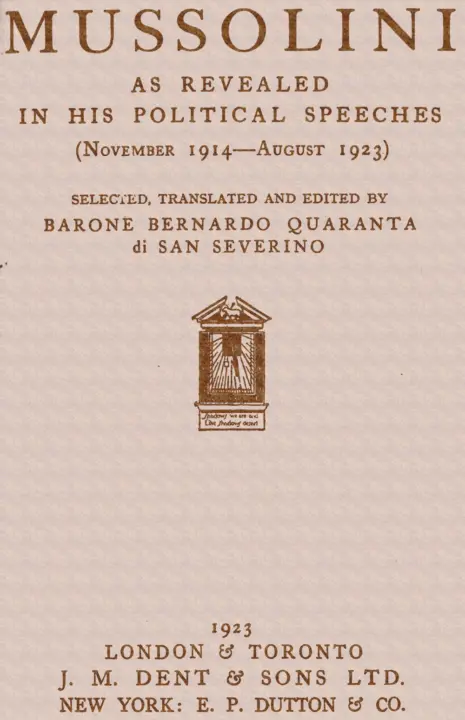
THE CLASSIC COLLECTION · 1923
"Mussolini as Revealed in His Political Speeches (November 1914-August 1923)" selected, translated, and edited by Barone Bernardo Quaranta di San Severino is a historical account written in the early 20th century. This work offers a collection of Benito Mussolini's political speeches, illustrating his evolution from a socialist leader to the Prime Minister of Italy and the driving force behind the Fascist movement. The likely topic of the book revolves around Mussolini's political philosophy, the rise of Fascism, and its implications for Italy and Europe during that tumultuous period. The opening of this historical account sets the stage for Mussolini's dramatic transformation and contextualizes the sentiments of post-war Italy. It discusses the backdrop of political instability and growing Communist threats that Mussolini sought to counteract. Through a passionate speech delivered before his expulsion from the Socialist Party, Mussolini asserts his undying belief in Socialism and the necessity of movement toward interventionist policies during World War I. This foundational rhetoric gives insight into his fervent nationalism, illustrating how he harnessed public sentiment to gain support for his emerging Fascist ideology. The introduction frames the collection as not merely a compilation of speeches, but as a crucial narrative revealing Mussolini's character, political mindset, and the historical forces at play during his rise to power.
Introduction adapted from the source catalogue; source summaries may be automatically generated.
Free to read · English · 110,565 words · No account needed
MAKE TIME FOR A GOOD BOOK
On by default. Untick to stop anonymous reading totals. Each page counts after 10 seconds in view. How this works.
Anonymous counting is on unless you have switched it off.
As for Hungary, she can certainly expect a revision of the treaty which mutilates her on every side. It must be added, however, that the chapter of Fiume is definitely closed in Hungarian history.
Centres of infection for another war exist all over the Balkan world. Let us quote Montenegro and Albania, for example. We are in favour of the independence of both these States, provided that they show themselves capable of enjoying it. Bulgaria has a right to Macedonia[7] and also to a port on the Ægean. And this is of capital importance for the economic expansion of Italy in Bulgaria. The Treaty of Sèvres crushed Turkey in order to exalt the Greece of Venizelos and Constantine, which gave the European war the sacrifice of 787 “euzoni.” We consider, as far as the Eastern Mediterranean is concerned, that Italy, on the whole, should follow a pro-Turkish policy.
Footnote 7:
Population: 1,181,000 Bulgarians, 499,000 Turks, and 228,000 Greeks.
The Treaty of Rapallo. Immediately after the signing of the Treaty of Rapallo, the Central Committee of the Fascio passed its judgment upon it, finding it “acceptable for the Eastern boundaries, inacceptable and deficient as regards Fiume, and insufficient and to be rejected as regards Zara and Dalmatia.” At three months’ distance this judgment does not seem to be contradicted by successive events. The Treaty of Rapallo is an unhappy compromise, against which pages of criticism were printed in the Popolo d’Italia, which it is now useless to repeat.
It must be explained why victorious Italy ever arrived at the point of signing the Peace of Rapallo. And the explanations do not need much mental exertion. Rapallo was the logical consequence of the line of foreign policy followed by us or imposed upon us before, during and after the war. It is explained by Wilson and his so-called experts and the absolute lack of Italian propaganda abroad and the dead-tiredness of the people. Rapallo is explained by the meeting of the oppressed nationalities held at Rome in April 1918, which meeting can be directly connected with the ill-fated story of Caporetto. Everything is paid for in this life. On 12th November 1920, we paid at Rapallo for the breakdown of 24th October 1917. Had there been no Caporetto, there would have been no Pact of Rome. In that congress the Yugoslavs threw dust in our eyes because in reality they did nothing towards breaking up the Dual Monarchy from within, of which they were the faithful slaves to the last, with traditional Croat loyalty. Not for nothing did the Hapsburg monarchy, upon its decease, try to present the Jugoslavs with its navy. But it was in the April of 1918 that the irreparable was committed, with the consent of all currents of Italian public opinion, including ours and the Nationalists—that is to say, our worst enemies were raised to the rank of effectual and powerful allies, and naturally, when the victory was obtained, there was no accepting of the rôle of vanquished, but they adopted that of co-operators with a relative share in the common booty. After the Pact of Rome it was no longer possible to place our knee on the chest of Yugoslavia—this is the truth. And so it happened that the Italian people—tired, impoverished and unnerved by two long years of useless negotiations, demoralised by the policy of the Government and the tremendous wave of after-war sabotage (against which only the Fascisti reacted powerfully)—accepted, or rather suffered, the Treaty of Rapallo, without manifestations of grief or joy. And, in order to finish it once and for all, many people would also have accepted the terrible line of Montemaggiore. All the parties of all the grades of Left and Right accepted the treaty as a lesser evil. We, too, submitted to it, considering it merely as a transitory and ephemeral act (has there ever been anything definite in the world, much less upon the moving sands of diplomacy?), and with the intention of gathering our forces to be ready for the revision which, sooner or later, would improve the treaty and not make it worse, would carry our boundaries to the Dinaric Alps, but never again allow the boundaries of Yugoslavia to reach the Isonzo.
Your reading position is saved on this browser. Take it to another device with a library code. Reading pages adapt to text, rather than matching a printed edition.
BEHIND THE BOOK
This eBook is for the use of anyone anywhere in the United States and most other parts of the world at no cost and with almost no restrictions whatsoever. You may copy it, give it away or re-use it under the terms of the Project Gutenberg License included with this eBook or online at www.gutenberg.org. If you are not located in the United States, you will have to check the laws of the country where you are located before using this eBook. Read the source licence.
The original source file, including credits and licence, is retained by this library. Request an original-format copy at no charge. Please include the book title and Project Gutenberg identifier #62754.
KEEP YOUR CURIOSITY GOING

David Patterson (Spirit) Hatch

David Patterson (Spirit) Hatch

David Patterson (Spirit) Hatch
Cécile Tormay

Moritz Busch
John L. Ransom