THE CLASSIC COLLECTION✦My autobiographyCLASSIC FREE BOOKS
My autobiography
Benito Mussolini
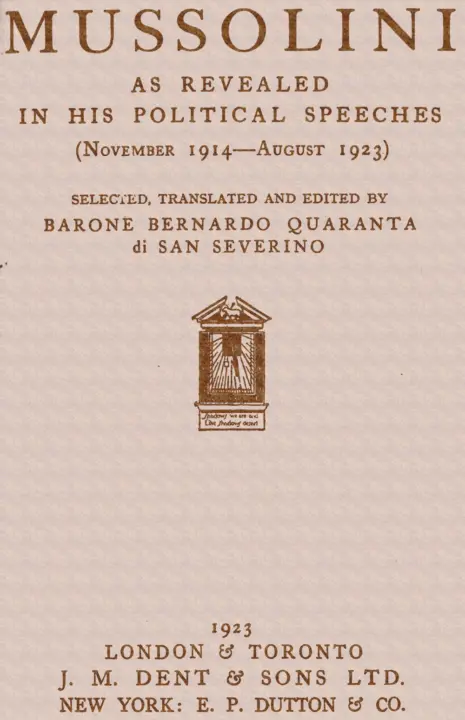
THE CLASSIC COLLECTION · 1923
"Mussolini as Revealed in His Political Speeches (November 1914-August 1923)" selected, translated, and edited by Barone Bernardo Quaranta di San Severino is a historical account written in the early 20th century. This work offers a collection of Benito Mussolini's political speeches, illustrating his evolution from a socialist leader to the Prime Minister of Italy and the driving force behind the Fascist movement. The likely topic of the book revolves around Mussolini's political philosophy, the rise of Fascism, and its implications for Italy and Europe during that tumultuous period. The opening of this historical account sets the stage for Mussolini's dramatic transformation and contextualizes the sentiments of post-war Italy. It discusses the backdrop of political instability and growing Communist threats that Mussolini sought to counteract. Through a passionate speech delivered before his expulsion from the Socialist Party, Mussolini asserts his undying belief in Socialism and the necessity of movement toward interventionist policies during World War I. This foundational rhetoric gives insight into his fervent nationalism, illustrating how he harnessed public sentiment to gain support for his emerging Fascist ideology. The introduction frames the collection as not merely a compilation of speeches, but as a crucial narrative revealing Mussolini's character, political mindset, and the historical forces at play during his rise to power.
Introduction adapted from the source catalogue; source summaries may be automatically generated.
Free to read · English · 110,565 words · No account needed
MAKE TIME FOR A GOOD BOOK
On by default. Untick to stop anonymous reading totals. Each page counts after 10 seconds in view. How this works.
Anonymous counting is on unless you have switched it off.
Apart from all that has been said, the present collection of speeches, besides showing Mussolini’s strong hand in the difficult art of statesmanship, displays clearly in almost every page (and so, possibly, the book may also appeal to others than politicians), additional important elements which are not usually found in a volume of political speeches, namely a richness of sympathy for mankind, a blunt straightforwardness, a gentleness of soul together with exceptional moral strength, pure idealism, which lift him not only above party politics, but also high above the average of mankind.
Such is the builder of New Italy, and the enthusiasm and deep confidence which Mussolini has inspired in our country, and the unanimous approval his work has prompted abroad, are a good omen for Italy’s future fortunes and for the welfare of the world at large.
BERNARDO QUARANTA di SAN SEVERINO.
SIENA, Via S. Quirico, N.1.
October 1923.
(English Translation)
Our movement has been crowned with success. The leader of our Party now holds the political power of the State for Italy and abroad. While this New Government represents our triumph, it celebrates, at the same time, our victory in the name of those who by land and by sea promoted it; and it accepts also, for the purpose of pacification, men from other parties, provided they are true to the cause of the Nation. The Italian Fascisti are too intelligent to wish to abuse their victory.
The supreme Quadrumvirate, which has resigned its powers in favour of the Party, thanks you for the magnificent proof of courage and of discipline which you have given, and salutes you. You have proved yourselves worthy of the fortunes and of the future of your Fatherland.
Demobilise in the same perfectly orderly manner in which you assembled for this great achievement, destined—as we firmly believe—to open a new era in the history of Italy. Return now to your usual occupations, as, in order to arrive at the summit of her fortunes, Italy needs to work. May nothing disturb the glory of these days through which we have just passed—days of superb passion and of Roman greatness.
Long live Italy!
Long live Fascismo!
Page 133, last line, for wars read stars.
Page 140, line 24, for times read temples.
Page 143, This Speech was delivered 20th September 1922.
Page 208, line 1, for Council of Munitions read Council of
Ministers.
Page 351, line 21, for 1885 read 1855.
“SO LONG AS THESE STUDENTS AND THESE UNIVERSITIES EXIST, THE NATION CANNOT PERISH AND BECOME A SLAVE, BECAUSE UNIVERSITIES SMASH FETTERS WITHOUT ALLOWING THE FORGING OF NEW ONES” 289 (Speech delivered at the University of Padua, 3rd June 1923.)
Your reading position is saved on this browser. Take it to another device with a library code. Reading pages adapt to text, rather than matching a printed edition.
BEHIND THE BOOK
This eBook is for the use of anyone anywhere in the United States and most other parts of the world at no cost and with almost no restrictions whatsoever. You may copy it, give it away or re-use it under the terms of the Project Gutenberg License included with this eBook or online at www.gutenberg.org. If you are not located in the United States, you will have to check the laws of the country where you are located before using this eBook. Read the source licence.
The original source file, including credits and licence, is retained by this library. Request an original-format copy at no charge. Please include the book title and Project Gutenberg identifier #62754.
KEEP YOUR CURIOSITY GOING

David Patterson (Spirit) Hatch

David Patterson (Spirit) Hatch

David Patterson (Spirit) Hatch
Cécile Tormay

Moritz Busch
John L. Ransom