THE CLASSIC COLLECTION✦My autobiographyCLASSIC FREE BOOKS
My autobiography
Benito Mussolini
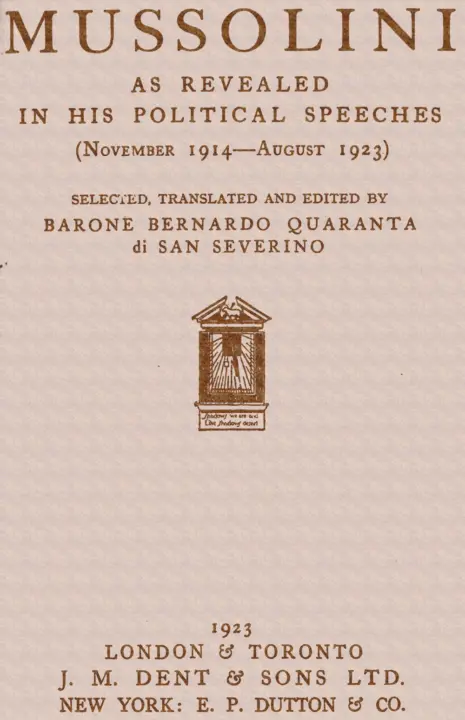
THE CLASSIC COLLECTION · 1923
"Mussolini as Revealed in His Political Speeches (November 1914-August 1923)" selected, translated, and edited by Barone Bernardo Quaranta di San Severino is a historical account written in the early 20th century. This work offers a collection of Benito Mussolini's political speeches, illustrating his evolution from a socialist leader to the Prime Minister of Italy and the driving force behind the Fascist movement. The likely topic of the book revolves around Mussolini's political philosophy, the rise of Fascism, and its implications for Italy and Europe during that tumultuous period. The opening of this historical account sets the stage for Mussolini's dramatic transformation and contextualizes the sentiments of post-war Italy. It discusses the backdrop of political instability and growing Communist threats that Mussolini sought to counteract. Through a passionate speech delivered before his expulsion from the Socialist Party, Mussolini asserts his undying belief in Socialism and the necessity of movement toward interventionist policies during World War I. This foundational rhetoric gives insight into his fervent nationalism, illustrating how he harnessed public sentiment to gain support for his emerging Fascist ideology. The introduction frames the collection as not merely a compilation of speeches, but as a crucial narrative revealing Mussolini's character, political mindset, and the historical forces at play during his rise to power.
Introduction adapted from the source catalogue; source summaries may be automatically generated.
Free to read · English · 110,565 words · No account needed
MAKE TIME FOR A GOOD BOOK
On by default. Untick to stop anonymous reading totals. Each page counts after 10 seconds in view. How this works.
Anonymous counting is on unless you have switched it off.
Fascista Council, Great, xv, 232–3, 314
Fascista Government, work of, xvii;
beginnings of, 163–4, 173;
“Government of speed,” 234;
policy respecting Fiume and Zara, 256;
foreign policy, 265, 293 et seq.
Fascista Party, National, xiv;
military organisation, xv;
numbers and adherents, 316
Fascista revolt, 76
Fascista State, 169, 173
Federation, of Labour, General, 106, 110;
of Seamen, 106
Federzoni, Signor, 190, 192
Fera, Signor, ex-Minister of Justice, 362
Ferrara, speech of 4th April 1921 at, 75
Ferrari, Giuseppe, 78
Ferrarin, 133, 285
Ferrario, General, 192
Fiat factory, 349
Fighters, National Association of, 87, 92, 99;
Fascio, 92
Finance, Ministry of, 272–3
Finland, xviii, 283
Finzi, 310
Fiume, 53, 74;
National Vindications and, 89;
Tardieu and, 96;
Mussolini visits D’Annunzio at, 103;
international relations and D’Annunzio’s occupation of, 104;
Italian acquisition of, 111;
Hungary and, 125;
the tragedy of, 128;
the war between General Caviglia and, 129;
the Fascio of, 131;
economic annexation of, demanded by the Fascisti, 132;
sympathy of Fascista for, 136;
Italian unity and, 144;
General Ferrario, 192;
the Belgrade Agreement, 193;
Agreements of Santa Margherita and, 248;
Arbitration Commission, 262;
Abbazia Conference,
278–9;
difficulties of Yugoslav Government, 301;
representations to Belgrade, 346
Florence, speech 9th Oct. 1919 at, 103;
speeches 19th June 1923 at, 328–9;
of the Middle Ages, 113
Foreign Affairs, Ministry of, Fascisti demand, 174
Foreign policy, 121, 132, 149, 251, 278, 293, 345
Forli, xvi
Forum, the, 234
France:
Italy’s neutrality in 1914, 12;
undertaking not to conclude a separate peace, 19;
heroism of, 45;
attitude of, towards Fiume question, 104
Franche-Comté, 21
Frankfurt, Treaty of, 9
Frankfurter Zeitung, 21
Freedom of the Press, 353, 355
Freemasonry, 201, 314, 318
Galassi, Angelico, 201
Galicia, 20;
Eastern, 280
Galileo, 77, 114
Gandolfo, General, 309
Garibaldi, 14, 27, 77, 114, 134;
“red shirts” of, 145;
Piedmont and, 352;
and Dumas, 353
Gasparri, Cardinal, 345
Gay, Harry Nelson, 335
Geneva, Protocol of;
loan to Austria, 299;
territorial integrity of Austria, 300
Genoa, 113, 311
Gentile, Senator, xii
George V., King of England, visit of, 304
Georgia, 133
Germany:
Italy’s neutrality between Triple Entente and Austro-German Alliance,
12;
dependence on Austria, 20;
and Belgium, 22;
Prussian militarism, 23, 60;
“Wilsonites” in, 54;
imperialist, doomed, 60;
war desired by, 72;
reparations problem, 124;
Upper Adige question and, 125;
resistance in the Ruhr, 240;
reparations, 294
Gioberti, 261
Giolitti, revelations of, 12;
adherents of, in upper bureaucracy, 106;
Italian intervention in the war and the followers of, 107;
attitude towards Upper Adige question, 188;
congratulates Mussolini, 362
Giordani, Giulio, 134
“Giovinezza” (Youth), xiv
Giulietti, Captain, 104
Giuriati, 310
Giustizia, La, 315
Goethe, 114
Gorizia, 48;
Italophobia in, 184
Grappa, 120
Graziadei, Antonio, 196–7
Graziani, General, xii
Greco-Albanian frontier, massacre of the Italian delegation for
delimitation of the, 363
Greece, 10;
Italian relations with, under Fascista Government, 212;
Italian note to, respecting Janina massacre, 363–4
Grodno, 123
Gronchi, speech on Electoral Reform by, 348
Guardie Regie, abolition of, xvii
Guesde on Socialist nations, 14
Guglielmotti, Maj.-General, 310
Hapsburg, House of, domination of, prevented by the war, 89;
war let loose by, 100;
attempt of, to present navy to Yugoslavs, 126;
Upper Adige and, 185, 187
Harden on Germany’s desire for war, 26
Harding, President, 279
Heraclea coal mines, 96
Hermada, 48
High Commissioners, 315
Hindenburg, 36
Hohenzollerns, the Germany of the, 26, 36;
passing of militarism with the, 60;
domination of, prevented by the war, 89;
Socialists and the, 99;
war let loose by the, 100
Holland, colonies of, 90
Hungary:
preparations against Roumania, 20;
Fiume and, 125;
Popular Party and, 201;
economic relations with, 213;
reparations, 295, 298.
See also Austro-Hungarian monarchy
Your reading position is saved on this browser. Take it to another device with a library code. Reading pages adapt to text, rather than matching a printed edition.
BEHIND THE BOOK
This eBook is for the use of anyone anywhere in the United States and most other parts of the world at no cost and with almost no restrictions whatsoever. You may copy it, give it away or re-use it under the terms of the Project Gutenberg License included with this eBook or online at www.gutenberg.org. If you are not located in the United States, you will have to check the laws of the country where you are located before using this eBook. Read the source licence.
The original source file, including credits and licence, is retained by this library. Request an original-format copy at no charge. Please include the book title and Project Gutenberg identifier #62754.
KEEP YOUR CURIOSITY GOING

David Patterson (Spirit) Hatch

David Patterson (Spirit) Hatch

David Patterson (Spirit) Hatch
Cécile Tormay

Moritz Busch
John L. Ransom