THE CLASSIC COLLECTION✦An outlaw’s diary: the CommuneCLASSIC FREE BOOKS
An outlaw’s diary: the Commune
Cécile Tormay
THE CLASSIC COLLECTION · 1875
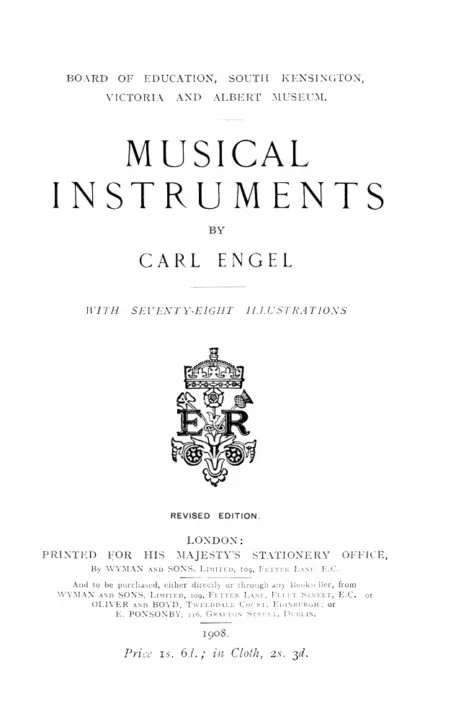
"Musical Instruments" by Carl Engel is a historical account written in the early 20th century. The work provides an in-depth exploration of musical instruments across various cultures and time periods, highlighting their evolution and significance throughout history. The book’s topic revolves around the extensive history of music and the diverse range of instruments that have been developed globally. The opening of the book begins with an introduction that emphasizes the universal appreciation for music as a fine art and traces the origin of musical instruments back to humanity's earliest inventions. Engel discusses the materials used in constructing instruments, noting how even primitive tribes possess unique instruments of their own. He touches on the cultural significance of these instruments, revealing how they reflect the identity of their respective societies, with specific examples like the incorporation of human skulls in African drums and the carved forms of instruments in other cultures. Overall, the beginning sets the stage for a detailed historical survey, showcasing the diverse global tapestry of musical heritage that the subsequent chapters will seek to expand upon.
Introduction adapted from the source catalogue; source summaries may be automatically generated.
Free to read · English · 43,460 words · No account needed
MAKE TIME FOR A GOOD BOOK
On by default. Untick to stop anonymous reading totals. Each page counts after 10 seconds in view. How this works.
Anonymous counting is on unless you have switched it off.
MY DEAR SIR,――Will you oblige me by certifying (if I am
correct) the following:――
The celebrated Mr. Smith (or Schmidt) was Handel’s private friend, and amanuensis. This said Mr. Smith was presented by Handel with his favourite fine double-keyed harpsichord, made by the best makers of the day, Andreas Ruckers of Antwerpia, 1651. This said instrument you have heard repeatedly Mr. Smith play on. Mr. Smith was father-in-law to you as well as your sister, the late Dowager Lady Rivers; and at his death, the said harpsichord, together with a large collection of Handel’s oratorios, etc., etc., MSS., came into the hands of the Dowager Lady Rivers. This instrument was parted with to a Mr. Wickham, surgeon, who parted with it to the Rev. W. Hawtrey, Prebendary of Winchester Cathedral, upon the death of whom I purchased it at the sale of his effects; and in my possession it still remains. Is not this the identical instrument now spoken of? Your early answer to these queries, as the only living witness, will oblige.
Dear Sir,
Yours faithfully,
G. W. CHARD.
P.S.――Will you oblige me by certifying on this sheet of
paper, and returning it?
Answer.
I certify that the above statement is correct, as far as my
knowledge goes.
Twyford, May 13th, 1842.
Witness to the above signature,
SUSANNA GREGG.
JAMES HARRIS.
[1] Figured and described in Lartet & Christy’s Reliquiæ Aquitanicæ, London, 1865-75, Pl. B. v., p. 48.
[2] The best instance is to be found in Lepsius’ Denkmäler, III. 106a., where a music-school of the Akhenaten period (about 1400 B.C.) is depicted.
[3] For coloured plate after this painting see Wilkinson’s Ancient Egyptians, Vol. I., Pl. xii. (facing page 480).
[4] See Transactions of the Royal Society of Edinburgh,
Vol. xx., Part I (1850).
[5] See E. Aldis, Carvings and Sculptures of Worcester
Cathedral (IV).
[6] See illustration in Ann. Arch., IV., p. 37.
[7] See illustration in Ann. Arch., iv., p. 98.
[8] For a more complete list of lute-makers see Von Lütgendorff, Die Geigen- und Lautenmacher vom Mittelalter bis zur Gegenwart, Frankfort, 1904.
Abyssinian instruments, 20.
Acocotl, 67.
Adair, quoted, 81.
Adufe, 25.
Æolian harp, 4.
African instruments in America, 82.
Ajacaxtli, 72.
Al-Farabi, lutist, 55-57.
American Indian instruments, 58 seq.
American Indians, metrical psalms of, 81.
American Indians, musical performances of, 75.
American Indians, North, musical talent of, 81.
Anglo-Saxon instruments, 84, 86, 90, 94.
Arab instruments, 3, 36, 48, 53 seq., 108.
Arabs in Spain, 36, 56.
Archlute, 101, 105.
Ashantee, trumpet from, 2.
Ash-shakandi, 55.
Asor, 20.
Assyrian instruments, 16 seq.
Aulos, 31.
Aztecs, instruments of the, 58, 59.
Your reading position is saved on this browser. Take it to another device with a library code. Reading pages adapt to text, rather than matching a printed edition.
BEHIND THE BOOK
This eBook is for the use of anyone anywhere in the United States and most other parts of the world at no cost and with almost no restrictions whatsoever. You may copy it, give it away or re-use it under the terms of the Project Gutenberg License included with this eBook or online at www.gutenberg.org. If you are not located in the United States, you will have to check the laws of the country where you are located before using this eBook. Read the source licence.
The original source file, including credits and licence, is retained by this library. Request an original-format copy at no charge. Please include the book title and Project Gutenberg identifier #65505.
KEEP YOUR CURIOSITY GOING
Cécile Tormay

Moritz Busch
John L. Ransom
Frances Wright
Cécile Tormay

Mabel Potter Daggett