THE CLASSIC COLLECTION✦An outlaw’s diary: the CommuneCLASSIC FREE BOOKS
An outlaw’s diary: the Commune
Cécile Tormay
THE CLASSIC COLLECTION · 1875
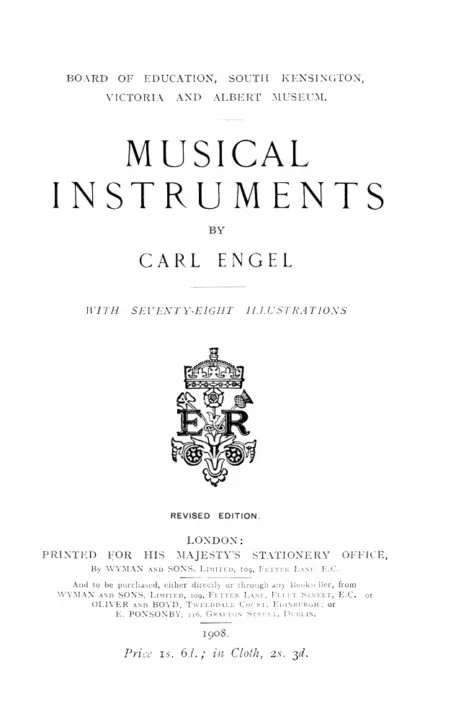
"Musical Instruments" by Carl Engel is a historical account written in the early 20th century. The work provides an in-depth exploration of musical instruments across various cultures and time periods, highlighting their evolution and significance throughout history. The book’s topic revolves around the extensive history of music and the diverse range of instruments that have been developed globally. The opening of the book begins with an introduction that emphasizes the universal appreciation for music as a fine art and traces the origin of musical instruments back to humanity's earliest inventions. Engel discusses the materials used in constructing instruments, noting how even primitive tribes possess unique instruments of their own. He touches on the cultural significance of these instruments, revealing how they reflect the identity of their respective societies, with specific examples like the incorporation of human skulls in African drums and the carved forms of instruments in other cultures. Overall, the beginning sets the stage for a detailed historical survey, showcasing the diverse global tapestry of musical heritage that the subsequent chapters will seek to expand upon.
Introduction adapted from the source catalogue; source summaries may be automatically generated.
Free to read · English · 43,460 words · No account needed
MAKE TIME FOR A GOOD BOOK
On by default. Untick to stop anonymous reading totals. Each page counts after 10 seconds in view. How this works.
Anonymous counting is on unless you have switched it off.
In the preparation of the revised edition of the late Dr. Engel’s handbook, first published in 1875, care has been taken to make as few alterations as possible and to express no views from which he might have dissented.
The greatly enlarged chapter relating to post-mediæval instruments has been chiefly compiled from Dr. Engel’s Descriptive Catalogue of the musical instruments in the Museum, published in 1874.
The pages relating to the Ancient Egyptians have been revised by Dr. W. M. Flinders Petrie, those dealing with the Greeks, Etruscans and Romans by Dr. Cecil H. Smith, and the description of Chinese and Japanese instruments by Dr. Stephen W. Bushell. The thanks of the Board are due to these gentlemen for their valuable co-operation.
8.――A MUSE PLAYING THE DIAULOS. Greek 31
9.――WALL PAINTING of a youth wearing a myrtle wreath and playing on the DOUBLE PIPES. Said to have been found in a columbarium in the Vigna Ammendola on the Appian Way near Rome, about 1823. British Museum Facing 34
10.――TUBA, CORNU AND LITUUS. Roman 35
11.――HSÜAN. Chinese 42
12.――(a) CH’IN (a species of Lute). Modern Chinese (b) SHÊNG (Mouth Organ). Chinese. 19th century (c) YUEH-CH’IN (Moon Guitar). Chinese. 19th century Facing 42
13.――(a) KOTO (a species of Lute). Japanese. 19th century (b) BIWA (a species of Guitar). Modern Japanese (c) SÂMISEN. Japanese Facing 44
14.――(a) SÂRINDA AND BOW. Indian (Bengal). 19th century (b) RUDRA VINA. Southern Indian (Madras). 19th century (c) SÂRANGI AND BOW. Southern Indian. 19th century Facing 48
15.――(a) KEMÁNGEH OR SITÂRA OR FIDDLE. Persian. About 1800 (b) NUY (Flute). Persian. 19th century (c) SANTIR (Dulcimer) CASE. Persian Facing 54
16.――POTTERY WHISTLES, with finger-holes. Ancient Mexican 59
17.――POTTERY FLAGEOLETS, with finger-holes. (a) and (c) Ancient Mexican; (b) from the Island of Sacrificios Facing 60
18.――BONE FLUTES. Ancient Peruvian, (a) and (b) Truxillo; (c) Lima Facing 60
19.――HUAYRA-PUHURA, discovered in a Peruvian tomb 64
20.――WOODEN TRUMPET. Used by Indians near the Orinoco 65
21.――JURUPARIS, with and without cover. South American 66
22.――BOTUTO. Used by Indians near the Orinoco 68
23.――CITHARA. From a 9th century MS. formerly in the monastery of St. Blasius in the Black Forest 84
24.――PSALTERIUM. From a 9th century MS. formerly in the monastery of St. Blasius in the Black Forest 85
25.――CITHARA. From a 9th century MS. formerly in the monastery of St. Blasius in the Black Forest 85
26.――KING PLAYING PSALTERY. After an engraving in N. X. Willemin’s Monuments Français Inédits, Vol. I., pl. 19, taken from Hortus Deliciarum, a MS. of the 12th century 86
27.――NABLUM. From a 9th century MS. at Angers 86
28.――FEMALE PLAYING A SPECIES OF CITOLE. From a 9th century MS. formerly in the monastery of St. Blasius in the Black Forest 86
Your reading position is saved on this browser. Take it to another device with a library code. Reading pages adapt to text, rather than matching a printed edition.
BEHIND THE BOOK
This eBook is for the use of anyone anywhere in the United States and most other parts of the world at no cost and with almost no restrictions whatsoever. You may copy it, give it away or re-use it under the terms of the Project Gutenberg License included with this eBook or online at www.gutenberg.org. If you are not located in the United States, you will have to check the laws of the country where you are located before using this eBook. Read the source licence.
The original source file, including credits and licence, is retained by this library. Request an original-format copy at no charge. Please include the book title and Project Gutenberg identifier #65505.
KEEP YOUR CURIOSITY GOING
Cécile Tormay

Moritz Busch
John L. Ransom
Frances Wright
Cécile Tormay

Mabel Potter Daggett