THE CLASSIC COLLECTION✦Lafcadio HearnCLASSIC FREE BOOKS
Lafcadio Hearn
Nina H. Kennard
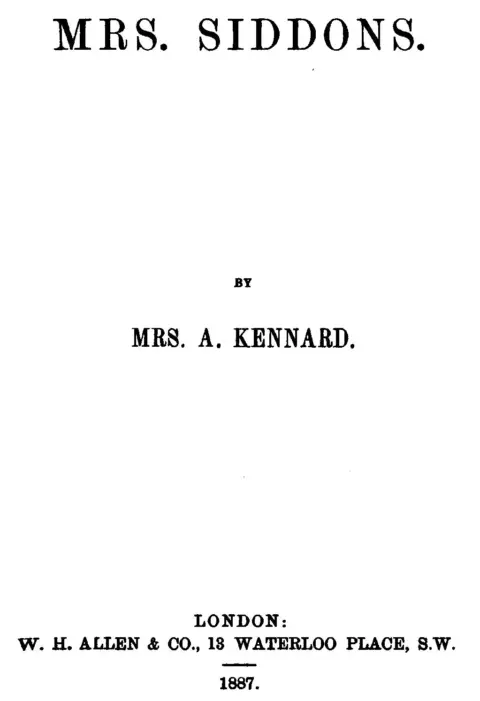
THE CLASSIC COLLECTION · 1887
"Mrs. Siddons" by Nina H. Kennard is a biographical account written in the late 19th century. The work focuses on the life and career of Sarah Siddons, a renowned actress known for her profound moral integrity and artistic achievements. The narrative is set against the backdrop of her rise from humble beginnings within a theatrical family to become one of the most celebrated figures in English theater. At the start of the biography, the author presents an overview of the historical and cultural context surrounding Mrs. Siddons's life. The opening chapters delve into her parentage and childhood, emphasizing the challenges faced by Sarah and her family as impoverished traveling actors in a society that often looked down on their profession. The text illustrates the rigors of their itinerant lifestyle while hinting at Sarah's emerging talents and strong character, suggesting the foundation upon which her later success would be built. The subsequent chapters promise to explore her years of hardship, love, and ultimate triumph in the world of theater, setting the stage for a captivating portrait of this remarkable woman.
Introduction adapted from the source catalogue; source summaries may be automatically generated.
Free to read · English · 78,042 words · No account needed
MAKE TIME FOR A GOOD BOOK
On by default. Untick to stop anonymous reading totals. Each page counts after 10 seconds in view. How this works.
Anonymous counting is on unless you have switched it off.
This electrified the parties in the green-room, who had not looked for such a flattering distinction for the young actress; but, of course, they were all too glad to follow Mrs. Siddons in anything, and Miss Mellon was overwhelmed with attention. Afterwards, on the return of Mrs. Siddons and Miss Mellon to their duties in London for the succeeding season, the former repeated the compliment she had paid her at Liverpool, making the same statement regarding her excellent conduct; and by thus bringing her forward under such advantageous circumstances, procured her admission to the first green-room, where her inferior salary did not entitle her to be, except on such a recommendation as that of Mrs. Siddons.
In the summer of 1790, being in delicate health, and disgusted at Sheridan’s treatment of her, she went with her husband to France, accompanied by Miss Wynn. They first stopped at Calais, where their daughters, Sarah and Maria, were at a boarding-school, and then went on to Lisle. The letter she wrote to Lady Harcourt on her return is so characteristic in its energetic, outspoken sincerity, that it seems unjust not to quote every word of it:—
“Sandgate, near Folkestone, Kent. August 2nd.
“After so long a silence, your good nature will exalt itself to hear a long letter full of egotism, and I will begin with Streatham, where you may remember to have heard me talk of going with no great degree of pleasurable expectation, supposing it impossible that I should ever feel much more for Mrs. P.[2] than admiration of her talents; but, after having very unexpectedly stayed there more than three weeks, during which time every moment gave me fresh instances of unremitting kindness and attention to me, and, indeed, a very extraordinary degree of benevolence and forbearance towards those who have not deserved much lenity at her hands (and it is wonderful how many there are of that description), I left them with great regret; and between their very great kindness, their wit, and their music, they made me love, esteem, and admire them very much. In a few days I set out with Mr. S., Miss Wynn, and her brother, for Calais, and, after a very rough passage, arrived at Calais, and found my dear girls quite well and improved in their persons, and (I am told) in their French. I was very much struck with the difference of objects and customs when I reflected how small a space divides one nation from the other, like true English. We saw all we could, and I thought of my dear Lord Harcourt, though not with him, in their churches. I own (though I blame myself at the same time for it) I was disgusted with all the pomp and magnificence of them, when I saw the priests ‘playing such fantastic tricks before high Heaven as (I think) must make the angels weep’; and the people gabbling over their prayers, even in the act of gaping, to have it over as quick as might be. Alas! said I to myself, in the pitifulness, and perhaps vanity, of my heart, how sorry I am for these poor deluded people, and how much more worthy the Deity (‘who does prefer before all temples the upright heart and pure’) are the sublime and simple forms of our religion. Indeed, my dear Madam, I am better satisfied with the ideas and feelings that have been excited in my heart in your garden at Nuneham, than ever I have been in those fine gewgaw places, and believe Mr. Haggitt, by his plain and sensible sermons, has done more good than a legion of these priests would do if they were to live to the age of Methusalem. I am willing to own that all this may be prejudice, and that we may not mean better than our neighbours; but fire shall not burn my opinion out of me, and so God mend all. Now, to turn to our great selves. We took our little folks to Lisle; it is a very fine town, and, though I know nothing of the language, the acting was so really good that it gave me very great pleasure. The language of true genius, like that of Nature, is intelligible to all. We stayed there a few days, and you would have laughed to have seen my amazement at the valet of the inn assisting the femme de chambre in the making of our beds. The beds are the best I ever slept upon; but the valet’s kind offices I could always, I think, dispense with, good heavens! Well, we returned to Calais, where I would have stayed a few months, and have employed myself in acquiring a few French phrases with the dear children, if Mrs. Temple would have taken me in; but she said she had not room to accommodate me, and I unwillingly gave up the point. In a day or two we set sail, after seeing the civic oath administered on the fourteenth. It was a fine thing even at Calais. I was extremely delighted and affected, not, indeed, at the sensible objects, though a great multitude is often a grand thing, but the idea of so many millions throughout that great nation, with one consent, at one moment (as it were by Divine Inspiration), breaking their bonds asunder, filled one with sympathetic exultation, good-will, and tenderness. I rejoiced with them from my heart, and most sincerely hope they will not abuse the glorious freedom they have obtained. We were nearly twenty hours on the sea on our return, and arrived at Dover fatigued and sick to death. Dr. Wynn was obliged to make the best of his way to London on account of a sermon he was engaged to preach, and took his charming sister with him. We made haste here, and it is the most agreeable sea-place, excepting those on the Devonshire coast, I ever saw. Perhaps agreeable is a bad word, for the country is much more sublime than beautiful. We have tremendous cliffs overhanging and frowning on the foaming sea, which is very often so saucy and tempestuous as to deserve frowning on; from whence, when the weather is clear, we see the land of France, and the vessels cross from the Downs to Calais. Sometimes, while you stand there, it is amazing with what velocity they skim along. Here are little neat lodgings, and good wholesome provisions. Perhaps they would not suit a great countess, as our friend Mr. Mason has it, but a little great actress is more easily accommodated. I’m afraid it will grow larger, though, and then adieu to the comforts of retirement. At present the place cannot contain above twenty or thirty strangers, I should think. I have bathed four times, and believe I shall persevere, for Sir Lucas Pepys says my disease is entirely nervous. I believe I am better, but I get on so slowly that I cannot speak as yet with much certainty. I still suffer a good deal. Mr. Siddons leaves me here for a fortnight while he goes to town upon business, and my spirits are so bad that I live in terror of being left alone so long. We have been here nearly three weeks, and I propose staying here, if possible, till September, when I shall go to town to my brother’s for some days, and then set off for Mr. Whalley’s at Bath. I shall hope to see you at Nuneham, though, before you leave it.
Your reading position is saved on this browser. Take it to another device with a library code. Reading pages adapt to text, rather than matching a printed edition.
BEHIND THE BOOK
This eBook is for the use of anyone anywhere in the United States and most other parts of the world at no cost and with almost no restrictions whatsoever. You may copy it, give it away or re-use it under the terms of the Project Gutenberg License included with this eBook or online at www.gutenberg.org. If you are not located in the United States, you will have to check the laws of the country where you are located before using this eBook. Read the source licence.
The original source file, including credits and licence, is retained by this library. Request an original-format copy at no charge. Please include the book title and Project Gutenberg identifier #66222.
KEEP YOUR CURIOSITY GOING
John L. Ransom

Herman W. Mudgett

Harriet Monroe
Daniel Dulany Addison
Charles Lanman

Harold Rosher