THE CLASSIC COLLECTION✦TensionCLASSIC FREE BOOKS
Tension
E. M. Delafield
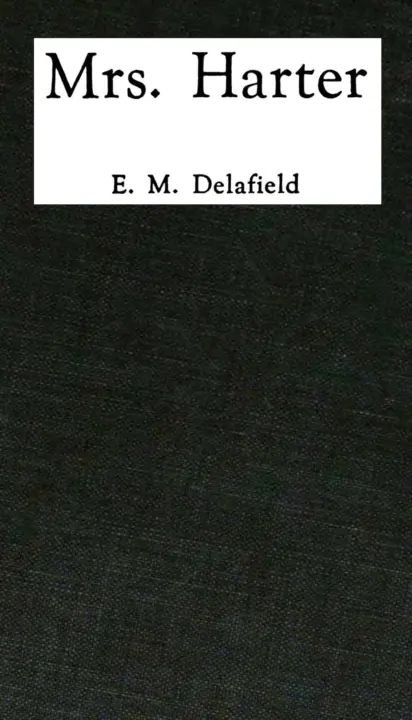
THE CLASSIC COLLECTION · 1925
"Mrs. Harter" by E. M. Delafield is a novel written in the early 20th century. The story revolves around the enigmatic character Diamond Harter, whose return to the quaint English town of Cross Loman stirs mixed recollections and intrigue among the locals. Through the eyes of those in the community, the narrative explores themes of perception, societal norms, and personal complexity, primarily focusing on Diamond's interactions with others, notably Captain Patch, a new acquaintance. At the start of the book, we are introduced to a reflective narrator, who grapples with the memories and impressions left by Mrs. Harter's presence alongside other town figures like Claire Ambrey and Nancy Fazackerly. The characters begin to reconstruct their thoughts surrounding Mrs. Harter, shedding light on their differing perceptions of her character, as well as introducing Captain Patch, who holds a unique interest in her. The atmosphere of Cross Loman, a seemingly tame yet layered community, rapidly comes alive as Diamond, with her assertive personality and past background, sets the stage for entangled relationships and social dynamics that will unfurl as the story progresses.
Introduction adapted from the source catalogue; source summaries may be automatically generated.
Free to read · English · 58,391 words · No account needed
MAKE TIME FOR A GOOD BOOK
On by default. Untick to stop anonymous reading totals. Each page counts after 10 seconds in view. How this works.
Anonymous counting is on unless you have switched it off.
The Kendal family applauded with a detached, deprecating air at the end of the song. “I may not know a great deal about music, but I know what I like,” Mumma remarked, as she has very frequently remarked on other occasions, and Puppa hummed something to himself, which I think he honestly believed to be a true and faithful repetition of the last line of Mrs. Harter’s song, and waved his head about from side to side in a musical sort of way.
The applause in the room was prolonged.
The song had been a very popular one, a modern sentimental ballad with all the sham values of its kind, and set to a tune that frankly was a tune, and could be trusted to “run in the heads” of those who heard it for hours after the concert was over. Mrs. Harter received an enthusiastic encore.
There was a whispered consultation between her and the accompanist, a youth who always plays at all Cross Loman concerts, and whom we look upon as being almost part of the piano.
To the surprise of everybody, and to the delight of a few, he struck up the air of “The Bluebells of Scotland.”
“‘Oh, where, tell me where, is your Highland laddie gone? Oh, where, tell me where, is your Highland laddie gone?’ ‘He’s gone with streaming banners where noble deeds are done, And it’s, oh! in my heart, I wish him safe at home.’”
The simplicity of the air was suited to Mrs. Harter’s clear voice, and she sang it without affectation.
“That’s more like,” Mrs. Fazackerly murmured to Captain Patch, who nodded emphatically. The accompanist was introducing an immense number of runs, variations, and repetitions of the well-known theme, between each of the verses. But while she was singing he subdued his accompaniment to the merest murmur:
“‘Oh, what, tell me what, if your Highland lad be slain? Oh, what, tell me what, if your Highland lad be slain?’ ‘Oh no! True love will be his guard and bring him safe again, For it’s, oh! my heart would break, if my Highland lad were slain.’”
The accompaniment ended in a torrent of notes, out of which the gallant, plaintive air emerged for the last time.
“I liked that,” said Claire, softly. Her eyes were tearful. Almost every tune that she knows very well indeed will bring tears to her eyes, by rousing associations with a past that she always rates higher than she does the present.
“She doesn’t look like the sort of person to sing that sort of song,” analyzed Sallie Ambrey. “She looks hard.”
“She looks unhappy,” said Mary.
Your reading position is saved on this browser. Take it to another device with a library code. Reading pages adapt to text, rather than matching a printed edition.
E. M. Delafield
E. M. Delafield
E. M. Delafield
E. M. Delafield
BEHIND THE BOOK
This eBook is for the use of anyone anywhere in the United States and most other parts of the world at no cost and with almost no restrictions whatsoever. You may copy it, give it away or re-use it under the terms of the Project Gutenberg License included with this eBook or online at www.gutenberg.org. If you are not located in the United States, you will have to check the laws of the country where you are located before using this eBook. Read the source licence.
The original source file, including credits and licence, is retained by this library. Request an original-format copy at no charge. Please include the book title and Project Gutenberg identifier #72945.
KEEP YOUR CURIOSITY GOING
Coulson Kernahan

Maurice Baring
Frances Wright
Cécile Tormay

Frederic Jesup Stimson

W. H. P. (William Henry Pope) Jarvis