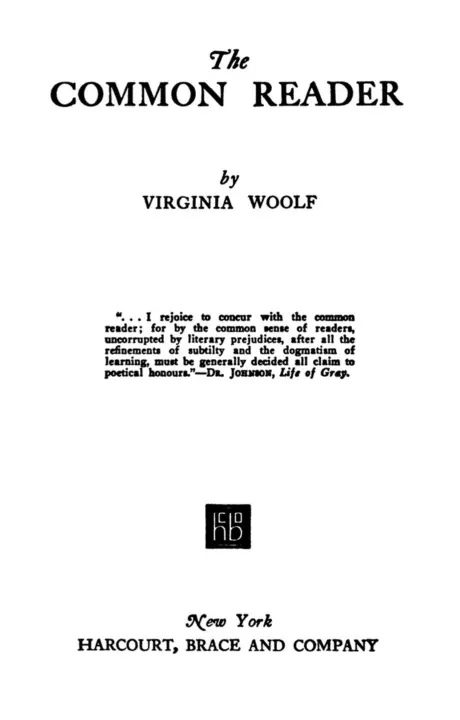
The Common Reader
Virginia Woolf
THE CLASSIC COLLECTION · 1925
"Mrs. Dalloway" by Virginia Woolf is a novel published in 1925. It follows a single day in the life of Clarissa Dalloway, an upper-class woman in post-World War I London, as she prepares to host an evening party. Through stream of consciousness narration, the story weaves between present moments and memories, exploring Clarissa's past relationships and choices. A parallel narrative follows Septimus Warren Smith, a war veteran struggling with trauma, whose fate will unexpectedly touch Clarissa's world by day's end.
Introduction adapted from the source catalogue; source summaries may be automatically generated.
Free to read · English · 64,104 words · No account needed
MAKE TIME FOR A GOOD BOOK
On by default. Untick to stop anonymous reading totals. Each page counts after 10 seconds in view. How this works.
Anonymous counting is on unless you have switched it off.
Now it was time to move, and, as a woman gathers her things together, her cloak, her gloves, her opera-glasses, and gets up to go out of the theatre into the street, she rose from the sofa and went to Peter.
And it was awfully strange, he thought, how she still had the power, as she came tinkling, rustling, still had the power as she came across the room, to make the moon, which he detested, rise at Bourton on the terrace in the summer sky.
“Tell me,” he said, seizing her by the shoulders. “Are you happy, Clarissa? Does Richard--”
The door opened.
“Here is my Elizabeth,” said Clarissa, emotionally, histrionically,
perhaps.
“How d’y do?” said Elizabeth coming forward.
The sound of Big Ben striking the half-hour struck out between them with extraordinary vigour, as if a young man, strong, indifferent, inconsiderate, were swinging dumb-bells this way and that.
“Hullo, Elizabeth!” cried Peter, stuffing his handkerchief into his pocket, going quickly to her, saying “Good-bye, Clarissa” without looking at her, leaving the room quickly, and running downstairs and opening the hall door.
“Peter! Peter!” cried Clarissa, following him out on to the landing. “My party to-night! Remember my party to-night!” she cried, having to raise her voice against the roar of the open air, and, overwhelmed by the traffic and the sound of all the clocks striking, her voice crying “Remember my party to-night!” sounded frail and thin and very far away as Peter Walsh shut the door.
Remember my party, remember my party, said Peter Walsh as he stepped down the street, speaking to himself rhythmically, in time with the flow of the sound, the direct downright sound of Big Ben striking the half-hour. (The leaden circles dissolved in the air.) Oh these parties, he thought; Clarissa’s parties. Why does she give these parties, he thought. Not that he blamed her or this effigy of a man in a tail-coat with a carnation in his buttonhole coming towards him. Only one person in the world could be as he was, in love. And there he was, this fortunate man, himself, reflected in the plate-glass window of a motor-car manufacturer in Victoria Street. All India lay behind him; plains, mountains; epidemics of cholera; a district twice as big as Ireland; decisions he had come to alone--he, Peter Walsh; who was now really for the first time in his life, in love. Clarissa had grown hard, he thought; and a trifle sentimental into the bargain, he suspected, looking at the great motor-cars capable of doing--how many miles on how many gallons? For he had a turn for mechanics; had invented a plough in his district, had ordered wheel-barrows from England, but the coolies wouldn’t use them, all of which Clarissa knew nothing whatever about.
Your reading position is saved on this browser. Take it to another device with a library code. Reading pages adapt to text, rather than matching a printed edition.
BEHIND THE BOOK
This eBook is for the use of anyone anywhere in the United States and most other parts of the world at no cost and with almost no restrictions whatsoever. You may copy it, give it away or re-use it under the terms of the Project Gutenberg License included with this eBook or online at www.gutenberg.org. If you are not located in the United States, you will have to check the laws of the country where you are located before using this eBook. Read the source licence.
The original source file, including credits and licence, is retained by this library. Request an original-format copy at no charge. Please include the book title and Project Gutenberg identifier #71865.
KEEP YOUR CURIOSITY GOING
Coulson Kernahan

Maurice Baring
Frances Wright
Cécile Tormay

Frederic Jesup Stimson

W. H. P. (William Henry Pope) Jarvis