THE CLASSIC COLLECTION✦Marsena, and Other Stories of the WartimeCLASSIC FREE BOOKS
Marsena, and Other Stories of the Wartime
Harold Frederic
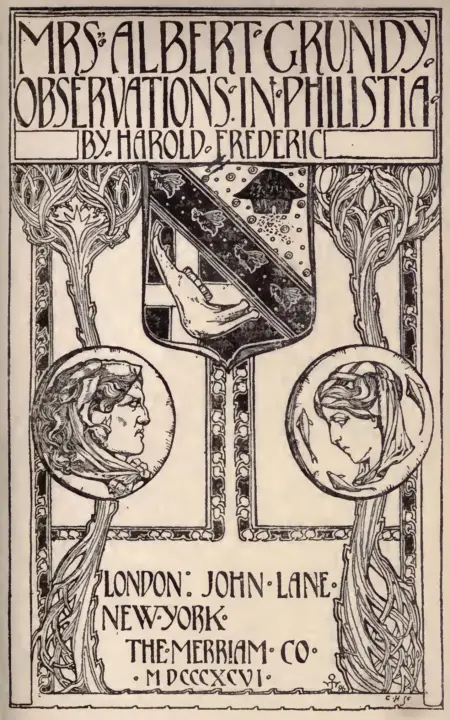
THE CLASSIC COLLECTION · 1896
"Mrs Albert Grundy—Observations in Philistia" by Harold Frederic is a fictional work likely written during the late 19th century. The narrative introduces Mrs. Albert Grundy, a social matron representing a satirical take on the standards and behaviors of the British middle class, particularly focusing on the themes of respectability and propriety within her domestic sphere. The story reflects on the paradoxes and contradictions inherent in societal norms and expectations, especially as they relate to gender and class. At the start of the story, we are presented with a glimpse into the life of Mrs. Grundy and her family in their home, "Fernbank." The opening details her preoccupation with maintaining a respectable household, her reluctance towards contemporary literature deemed inappropriate for her daughters, and her thoughts on a recent scandal surrounding a novel written by a controversial author. The narrative relocates to a dinner party with various guests, revealing a tension between social aspirations and the mundane realities of life, showcasing the trivialities of societal interactions and the intricacies of personal relationships. This opening serves to establish the tone of satire, hinting at deeper commentaries on the moral fabric of society as seen through the lens of a concerned mother and community figure.
Introduction adapted from the source catalogue; source summaries may be automatically generated.
Free to read · English · 27,370 words · No account needed
MAKE TIME FOR A GOOD BOOK
On by default. Untick to stop anonymous reading totals. Each page counts after 10 seconds in view. How this works.
Anonymous counting is on unless you have switched it off.
The telegraph man stared coldly at my luckless despatch, and then at me. “You would wish to state to your friend, perhaps,” he suggested, “that they seem as if they had been coloured with red, owing to the change in the leaves.”
“No, no,” I put in. “It must be that they have been painted, are painted, or he will not me understand.”
“But, my good sir,” retorted the operator with emphasis, “they are not painted! From the door gaze you forth! What make you with this nonsense, that Brocken and vicinity are red painted?”
“Well, then,” I said wearily, oppressed by the magnitude of the task, “I don’t know how to word it myself, but you can fix it for me. Just say that I am going to paint them red--that will do just as well.
“But you shall not! It is forbidden!” exclaimed the official, holding himself like a poker, and glaring vehemence through his glasses. “It is strongly forbidden! When you one brush-mark shall make, quick to the prison go you. In Germany have we for natural beauty respect--also laws.”
Reluctantly, but of necessity, I abandoned metaphor, and in a humble spirit telegraphed in English to Uncle Dudley at his club that I was very glad. Even as my pen clung in irresolution on the paper over this word “glad,” the impulse rose in me to add: “Tired of Harz. Am returning immediately.”
“When the same here is,” remarked the operator, moodily studying the unknown words, “in Brunswick stopped it will be.”
I translated it for him, and added, “I go from here home, to be where officials their own business mind.”
He nodded, not unamiably, and replied as he handed me out my change: “Yes, I know: England. So well their own business there officials mind, that Balfour to Argentina easily comes.”
Walking up the hillside again, already quite captive to the fascination of the morrow’s homeward flight, I met at the turn of the path a family party--father, mother, and two girls in the younger teens--seated along the rocky siding, and gazing with a common air of dejection upon a portentous row of bags and portmanteaus at their feet. The notion that they were Hamburgers died still-born. Nothing more obviously un-German than these wayfarers was ever seen.
“I hope, sir,” the man spoke up as I approached, “that I am right in presuming that you speak English!”
I bowed assent, and even as I did so, recognised him. “I hope I am right,” I answered, “in thinking that I have met you before--at Mr Albert Grundy’s in London--you are the American gentleman with the Oboid Oil Engine, are you not?”
Your reading position is saved on this browser. Take it to another device with a library code. Reading pages adapt to text, rather than matching a printed edition.
Harold Frederic
Harold Frederic
Harold Frederic
Harold Frederic
BEHIND THE BOOK
This eBook is for the use of anyone anywhere in the United States and most other parts of the world at no cost and with almost no restrictions whatsoever. You may copy it, give it away or re-use it under the terms of the Project Gutenberg License included with this eBook or online at www.gutenberg.org. If you are not located in the United States, you will have to check the laws of the country where you are located before using this eBook. Read the source licence.
The original source file, including credits and licence, is retained by this library. Request an original-format copy at no charge. Please include the book title and Project Gutenberg identifier #50496.
KEEP YOUR CURIOSITY GOING
Cécile Tormay

Moritz Busch
Coulson Kernahan
John L. Ransom

Maurice Baring
Frances Wright