THE CLASSIC COLLECTION✦Marsena, and Other Stories of the WartimeCLASSIC FREE BOOKS
Marsena, and Other Stories of the Wartime
Harold Frederic
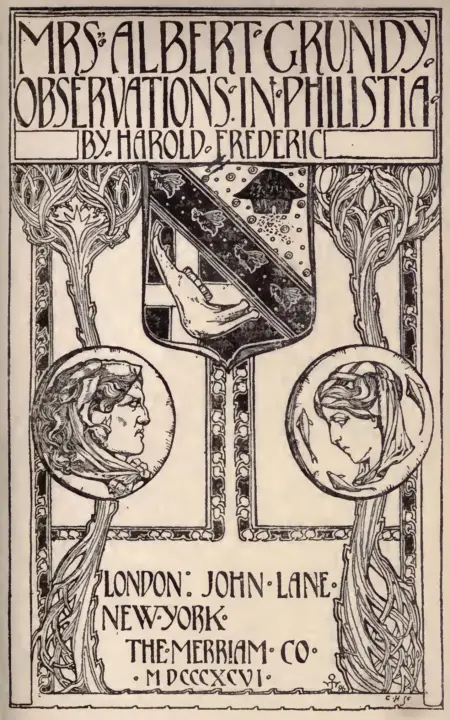
THE CLASSIC COLLECTION · 1896
"Mrs Albert Grundy—Observations in Philistia" by Harold Frederic is a fictional work likely written during the late 19th century. The narrative introduces Mrs. Albert Grundy, a social matron representing a satirical take on the standards and behaviors of the British middle class, particularly focusing on the themes of respectability and propriety within her domestic sphere. The story reflects on the paradoxes and contradictions inherent in societal norms and expectations, especially as they relate to gender and class. At the start of the story, we are presented with a glimpse into the life of Mrs. Grundy and her family in their home, "Fernbank." The opening details her preoccupation with maintaining a respectable household, her reluctance towards contemporary literature deemed inappropriate for her daughters, and her thoughts on a recent scandal surrounding a novel written by a controversial author. The narrative relocates to a dinner party with various guests, revealing a tension between social aspirations and the mundane realities of life, showcasing the trivialities of societal interactions and the intricacies of personal relationships. This opening serves to establish the tone of satire, hinting at deeper commentaries on the moral fabric of society as seen through the lens of a concerned mother and community figure.
Introduction adapted from the source catalogue; source summaries may be automatically generated.
Free to read · English · 27,370 words · No account needed
MAKE TIME FOR A GOOD BOOK
On by default. Untick to stop anonymous reading totals. Each page counts after 10 seconds in view. How this works.
Anonymous counting is on unless you have switched it off.
The consoling suggestion that soon the necessity of giving home-dinners to the directors in her husband’s companies would have ended, and that then a few weeks out of London, away somewhere in the air of the mountains or the sea, would bring back all her wonted strength and spirits, did no good. She shook her head and sighed again.
“No,” she said, “it isn’t physical. That is to say, it is physical, but the cause is mental. It is over-worry.”
“Of all people on earth--you!” I replied reproachfully. “Why think of it--a husband who is the dream of docile propriety, a competency broadening each year into a fortune, a home like this, such servants, such appointments, such a circle of admiring friends--and then your daughters! Why, to be the mother of such a girl as Ermyntrude-------”
“Precisely,” interrupted Mrs Albert. “To be the mother of such a girl, as you say. Little you know what it really means! But, no--I know what you were going to say--please don’t! it is too sad a subject.”
I could do nothing but feebly strive to look my surprise. To think
of sadness connected with tall, handsome, good-hearted Ermie, was
impossible.
“You think I am exaggerating, I know,” Mrs Albert went on. “Ah, you do
not know!”
“Nothing could be more evident,” I replied, “than that I don’t know. I can’t even imagine what on earth you are driving at.”
Mrs Albert paused for a moment, and pushed the toe of her wee slipper meditatively back and forth on the figure of the carpet.
“Yes, I will tell you,” she said at last. “You are such an old friend of the family that you are almost one of us. And besides, you are always sympathetic--so different from Dudley. Well, the point is this. You know the young man--Sir Watkyn’s son--Mr Eustace Hump.”
“I have met him here,” I assented.
“Well, I doubt if you will meet him here any more,” Mrs Albert said,
impressively.
“The deprivation shall not drive me to despair or drink,” I assured her. “I will watch over myself.”
“I dare say you did not care much for him,” said Mrs Albert. “I know Dudley didn’t. But, all the same, he was eligible. He is an only son, and his father is a Baronet--an hereditary title--and they are rolling in wealth. And Eustace himself, when you get to know him, has some very admirable qualities. You know he writes!”
“I have heard him say so,” I responded, perhaps not over graciously.
Your reading position is saved on this browser. Take it to another device with a library code. Reading pages adapt to text, rather than matching a printed edition.
Harold Frederic
Harold Frederic
Harold Frederic
Harold Frederic
BEHIND THE BOOK
This eBook is for the use of anyone anywhere in the United States and most other parts of the world at no cost and with almost no restrictions whatsoever. You may copy it, give it away or re-use it under the terms of the Project Gutenberg License included with this eBook or online at www.gutenberg.org. If you are not located in the United States, you will have to check the laws of the country where you are located before using this eBook. Read the source licence.
The original source file, including credits and licence, is retained by this library. Request an original-format copy at no charge. Please include the book title and Project Gutenberg identifier #50496.
KEEP YOUR CURIOSITY GOING
Cécile Tormay

Moritz Busch
Coulson Kernahan
John L. Ransom

Maurice Baring
Frances Wright