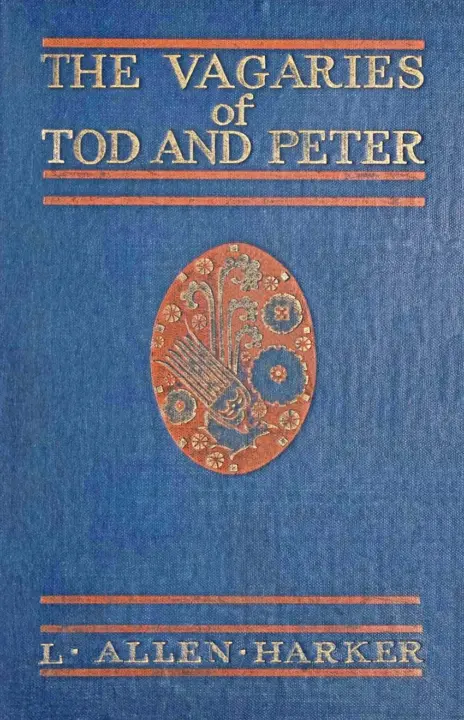
The Vagaries of Tod and Peter
L. Allen (Lizzie Allen) Harker
THE CLASSIC COLLECTION · 1912
"Mr. Wycherly's Wards" by L. Allen Harker is a novel written in the early 20th century. The story revolves around Mr. Wycherly, who takes guardianship of two boys, Edmund and Montagu, after the death of their aunt, Miss Esperance. The novel explores the challenges and humorous situations that arise as Mr. Wycherly relocates to Oxford and attempts to manage life with his wards, while grappling with the expectations of society and their new living conditions. The opening of the novel introduces Mr. Wycherly's sudden decision to move to Oxford, driven by a desire to create a comforting environment for the boys after their aunt's passing. As he settles into a quirky old house, the chaos of their new living situation becomes apparent when he realizes that they lack a capable servant. The boys, each with distinct personalities, are depicted as lively companions who readily adapt to their new home, and they playfully interact with their guardian as they adjust to their new lives. This initial chapter sets the stage for a mix of humor and heartfelt moments as the family dynamics unfold in their new environment.
Introduction adapted from the source catalogue; source summaries may be automatically generated.
Free to read · English · 65,838 words · No account needed
MAKE TIME FOR A GOOD BOOK
On by default. Untick to stop anonymous reading totals. Each page counts after 10 seconds in view. How this works.
Anonymous counting is on unless you have switched it off.
And Jane-Anne came in with a nervous rush, but she did not forget to
shut the door behind her.
She dropped on her knees beside him and seized his hand, kissing it passionately, much to his confusion. He was quite unaccustomed to violent manifestations of feeling, and his long residence in Scotland had increased his natural reserve.
"I know it's you who managed that I shouldn't go back, and I do want so to thank you. You don't know what I feel like. Please, sir, I will try to be useful. Anything you would like me to do----"
Very gently Mr. Wycherly withdrew his hand. "Suppose you sit on a chair," he suggested, "and we will have a chat together."
With stately courtesy, he placed a chair for Jane-Anne, and, seated again in his own revolving-chair, turned to face her.
As always, when much moved, she was very white, and to-night her great eyes were soft and dog-like in their devotion.
"By the way," said Mr. Wycherly, "I haven't forgotten your inquiry about the poem that you cannot remember, and I have marked in a volume of Wordsworth a number of verses dealing with mountains. Perhaps you would like to look through it at your leisure."
"Thank you, sir," Jane-Anne whispered.
"I know nothing," Mr. Wycherly continued, "more annoying than a half-remembered quotation. I sincerely hope that you will soon find it."
For a moment there was silence, then:
"Sir," Jane-Anne said earnestly, "are you very lonely now the young gentlemen have gone back to school?"
"I do miss them greatly of course."
"Do you remember, sir, when you came to see me, when I was in bed the first day I was here, you said when they went back that the sun set for you----"
"Did I?" said Mr. Wycherly, rather surprised at himself.
"You really did, sir, and I wondered whether--though the sun has set--whether you'd let me try--to be a little tiny star--just so you wouldn't feel quite so lonely."
Mr. Wycherly's hand still tingled with the touch of those soft unaccustomed girlish lips, nevertheless he held it out to her, saying, "That will be very kind of you."
Jane-Anne placed her own within it and she did not attempt to kiss Mr. Wycherly's hand again, but she looked at him as though she would read his very soul and asked: "Sir, have you ever heard anything about a place called Greece?"
Mr. Wycherly laughed. "For a considerable portion of my life," he replied, "I have heard about little else."
"Will you tell me things sometimes, sir? Will you?"
Your reading position is saved on this browser. Take it to another device with a library code. Reading pages adapt to text, rather than matching a printed edition.
L. Allen (Lizzie Allen) Harker
L. Allen (Lizzie Allen) Harker
L. Allen (Lizzie Allen) Harker
L. Allen (Lizzie Allen) Harker
BEHIND THE BOOK
This eBook is for the use of anyone anywhere in the United States and most other parts of the world at no cost and with almost no restrictions whatsoever. You may copy it, give it away or re-use it under the terms of the Project Gutenberg License included with this eBook or online at www.gutenberg.org. If you are not located in the United States, you will have to check the laws of the country where you are located before using this eBook. Read the source licence.
The original source file, including credits and licence, is retained by this library. Request an original-format copy at no charge. Please include the book title and Project Gutenberg identifier #54418.
KEEP YOUR CURIOSITY GOING
Coulson Kernahan

Maurice Baring
Frances Wright
Cécile Tormay

Frederic Jesup Stimson

W. H. P. (William Henry Pope) Jarvis