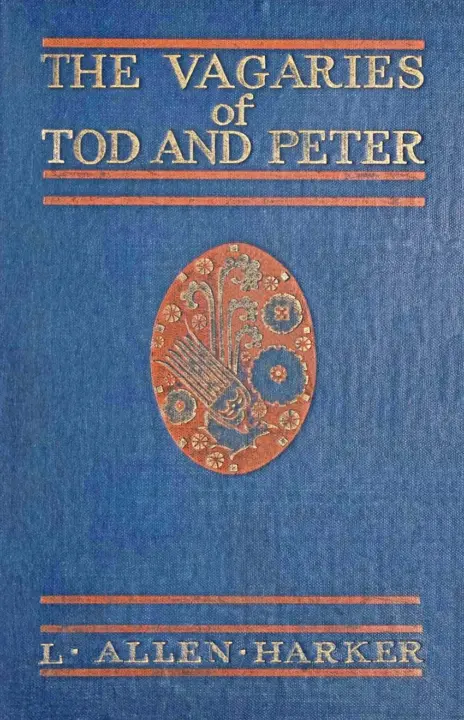
The Vagaries of Tod and Peter
L. Allen (Lizzie Allen) Harker
THE CLASSIC COLLECTION · 1912
"Mr. Wycherly's Wards" by L. Allen Harker is a novel written in the early 20th century. The story revolves around Mr. Wycherly, who takes guardianship of two boys, Edmund and Montagu, after the death of their aunt, Miss Esperance. The novel explores the challenges and humorous situations that arise as Mr. Wycherly relocates to Oxford and attempts to manage life with his wards, while grappling with the expectations of society and their new living conditions. The opening of the novel introduces Mr. Wycherly's sudden decision to move to Oxford, driven by a desire to create a comforting environment for the boys after their aunt's passing. As he settles into a quirky old house, the chaos of their new living situation becomes apparent when he realizes that they lack a capable servant. The boys, each with distinct personalities, are depicted as lively companions who readily adapt to their new home, and they playfully interact with their guardian as they adjust to their new lives. This initial chapter sets the stage for a mix of humor and heartfelt moments as the family dynamics unfold in their new environment.
Introduction adapted from the source catalogue; source summaries may be automatically generated.
Free to read · English · 65,838 words · No account needed
MAKE TIME FOR A GOOD BOOK
On by default. Untick to stop anonymous reading totals. Each page counts after 10 seconds in view. How this works.
Anonymous counting is on unless you have switched it off.
Mr. Wycherly took a handful of silver out of his pocket and abstracted this sum and laid it upon the desk. She of the ledger ignored the offering and continued her cross-examination:
"What wages?"
Mr. Wycherly mentally invoked a blessing upon Lady Alicia's practical head as he replied quite glibly, "From twenty to twenty-five pounds, but she must be trustworthy and capable."
"What outings?"
Here was a poser! But the fighting spirit had been roused in Mr. Wycherly. He would not be browbeaten by this stout, ungracious person who took his eighteenpence, and so far had done nothing but ask questions, affording him no information whatsoever.
"That," he retorted with dignity, "can be arranged later on."
"Your name and address?" was the next query, and when he furnished this information, carefully spelling his name, it pained him inexpressibly to note that she wrote it down as "Witcherby," at the same time remarking in a rumbling tone indicative of displeasure, "Very old 'ouses, most inconvenient, most trying stairs.... 'Ow soon do you want a general?"
"A what?" asked Mr. Wycherly, this time thoroughly mystified.
"A general, that's what she is if there's no more kep'. You won't get no cook-'ousekeeper unless she's to 'ave 'er meals along with you, and a little girl to do the rough work."
"She can't possibly have her meals with me," cried Mr. Wycherly, crimson at the very thought. "It would be most unpleasant--for both of us."
"Then as I said it's a general you wants."
"And have you upon your books any staid and respectable young woman--preferably an orphan--" Mr. Wycherly interpolated, remembering Montagu's suggestion, "who could come to us at once?"
"Not, so to speak, to-day, I 'aven't; but they often comes in of a Monday, and I'll let you know. I could send 'er along; it isn't far."
The ledger was shut with a bang as an intimation that the interview was at an end, and Mr. Wycherly fared forth into the street with heated brow and a sense that, in spite of his heroism in braving so dreadful a person, he was not much further on his quest. "Monday, she said," he kept repeating to himself, "and to-day is only Thursday."
When he got back to Holywell, the boys were standing at the front door on the lookout for him. They rushed towards him exclaiming in delighted chorus: "We've got a woman. We thought we'd ask at the King's Arms, and they told us of one."
"What? A servant?" asked Mr. Wycherly with incredulous joy.
"No, no, a day-body. The boots knew about her; she lives down Hell
Lane, just about opposite."
Your reading position is saved on this browser. Take it to another device with a library code. Reading pages adapt to text, rather than matching a printed edition.
L. Allen (Lizzie Allen) Harker
L. Allen (Lizzie Allen) Harker
L. Allen (Lizzie Allen) Harker
L. Allen (Lizzie Allen) Harker
BEHIND THE BOOK
This eBook is for the use of anyone anywhere in the United States and most other parts of the world at no cost and with almost no restrictions whatsoever. You may copy it, give it away or re-use it under the terms of the Project Gutenberg License included with this eBook or online at www.gutenberg.org. If you are not located in the United States, you will have to check the laws of the country where you are located before using this eBook. Read the source licence.
The original source file, including credits and licence, is retained by this library. Request an original-format copy at no charge. Please include the book title and Project Gutenberg identifier #54418.
KEEP YOUR CURIOSITY GOING
Coulson Kernahan

Maurice Baring
Frances Wright
Cécile Tormay

Frederic Jesup Stimson

W. H. P. (William Henry Pope) Jarvis