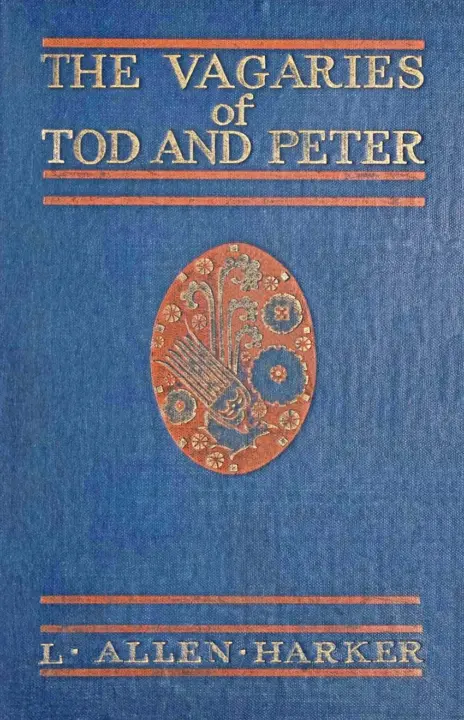
The Vagaries of Tod and Peter
L. Allen (Lizzie Allen) Harker
THE CLASSIC COLLECTION · 1912
"Mr. Wycherly's Wards" by L. Allen Harker is a novel written in the early 20th century. The story revolves around Mr. Wycherly, who takes guardianship of two boys, Edmund and Montagu, after the death of their aunt, Miss Esperance. The novel explores the challenges and humorous situations that arise as Mr. Wycherly relocates to Oxford and attempts to manage life with his wards, while grappling with the expectations of society and their new living conditions. The opening of the novel introduces Mr. Wycherly's sudden decision to move to Oxford, driven by a desire to create a comforting environment for the boys after their aunt's passing. As he settles into a quirky old house, the chaos of their new living situation becomes apparent when he realizes that they lack a capable servant. The boys, each with distinct personalities, are depicted as lively companions who readily adapt to their new home, and they playfully interact with their guardian as they adjust to their new lives. This initial chapter sets the stage for a mix of humor and heartfelt moments as the family dynamics unfold in their new environment.
Introduction adapted from the source catalogue; source summaries may be automatically generated.
Free to read · English · 65,838 words · No account needed
MAKE TIME FOR A GOOD BOOK
On by default. Untick to stop anonymous reading totals. Each page counts after 10 seconds in view. How this works.
Anonymous counting is on unless you have switched it off.
"Now I," interposed Edmund, who had looked on with astounded disapprobation at this display of sentiment, "I should loathe and abominate anyone who kissed me and I should try to forget it as soon as ever I could."
"So should I," Montagu agreed, "rather--but I suppose girls are
different."
"Course they are," Herrick chimed in; "quite different and much better and more precious. Daddie says so."
This point of view did not appeal to the boys.
"I don't know about 'precious,'" Edmund said scornfully. "It depends what you mean by precious."
"I'm precious," Herrick explained, "very, very precious. That's why
they were so afraid they'd lost me this morning, 'cause I'm so
precious."
"I'm not," said Jane-Anne. "Female orphans never are so far as I can make out, but I'd like to be. Oh, it would be lovelly!"
Herrick had been staring hard at Jane-Anne for some minutes and at last could contain herself no longer.
"Why," she demanded, "do you wear such a funny hat? Do you like it?"
"Why d'you wear no hat at all?" Montagu interposed, vaguely aware that Herrick's question was not tactful.
"I wear a bonnet generally," Herrick remarked with dignity, "but I came out without it this morning 'cause they were in such a hurry. D'you like my smock?" she asked, turning to Jane-Anne. "Mummy made it."
"I like everything about you," Jane-Anne answered, with commendable enthusiasm. "I think you're a dear darling, and I hate all my clothes, but I can't go about without any because people would stare, beside it's generally too cold." And though the sun was shining hot on the lawn, Jane-Anne shivered.
Montagu looked at his watch.
"We'll have to go and get ready," he said. "We're all going on the river this morning--they're going away this afternoon--and I promised to take her back to the hotel at half-past ten to have her face washed. I wish you were coming too," he added kindly, "but it's not our party."
"Good-bye, little girl," said Herrick, "and I hope you'll soon have a nicer hat, a really pretty one." And again Herrick kissed Jane-Anne.
"I'll let you out at the garden door," said Edmund, "then we shan't run
into Mrs. Dew."
Quite silently Jane-Anne followed him to the end of the garden where there was a door in the wall. It was seldom used and the key was stiff, but by great efforts with both hands, Edmund managed to turn it.
"Come again, soon," he said hospitably, "and we'll have some more
cricket."
Your reading position is saved on this browser. Take it to another device with a library code. Reading pages adapt to text, rather than matching a printed edition.
L. Allen (Lizzie Allen) Harker
L. Allen (Lizzie Allen) Harker
L. Allen (Lizzie Allen) Harker
L. Allen (Lizzie Allen) Harker
BEHIND THE BOOK
This eBook is for the use of anyone anywhere in the United States and most other parts of the world at no cost and with almost no restrictions whatsoever. You may copy it, give it away or re-use it under the terms of the Project Gutenberg License included with this eBook or online at www.gutenberg.org. If you are not located in the United States, you will have to check the laws of the country where you are located before using this eBook. Read the source licence.
The original source file, including credits and licence, is retained by this library. Request an original-format copy at no charge. Please include the book title and Project Gutenberg identifier #54418.
KEEP YOUR CURIOSITY GOING
Coulson Kernahan

Maurice Baring
Frances Wright
Cécile Tormay

Frederic Jesup Stimson

W. H. P. (William Henry Pope) Jarvis