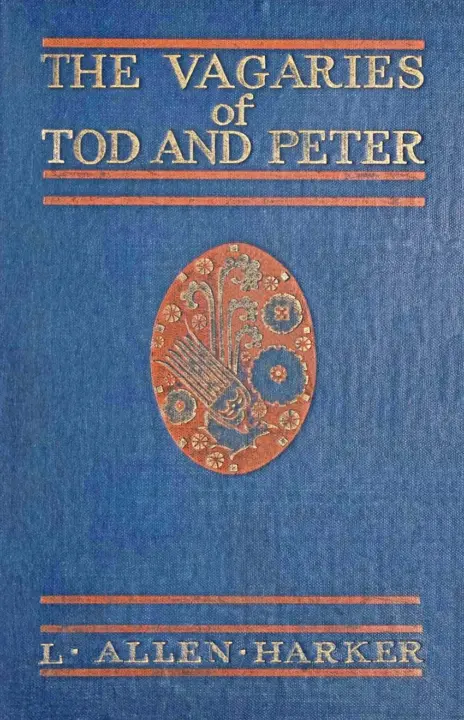
The Vagaries of Tod and Peter
L. Allen (Lizzie Allen) Harker
THE CLASSIC COLLECTION · 1912
"Mr. Wycherly's Wards" by L. Allen Harker is a novel written in the early 20th century. The story revolves around Mr. Wycherly, who takes guardianship of two boys, Edmund and Montagu, after the death of their aunt, Miss Esperance. The novel explores the challenges and humorous situations that arise as Mr. Wycherly relocates to Oxford and attempts to manage life with his wards, while grappling with the expectations of society and their new living conditions. The opening of the novel introduces Mr. Wycherly's sudden decision to move to Oxford, driven by a desire to create a comforting environment for the boys after their aunt's passing. As he settles into a quirky old house, the chaos of their new living situation becomes apparent when he realizes that they lack a capable servant. The boys, each with distinct personalities, are depicted as lively companions who readily adapt to their new home, and they playfully interact with their guardian as they adjust to their new lives. This initial chapter sets the stage for a mix of humor and heartfelt moments as the family dynamics unfold in their new environment.
Introduction adapted from the source catalogue; source summaries may be automatically generated.
Free to read · English · 65,838 words · No account needed
MAKE TIME FOR A GOOD BOOK
On by default. Untick to stop anonymous reading totals. Each page counts after 10 seconds in view. How this works.
Anonymous counting is on unless you have switched it off.
Mr. Wycherly, who was shaving, dropped his razor and turned a soapy and astonished countenance towards Montagu, exclaiming, "What! al----!" when he hastily changed his remark to: "They've come to breakfast with us, have they? How exceedingly kind and friendly; run down at once and ask Mrs. Dew to lay three more places."
Herrick staring at Edmund, heard this and said slowly: "They don't
generally lay for them."
"What?" cried Edmund, immensely interested. "Don't you have plates and
knives and things?"
"I do," said Herrick; "at least not knives 'cept a silver one, but they never do. They will be pleased."
"But do you mean to tell me," Edmund exclaimed, appalled at the eccentricity of the Wycherly menage as revealed by their daughter, "that they eat things right off the cloth? Whatever do they do when there's gravy?"
"They never has gravy, poor dears," said Herrick sadly.
Edmund sighed. As old Elsa would have said, it was "ayont him"; and they both looked so nice too. It was impossible to imagine Mr. and Mrs. Wycherly gnawing cutlets without so much as a plate between them. He got into his waistcoat and jacket in thoughtful silence. Montagu, who had not paid any attention to these astonishing revelations, being filled with hospitable concern as to whether there would be sufficient bacon and eggs for three extra persons, gave his hair one final thump with the brush and prepared to go downstairs.
"Stop!" cried Edmund; "you haven't said your prayers; hurry up!" Both boys knelt down by the bed, side by side, while Herrick watched their bowed heads with solemn interest.
"Why don't you begin?" she asked impatiently after a minute's silence.
"I've done," Edmund announced cheerfully, arising from his knees, when Montagu followed suit and rushed downstairs.
"But you didn't say anything."
"We don't say prayers out loud. It's only very little children say them
out loud."
"Oh!" she said, as though suddenly enlightened. "Umpy dear says his very loud, but Mr. Woolykneeze looks into his hat like a grown-up genpleman; you can't hear a fing."
"But," Edmund objected, "one hasn't always got a hat in the morning," and opening Mr. Wycherly's door a very little, he called through: "I say, Guardie, do you always say your prayers into a hat?"
"Really, Edmund," said poor Mr. Wycherly, much perturbed by this second interruption, "I do so dislike doors being opened while I am shaving, especially when as in this instance----"
Edmund banged the door.
"I'm sure he doesn't," he said confidently. "He can't, for his hat's downstairs. P'raps that Mr. What's-is-name you mentioned has a special kind."
"Mr. Woolykneeze has hundreds of hats," Herrick announced magnificently.
Your reading position is saved on this browser. Take it to another device with a library code. Reading pages adapt to text, rather than matching a printed edition.
L. Allen (Lizzie Allen) Harker
L. Allen (Lizzie Allen) Harker
L. Allen (Lizzie Allen) Harker
L. Allen (Lizzie Allen) Harker
BEHIND THE BOOK
This eBook is for the use of anyone anywhere in the United States and most other parts of the world at no cost and with almost no restrictions whatsoever. You may copy it, give it away or re-use it under the terms of the Project Gutenberg License included with this eBook or online at www.gutenberg.org. If you are not located in the United States, you will have to check the laws of the country where you are located before using this eBook. Read the source licence.
The original source file, including credits and licence, is retained by this library. Request an original-format copy at no charge. Please include the book title and Project Gutenberg identifier #54418.
KEEP YOUR CURIOSITY GOING
Coulson Kernahan

Maurice Baring
Frances Wright
Cécile Tormay

Frederic Jesup Stimson

W. H. P. (William Henry Pope) Jarvis