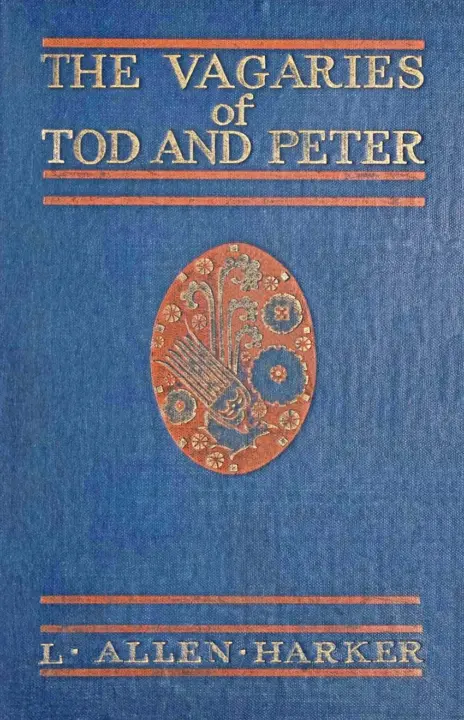
The Vagaries of Tod and Peter
L. Allen (Lizzie Allen) Harker
THE CLASSIC COLLECTION · 1912
"Mr. Wycherly's Wards" by L. Allen Harker is a novel written in the early 20th century. The story revolves around Mr. Wycherly, who takes guardianship of two boys, Edmund and Montagu, after the death of their aunt, Miss Esperance. The novel explores the challenges and humorous situations that arise as Mr. Wycherly relocates to Oxford and attempts to manage life with his wards, while grappling with the expectations of society and their new living conditions. The opening of the novel introduces Mr. Wycherly's sudden decision to move to Oxford, driven by a desire to create a comforting environment for the boys after their aunt's passing. As he settles into a quirky old house, the chaos of their new living situation becomes apparent when he realizes that they lack a capable servant. The boys, each with distinct personalities, are depicted as lively companions who readily adapt to their new home, and they playfully interact with their guardian as they adjust to their new lives. This initial chapter sets the stage for a mix of humor and heartfelt moments as the family dynamics unfold in their new environment.
Introduction adapted from the source catalogue; source summaries may be automatically generated.
Free to read · English · 65,838 words · No account needed
MAKE TIME FOR A GOOD BOOK
On by default. Untick to stop anonymous reading totals. Each page counts after 10 seconds in view. How this works.
Anonymous counting is on unless you have switched it off.
The pale face under the shadow of the inverted pie-dish was odd and arresting. The eyes, long-lashed and brilliant, were really brown eyes, almost the colour of old, dark sherry; deep-set under delicately pencilled, very black eyebrows. Her mouth was rather large with well-cut full red lips and strong even white teeth; but her face was painfully thin, the cheeks so hollow and the chin so sharp that her eyes dominated everything, were out of proportion, and imparted to the beholder an uncomfortable sense of tragedy and gloom almost painful--until she smiled. Then the slumbering fire in the great eyes was quenched and they looked peaceful and pleasant as clear brown water under sunshine in a Devonshire trout stream.
"Hadn't you better come in and wait for your aunt?" Edmund suggested. "If you go back now you're certain to miss her."
"May I?" asked the little girl, smiling all over her face. "May I? I
hope aunt won't mind."
"Come in," said Edmund, and shut the door.
The side-door opened straight into the scullery; then came the kitchen, large, orderly, and comfortable; opening out of that was a housekeeper's room not yet completely furnished. Edmund led his guest through these apartments and across a narrow passage to the dining-room where Montagu was sitting on the floor fastening on his pads.
"Here's Mrs. Dew's niece!" Edmund announced. "This is Montagu," he continued. "What's your name? We can't call you Mrs. Dew's niece all the time."
Montagu arose from the floor and shook hands in solemn silence after the
manner of boys.
"My name's Jane-Anne, please, sir," said the little girl.
"My name's Edmund, please, miss," that youth remarked, grinning broadly.
Jane-Anne looked surprised. She saw nothing unusual in her mode of
address.
For a minute the three stood and stared at each other.
"Would you like," Edmund asked in tones of honeyed politeness, "to see me bowl to him? I was just going to when you came."
"Please, sir," said Jane-Anne with commendable alacrity, "I should like
it very much."
"Perhaps," Montagu suggested, though not over hopefully, "you'd like to
field."
"Field," repeated Jane-Anne; "what's that?"
"Run after the ball when he hits it, and throw it back to me," Edmund
explained.
"Oh, I could do that--do let me--it would be lovelly."
"Oh, you shall field as much as you like," Edmund promised graciously, and they all went into the garden.
Your reading position is saved on this browser. Take it to another device with a library code. Reading pages adapt to text, rather than matching a printed edition.
L. Allen (Lizzie Allen) Harker
L. Allen (Lizzie Allen) Harker
L. Allen (Lizzie Allen) Harker
L. Allen (Lizzie Allen) Harker
BEHIND THE BOOK
This eBook is for the use of anyone anywhere in the United States and most other parts of the world at no cost and with almost no restrictions whatsoever. You may copy it, give it away or re-use it under the terms of the Project Gutenberg License included with this eBook or online at www.gutenberg.org. If you are not located in the United States, you will have to check the laws of the country where you are located before using this eBook. Read the source licence.
The original source file, including credits and licence, is retained by this library. Request an original-format copy at no charge. Please include the book title and Project Gutenberg identifier #54418.
KEEP YOUR CURIOSITY GOING
Coulson Kernahan

Maurice Baring
Frances Wright
Cécile Tormay

Frederic Jesup Stimson

W. H. P. (William Henry Pope) Jarvis