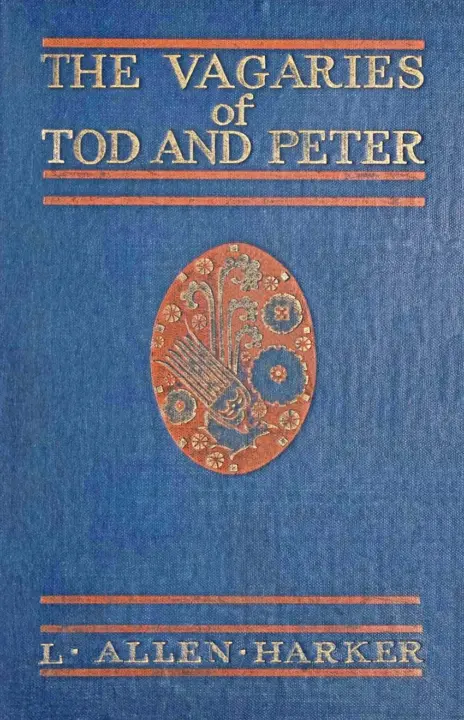
The Vagaries of Tod and Peter
L. Allen (Lizzie Allen) Harker
THE CLASSIC COLLECTION · 1912
"Mr. Wycherly's Wards" by L. Allen Harker is a novel written in the early 20th century. The story revolves around Mr. Wycherly, who takes guardianship of two boys, Edmund and Montagu, after the death of their aunt, Miss Esperance. The novel explores the challenges and humorous situations that arise as Mr. Wycherly relocates to Oxford and attempts to manage life with his wards, while grappling with the expectations of society and their new living conditions. The opening of the novel introduces Mr. Wycherly's sudden decision to move to Oxford, driven by a desire to create a comforting environment for the boys after their aunt's passing. As he settles into a quirky old house, the chaos of their new living situation becomes apparent when he realizes that they lack a capable servant. The boys, each with distinct personalities, are depicted as lively companions who readily adapt to their new home, and they playfully interact with their guardian as they adjust to their new lives. This initial chapter sets the stage for a mix of humor and heartfelt moments as the family dynamics unfold in their new environment.
Introduction adapted from the source catalogue; source summaries may be automatically generated.
Free to read · English · 65,838 words · No account needed
MAKE TIME FOR A GOOD BOOK
On by default. Untick to stop anonymous reading totals. Each page counts after 10 seconds in view. How this works.
Anonymous counting is on unless you have switched it off.
"My dear Jane-Anne, you are talking nonsense."
"I'm not; really, truly, not. I often see people look at you in the street and I often hear them say nice things----"
"Good heavens," cried Mr. Wycherly, "how dreadful!"
"I shouldn't think it a bit dreadful if they said such things about me," Jane-Anne said, "but they don't yet--not often."
"Do they ever?" Mr. Wycherly asked anxiously.
"If I told you, you would say it was impertinent, so I won't tell you,
dear master."
"Will you promise me to let your hair alone?"
"If I promise, I should have to," Jane-Anne said doubtfully.
"That's why I want you to promise."
"Will a year do?" pleaded Jane-Anne.
"Three years," Mr. Wycherly maintained.
Jane-Anne sighed deeply. "Well, I promise--but if at the end of that time I find something that will really truly make it curl, without smelling horrible or burning or spoiling it----"
"Three years will do," said Mr. Wycherly.
That evening when she went to say good-night to him he read her "A
Face," by Robert Browning.
"If one could have that little head of hers
Painted upon a background of pure gold...."
Jane-Anne listened, breathless, charmed. When he had finished he turned
to her:
"That always makes me think of you, and I wish I could have you painted so. But you wouldn't be a bit like it if you had different hair."
Jane-Anne was silent for nearly two minutes; then she said thoughtfully:
"I rather like Browning's poetry after all. I'll quote a bit in my next scripture just to please Miss Willows."
At first her position in the school was something of an anomaly. Her exceptional ability and her fleetness of foot gave her an assured place in the school work and games at once. Her personal appearance and her eager charm brought her friends. Then one of the girls, who had asked her to tea, a girl living in a large house in the Woodstock Road, whose people had nothing whatever to do with any of the colleges, discovered that she was no relation to the old gentleman in whose house she lived and that her aunt was his servant.
The girl was horrified, told every girl she could get to listen, and always concluded the harangue with the remark: "We all know the school's mixed enough, but it's getting a bit too much when they take the daughters of domestic servants. Someone ought to write and complain."
She forthwith cut Jane-Anne, as did several others. Jane-Anne was puzzled, then angry, and finally forced the girl to explain her conduct in the playground.
"Your aunt's his servant," the girl concluded, "and we don't like it."
Your reading position is saved on this browser. Take it to another device with a library code. Reading pages adapt to text, rather than matching a printed edition.
L. Allen (Lizzie Allen) Harker
L. Allen (Lizzie Allen) Harker
L. Allen (Lizzie Allen) Harker
L. Allen (Lizzie Allen) Harker
BEHIND THE BOOK
This eBook is for the use of anyone anywhere in the United States and most other parts of the world at no cost and with almost no restrictions whatsoever. You may copy it, give it away or re-use it under the terms of the Project Gutenberg License included with this eBook or online at www.gutenberg.org. If you are not located in the United States, you will have to check the laws of the country where you are located before using this eBook. Read the source licence.
The original source file, including credits and licence, is retained by this library. Request an original-format copy at no charge. Please include the book title and Project Gutenberg identifier #54418.
KEEP YOUR CURIOSITY GOING
Coulson Kernahan

Maurice Baring
Frances Wright
Cécile Tormay

Frederic Jesup Stimson

W. H. P. (William Henry Pope) Jarvis