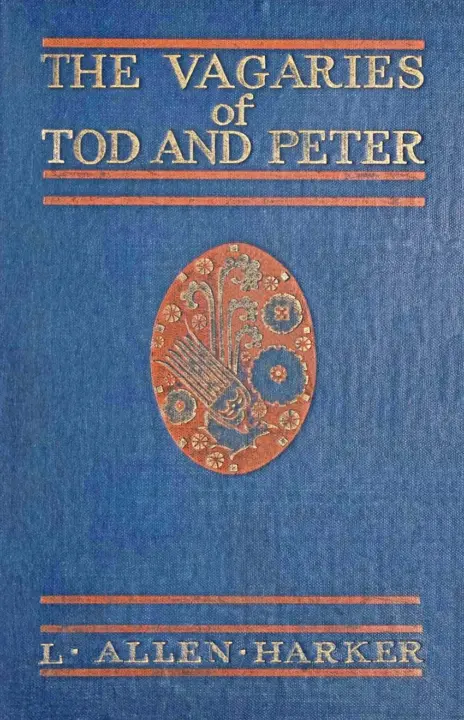
The Vagaries of Tod and Peter
L. Allen (Lizzie Allen) Harker
THE CLASSIC COLLECTION · 1912
"Mr. Wycherly's Wards" by L. Allen Harker is a novel written in the early 20th century. The story revolves around Mr. Wycherly, who takes guardianship of two boys, Edmund and Montagu, after the death of their aunt, Miss Esperance. The novel explores the challenges and humorous situations that arise as Mr. Wycherly relocates to Oxford and attempts to manage life with his wards, while grappling with the expectations of society and their new living conditions. The opening of the novel introduces Mr. Wycherly's sudden decision to move to Oxford, driven by a desire to create a comforting environment for the boys after their aunt's passing. As he settles into a quirky old house, the chaos of their new living situation becomes apparent when he realizes that they lack a capable servant. The boys, each with distinct personalities, are depicted as lively companions who readily adapt to their new home, and they playfully interact with their guardian as they adjust to their new lives. This initial chapter sets the stage for a mix of humor and heartfelt moments as the family dynamics unfold in their new environment.
Introduction adapted from the source catalogue; source summaries may be automatically generated.
Free to read · English · 65,838 words · No account needed
MAKE TIME FOR A GOOD BOOK
On by default. Untick to stop anonymous reading totals. Each page counts after 10 seconds in view. How this works.
Anonymous counting is on unless you have switched it off.
The next few days drove Mrs. Dew almost to desperation. It was impossible to make Jane-Anne "keep herself to herself," as that good woman considered decorous and desirable.
Wherever the young gentlemen were, there was Jane-Anne, and it wasn't altogether her own fault. They sought her out. She fielded at impromptu cricket matches, and discussed high subjects with Montagu. She proudly displayed her knowledge of the Greek alphabet, and assisted to stick in stamps in a long-neglected album. She even confided to the boys her misfortune with the "Magnolia Bloom," nor was she wholly crushed by their scorn for her silliness. Apropos of this, one day, she said:
"I wouldn't mind so much being brown if only I had curly hair."
"The Greeks always had curly hair," Montagu announced authoritatively. "I can't think why you've been left out, 'ribbed and rippled like the wet sea-sand,'" he quoted.
"I wonder," Edmund remarked, with a gravity that would have warned a wiser person, "that you never wash it in beer, then it would curl like anything."
"Would it?" exclaimed Jane-Anne, in great excitement. "Is that why
yours is so curly?"
Edmund winked at Montagu, who grinned appreciatively. "Of course it is," he cried; "all our chaps wash their heads in beer every Saturday, that's why we've all got such ripping hair. Look at it." And Edmund thrust his head under Jane-Anne's nose.
She ran her hand gently over the short, fair hair that was indeed "ribbed and rippled like the wet sea-sand," then she sniffed delicately, remarking: "I wonder it doesn't smell of it."
"Oh, the smell soon goes off," Edmund answered airily.
"Why don't you do it?" she asked Montagu. "Your hair's as straight as
mine."
"He's too slack," Edmund remarked.
"Oh, I can't be bothered," Montagu said carelessly; "I don't want curly hair. If I did I should wash it in beer."
At that moment Mr. Wycherly called the boys to go out with him, and they rushed off leaving Jane-Anne to digest this seemingly simple specific for curly hair.
Reflection unfollowed by action was impossible to Jane-Anne.
The beds were made. Her share of the dusting was done. The boys and Mr. Wycherly would be out until luncheon, and her aunt was busy in the kitchen where she strongly objected to have Jane-Anne, as she described it, "clutterin' round."
There was a large cask of beer in the cellar, and the key was in the door. The cellar was to the front of the house under the dining-room, and was consequently some distance from the kitchen.
Jane-Anne rushed upstairs, seized her large bedroom jug, emptied it, and descended with it to the cellar.
Your reading position is saved on this browser. Take it to another device with a library code. Reading pages adapt to text, rather than matching a printed edition.
L. Allen (Lizzie Allen) Harker
L. Allen (Lizzie Allen) Harker
L. Allen (Lizzie Allen) Harker
L. Allen (Lizzie Allen) Harker
BEHIND THE BOOK
This eBook is for the use of anyone anywhere in the United States and most other parts of the world at no cost and with almost no restrictions whatsoever. You may copy it, give it away or re-use it under the terms of the Project Gutenberg License included with this eBook or online at www.gutenberg.org. If you are not located in the United States, you will have to check the laws of the country where you are located before using this eBook. Read the source licence.
The original source file, including credits and licence, is retained by this library. Request an original-format copy at no charge. Please include the book title and Project Gutenberg identifier #54418.
KEEP YOUR CURIOSITY GOING
Coulson Kernahan

Maurice Baring
Frances Wright
Cécile Tormay

Frederic Jesup Stimson

W. H. P. (William Henry Pope) Jarvis