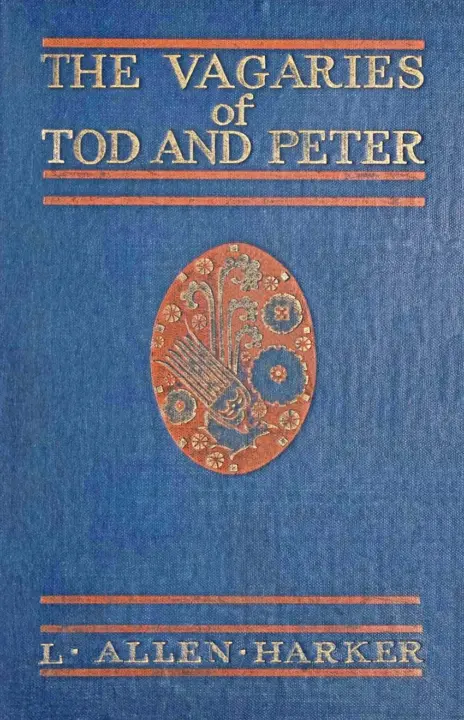
The Vagaries of Tod and Peter
L. Allen (Lizzie Allen) Harker
THE CLASSIC COLLECTION · 1912
"Mr. Wycherly's Wards" by L. Allen Harker is a novel written in the early 20th century. The story revolves around Mr. Wycherly, who takes guardianship of two boys, Edmund and Montagu, after the death of their aunt, Miss Esperance. The novel explores the challenges and humorous situations that arise as Mr. Wycherly relocates to Oxford and attempts to manage life with his wards, while grappling with the expectations of society and their new living conditions. The opening of the novel introduces Mr. Wycherly's sudden decision to move to Oxford, driven by a desire to create a comforting environment for the boys after their aunt's passing. As he settles into a quirky old house, the chaos of their new living situation becomes apparent when he realizes that they lack a capable servant. The boys, each with distinct personalities, are depicted as lively companions who readily adapt to their new home, and they playfully interact with their guardian as they adjust to their new lives. This initial chapter sets the stage for a mix of humor and heartfelt moments as the family dynamics unfold in their new environment.
Introduction adapted from the source catalogue; source summaries may be automatically generated.
Free to read · English · 65,838 words · No account needed
MAKE TIME FOR A GOOD BOOK
On by default. Untick to stop anonymous reading totals. Each page counts after 10 seconds in view. How this works.
Anonymous counting is on unless you have switched it off.
She would consult Mr. Wycherly. She had infinite faith in his sympathy, his wisdom, and his resource. She would show him this enchanting journal and see what he thought of it. Perhaps he, who read so many books, was already familiar with its pages.
She carried it with her when she went to bid him good-night. It had become an established custom for Jane-Anne to bid him good-night at considerable length.
"Have you ever read The Peeress, sir?" she asked, laying it on his table on the top of an open book.
"Never," said Mr. Wycherly. "Is this the lady?" He opened it, turned the pages somewhat hastily, and actually blushed.
"My dear child!" he exclaimed, "where did you get hold of this extremely
shameless production?"
"Mrs. Methuen always takes it, sir; it's a ladies' paper. She left this
number here."
"Mrs. Methuen, that refined and charming young lady! Surely, my dear,
you are mistaken."
"No, sir, really. Lots of ladies always read it, aunt said so. I wanted to take it back to her lest she should want it, but aunt says she gets it every week, and she didn't think it mattered."
"That being the case," Mr. Wycherly remarked, hastily shutting the magazine, "it is evidently not intended for me, and you had better take it away."
"Oh, sir," Jane-Anne pleaded, "do look at the pictures. They're such
beautiful ladies."
But Mr. Wycherly steadfastly averted his gaze from the offending
magazine, exclaiming:
"Beautiful! My dear child, how can you apply that dignified and really expressive adjective to anything so dreadful? Have you ever seen any human being who in the least resembled the extremely indelicate creatures depicted in this paper?"
"No, sir, but I'd like to. They've all got such curly hair."
"Most of them," Mr. Wycherly said severely, "appear to wear very little else. We must show you some really beautiful pictures, Jane-Anne, and then perhaps you will realise the worthlessness of these."
She felt that it was an unpropitious moment for the introduction of "Magnolia Bloom toilet powder." Mr. Wycherly's attitude was strangely unsympathetic. Nevertheless she was full of tenacity of purpose, so she said, in what she was assured Bruey would have considered a "winning" voice:
"Please, sir, is there anything I could do to earn one-and-six?"
Mr. Wycherly laughed. "I think you have earned it many times over by all the things you do for me. Would you like it now?"
He took a handful of silver from his pocket and pushed the coins toward
her, saying:
Your reading position is saved on this browser. Take it to another device with a library code. Reading pages adapt to text, rather than matching a printed edition.
L. Allen (Lizzie Allen) Harker
L. Allen (Lizzie Allen) Harker
L. Allen (Lizzie Allen) Harker
L. Allen (Lizzie Allen) Harker
BEHIND THE BOOK
This eBook is for the use of anyone anywhere in the United States and most other parts of the world at no cost and with almost no restrictions whatsoever. You may copy it, give it away or re-use it under the terms of the Project Gutenberg License included with this eBook or online at www.gutenberg.org. If you are not located in the United States, you will have to check the laws of the country where you are located before using this eBook. Read the source licence.
The original source file, including credits and licence, is retained by this library. Request an original-format copy at no charge. Please include the book title and Project Gutenberg identifier #54418.
KEEP YOUR CURIOSITY GOING
Coulson Kernahan

Maurice Baring
Frances Wright
Cécile Tormay

Frederic Jesup Stimson

W. H. P. (William Henry Pope) Jarvis