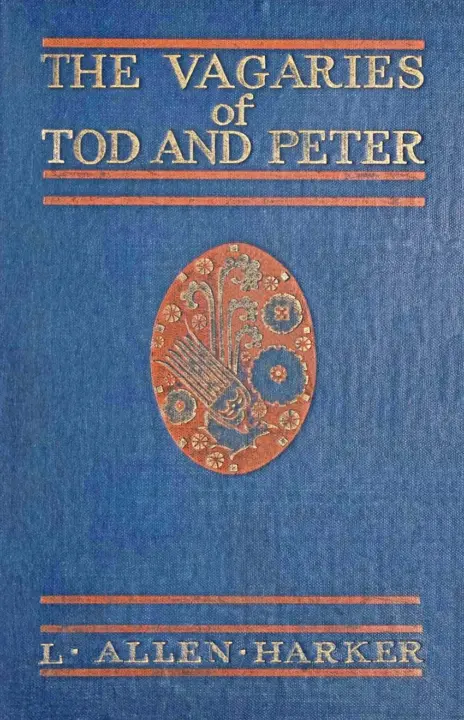
The Vagaries of Tod and Peter
L. Allen (Lizzie Allen) Harker
THE CLASSIC COLLECTION · 1912
"Mr. Wycherly's Wards" by L. Allen Harker is a novel written in the early 20th century. The story revolves around Mr. Wycherly, who takes guardianship of two boys, Edmund and Montagu, after the death of their aunt, Miss Esperance. The novel explores the challenges and humorous situations that arise as Mr. Wycherly relocates to Oxford and attempts to manage life with his wards, while grappling with the expectations of society and their new living conditions. The opening of the novel introduces Mr. Wycherly's sudden decision to move to Oxford, driven by a desire to create a comforting environment for the boys after their aunt's passing. As he settles into a quirky old house, the chaos of their new living situation becomes apparent when he realizes that they lack a capable servant. The boys, each with distinct personalities, are depicted as lively companions who readily adapt to their new home, and they playfully interact with their guardian as they adjust to their new lives. This initial chapter sets the stage for a mix of humor and heartfelt moments as the family dynamics unfold in their new environment.
Introduction adapted from the source catalogue; source summaries may be automatically generated.
Free to read · English · 65,838 words · No account needed
MAKE TIME FOR A GOOD BOOK
On by default. Untick to stop anonymous reading totals. Each page counts after 10 seconds in view. How this works.
Anonymous counting is on unless you have switched it off.
Mr. Wycherly surveyed the scene with kind, pleased eyes; nor did he realise then that what made it all seem so endearing and familiar was the fact that on the horse-hair sofa there sprawled--"sat" is far too decorous a word--a lively boy of ten, with rumpled, curly, yellow hair and a rosy handsome face from which frank blue eyes looked forth upon a world that, so far, contained little that he did not consider in the light of an adventure.
While balanced on the edge of the table--again "sat" is quite undescriptive--another boy swung his long legs while his hands were plunged deep in his trouser pockets. A tall, thin boy this, with grave dark eyes, long-lashed and gentle, and a scholar's forehead.
Montagu, nearly fourteen, had just reached the age when clothes seem always rather small, sleeves short, likewise trousers: when wrists are red and obtrusive and hair at the crown of the head stands straight on end.
Neither of the boys ever sat still except when reading. Then Montagu, at all events, was lost to the world. They frequently talked loudly and at the same time, and were noisy, gay and restless as is the usual habit of their healthy kind.
Strange companions truly for a scholarly recluse! Yet the boys were absolutely at ease with and fearless of their guardian.
With him they were even more artlessly natural than with schoolfellows of their own age. Their affection for him was literally a part of their characters, and, in Montagu's case, passionately protective. The elder boy had already realised how singularly unfitted Mr. Wycherly was, both by temperament and habit, to grapple with practical difficulties.
"Ah'm awfu' hungry," said Edmund presently, in broadest Doric.
"Edmund," remarked his guardian, "I have noticed on several occasions since you returned from school that you persist in talking exactly like the peasantry at Burnhead. Why?"
"Well, you see, Guardie, for one thing I'm afraid of forgetting it. And then, you know, it amuses the chaps. They admire it very much."
"But you never did it in Scotland," Mr. Wycherly expostulated.
"Oh, didn't I. Not to you and Aunt Esperance, perhaps, but you should have heard me when I got outside----
"I don't like it, Edmund, and I wonder your masters have not found fault
with you."
"They think I can't help it, and it makes them laugh--you should hear me say my collect exactly like Sandie Croall----"
"Indeed I wish to hear nothing of the kind," said Mr. Wycherly in dignified reproof. "I can't think why you should copy the lower classes in your mode of speech."
Your reading position is saved on this browser. Take it to another device with a library code. Reading pages adapt to text, rather than matching a printed edition.
L. Allen (Lizzie Allen) Harker
L. Allen (Lizzie Allen) Harker
L. Allen (Lizzie Allen) Harker
L. Allen (Lizzie Allen) Harker
BEHIND THE BOOK
This eBook is for the use of anyone anywhere in the United States and most other parts of the world at no cost and with almost no restrictions whatsoever. You may copy it, give it away or re-use it under the terms of the Project Gutenberg License included with this eBook or online at www.gutenberg.org. If you are not located in the United States, you will have to check the laws of the country where you are located before using this eBook. Read the source licence.
The original source file, including credits and licence, is retained by this library. Request an original-format copy at no charge. Please include the book title and Project Gutenberg identifier #54418.
KEEP YOUR CURIOSITY GOING
Coulson Kernahan

Maurice Baring
Frances Wright
Cécile Tormay

Frederic Jesup Stimson

W. H. P. (William Henry Pope) Jarvis