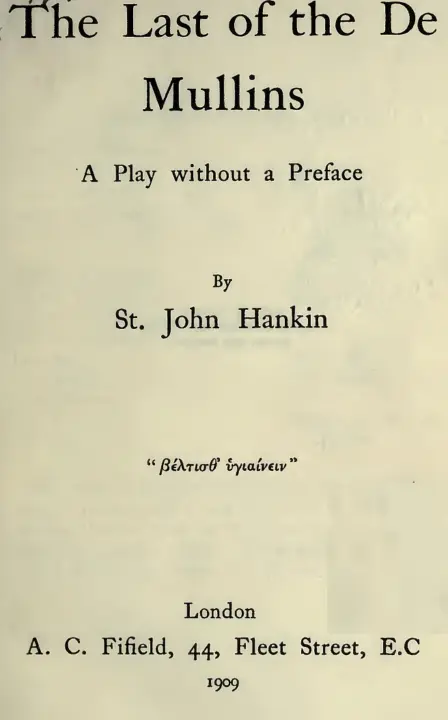
The Last of the De Mullins: A Play Without a Preface
St. John Hankin
THE CLASSIC COLLECTION · 1901
"Mr. Punch's Dramatic Sequels" by St. John Hankin is a collection of humorous theatrical sequels written in the late 19th century. The work is a playful exploration of famous plays, such as "Hamlet" and "Much Ado About Nothing," where Hankin humorously imagines what might occur after the curtain falls on these classic tales. Through wit and satire, he captures the characters' quirks and societal norms, presenting a rich tapestry of post-play life that adds depth and amusement to the original narratives. At the start of the work, the author introduces a series of theatrical pieces beginning with "Alcestis," where the titular character is brought back from the dead by Heracles, only to bemoan the annoying aspects of married life with her husband, Admetus. This light, comedic tone sets the stage for the ensuing stories, blending classical themes with modern issues of marriage and societal expectations. The opening passages feature clever dialogues and character interactions, setting a playful atmosphere as the characters grapple with their circumstances in exaggerated and humorous ways, inviting readers into a whimsical reflection on drama and life.
Introduction adapted from the source catalogue; source summaries may be automatically generated.
Free to read · English · 24,647 words · No account needed
MAKE TIME FOR A GOOD BOOK
On by default. Untick to stop anonymous reading totals. Each page counts after 10 seconds in view. How this works.
Anonymous counting is on unless you have switched it off.
[In homely vernacular.] Look here, Bill, you can drop that jargon. There's no one here but ourselves, and I ain't amused by it. It's all very well to try it on when there's gentlefolk about, but when we're alone you take a rest.
[Puzzled.] Ay, marry!
[Throwing down tools.] Stow it, I say, or I'll have to make you. Marry, indeed! If you mean "Yes," say "Yes." If you mean "No," say "No."
All right, mate.
[Grumbling.] It's bad enough staying up all night building more rooms on to this confounded castle--I should have thought it was big enough and ugly enough without our additions--but if I'm to listen to your gab, s'help me----!
Hush! here comes some one.
[They make a valiant pretence of work as HORATIO and FORTINBRAS enter.
[Ecstatically, completely deceived by this simple ruse.] My
Master-Builders!
Idle dogs!
[Elizabethan again.] Argal, goodman builder, will he nill he, he that builds not ill builds well, and he that builds not well builds ill. Therefore, perpend!
[Appreciatively.] How absolute the knave is!
He seems to me to be an absolute fool.
Not at all. A most intelligent working man. I'll draw him out. [To 1ST CLOWN.] When will the house be finished, sirrah?
When it is done, Sir.
Ay, fool, and when will that be?
When it is finished, o' course.
[To FORTINBRAS.] There! What do you call that? Witty, eh?
I call it perfectly idiotic, if you ask me.
Well, well; we'll try again. [To 1ST CLOWN.] And whose is the house,
fellow?
[Fatuously.] Marry, his that owns it. Ask another.
[To FORTINBRAS.] Ha! Ha! Good again. By the Lord, Fortinbras, as Hamlet used to say, the toe of the peasant comes so near the heel of the courtier, it galls his kibe.
[Savagely.] The toe of the courtier is getting so perilously near the person of the peasant that you'd better get rid of the latter as soon as possible.
[Doubtfully.] Perhaps you're right. And yet I was always taught to consider that kind of thing awfully entertaining. But, there. Fashions change in humour as in other things. Send them away.
[Giving them money.] Away with you, fellows. Go and get drunk.
[Exeunt clowns.
[Relapses into blank verse on their departure.]
What think you of the New Wing, Fortinbras?
The whole effect is cheerful, is it not?
Good large sash windows, lots of light and air;
No mediæval nonsense.
[Who does not admire the building.] So I see!
Your reading position is saved on this browser. Take it to another device with a library code. Reading pages adapt to text, rather than matching a printed edition.
BEHIND THE BOOK
This eBook is for the use of anyone anywhere in the United States and most other parts of the world at no cost and with almost no restrictions whatsoever. You may copy it, give it away or re-use it under the terms of the Project Gutenberg License included with this eBook or online at www.gutenberg.org. If you are not located in the United States, you will have to check the laws of the country where you are located before using this eBook. Read the source licence.
The original source file, including credits and licence, is retained by this library. Request an original-format copy at no charge. Please include the book title and Project Gutenberg identifier #47792.
KEEP YOUR CURIOSITY GOING
Maurice Baring
W. B. (William Butler) Yeats
Edward Martyn

John Brougham & Charlotte Brontë
Marguerite Merington
Leonid Andreyev