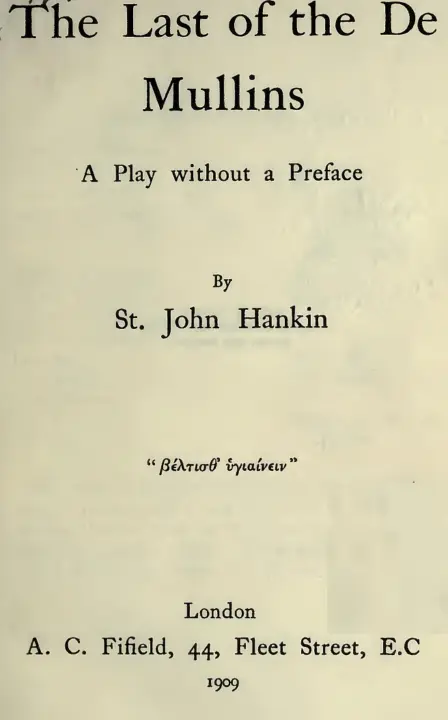
The Last of the De Mullins: A Play Without a Preface
St. John Hankin
THE CLASSIC COLLECTION · 1901
"Mr. Punch's Dramatic Sequels" by St. John Hankin is a collection of humorous theatrical sequels written in the late 19th century. The work is a playful exploration of famous plays, such as "Hamlet" and "Much Ado About Nothing," where Hankin humorously imagines what might occur after the curtain falls on these classic tales. Through wit and satire, he captures the characters' quirks and societal norms, presenting a rich tapestry of post-play life that adds depth and amusement to the original narratives. At the start of the work, the author introduces a series of theatrical pieces beginning with "Alcestis," where the titular character is brought back from the dead by Heracles, only to bemoan the annoying aspects of married life with her husband, Admetus. This light, comedic tone sets the stage for the ensuing stories, blending classical themes with modern issues of marriage and societal expectations. The opening passages feature clever dialogues and character interactions, setting a playful atmosphere as the characters grapple with their circumstances in exaggerated and humorous ways, inviting readers into a whimsical reflection on drama and life.
Introduction adapted from the source catalogue; source summaries may be automatically generated.
Free to read · English · 24,647 words · No account needed
MAKE TIME FOR A GOOD BOOK
On by default. Untick to stop anonymous reading totals. Each page counts after 10 seconds in view. How this works.
Anonymous counting is on unless you have switched it off.
I dare say Mrs. Tanqueray has, if you wish to know it.
[Footman hands soup.
I shall be eternally indebted to her.
Why?
I shall engage him at once. [Begins to eat his soup, frowns, and then puts down his spoon.] But I'm afraid you'll want him back yourself.
No. My wife is most particular about the character of her servants.
Ah! I'm more particular about the character of my soup.
[His hand goes out instinctively towards his sherry-glass. As he is about to raise it he sees that it is empty, and refrains.
Cayley, you ought to marry. Then you'd realise that there are more important things in the world than soup.
Of course there are, my dear fellow. There's the fish and the joint.
[Fish of an unattractive kind is handed to him.
He takes some.
Sybarite!
[CAYLEY looks at his fish dubiously, then leaves it untasted.
You are quite wrong. A simple cut of beef or mutton, well-cooked, is
quite enough for me.
[To CAYLEY.] Lemonade, Sir?
Eh, what? No, thank you.
Ah, Cayley. What will you drink? [CAYLEY'S face brightens visibly.] I'm afraid I can't offer you any wine. [It falls again.] My wife never allows alcohol at her table. But there are various sorts of mineral waters. You don't mind?
[Grimly.] Not at all, my dear fellow, not at all. Which brand of mineral water do you consider most--ah--stimulating?
[Laughing mirthlessly.] I'm afraid, Cayley, you're not a convert to
Temperance principles yet. That shows you have never heard my wife
speak.
[Emphatically.] Never! Temperance meetings are not in my line.
[Footman removes his plate.
Perhaps some of the other movements in which she is interested would appeal to you more. [With a touch of happy pride.] As you may know, my wife is a vice-president of the Anti-Vaccination Society, and of the Woman's Home Rule Union. Indeed, she is in great request on all public platforms.
[With simulated enthusiasm.] I feel sure of that, my dear Aubrey. [Footman hands CAYLEY some rice-pudding. CAYLEY puts up his eye-glass, and eyes it curiously.] What is this?
Rice-pudding, Sir.
[CAYLEY drops spoon hastily.
[Politely.] You're eating nothing, Cayley.
[With some concern.] Aubrey, have I slept through the joint? I have no recollection of eating it. If, in a moment of abstraction, I refused it, may I change my mind?
[Sternly.] My wife never has meat at her table on Fridays.
Your reading position is saved on this browser. Take it to another device with a library code. Reading pages adapt to text, rather than matching a printed edition.
BEHIND THE BOOK
This eBook is for the use of anyone anywhere in the United States and most other parts of the world at no cost and with almost no restrictions whatsoever. You may copy it, give it away or re-use it under the terms of the Project Gutenberg License included with this eBook or online at www.gutenberg.org. If you are not located in the United States, you will have to check the laws of the country where you are located before using this eBook. Read the source licence.
The original source file, including credits and licence, is retained by this library. Request an original-format copy at no charge. Please include the book title and Project Gutenberg identifier #47792.
KEEP YOUR CURIOSITY GOING
Maurice Baring
W. B. (William Butler) Yeats
Edward Martyn

John Brougham & Charlotte Brontë
Marguerite Merington
Leonid Andreyev