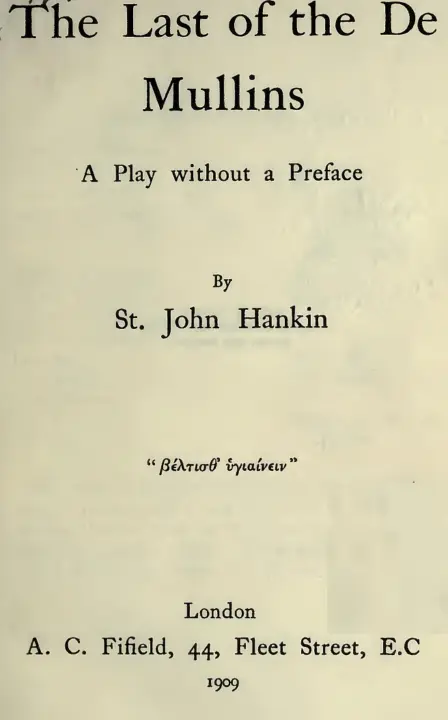
The Last of the De Mullins: A Play Without a Preface
St. John Hankin
THE CLASSIC COLLECTION · 1901
"Mr. Punch's Dramatic Sequels" by St. John Hankin is a collection of humorous theatrical sequels written in the late 19th century. The work is a playful exploration of famous plays, such as "Hamlet" and "Much Ado About Nothing," where Hankin humorously imagines what might occur after the curtain falls on these classic tales. Through wit and satire, he captures the characters' quirks and societal norms, presenting a rich tapestry of post-play life that adds depth and amusement to the original narratives. At the start of the work, the author introduces a series of theatrical pieces beginning with "Alcestis," where the titular character is brought back from the dead by Heracles, only to bemoan the annoying aspects of married life with her husband, Admetus. This light, comedic tone sets the stage for the ensuing stories, blending classical themes with modern issues of marriage and societal expectations. The opening passages feature clever dialogues and character interactions, setting a playful atmosphere as the characters grapple with their circumstances in exaggerated and humorous ways, inviting readers into a whimsical reflection on drama and life.
Introduction adapted from the source catalogue; source summaries may be automatically generated.
Free to read · English · 24,647 words · No account needed
MAKE TIME FOR A GOOD BOOK
On by default. Untick to stop anonymous reading totals. Each page counts after 10 seconds in view. How this works.
Anonymous counting is on unless you have switched it off.
[PAULINE goes forward to greet her.
[Not seeing her.] Ah, my dear son [runs across the room to CLAUDE before the eyes of the deeply scandalised JAMES, and kisses him repeatedly], how glad I am to see you again! And your grand house! And your fine servants! In livery, too!
[PAULINE shudders, and so does JAMES. The latter
goes out.
My dearest mother!
[Kisses her.
[Beaming on Pauline.] How do you do, my dear? Let me give my Claude's
wife a kiss.
[Does so in resounding fashion.
[As soon as she has recovered from the warmth of this embrace.] How do you do, Mrs. Melnotte? Won't you sit down?
Thank you kindly, my dear. I don't mind if I do.
[A ring is heard outside, followed by the sound of someone being admitted. PAULINE looks anxiously towards the door.
[To herself.] A visitor! How unlucky! I wonder who it is?
[Throwing open the door.] Mrs. Deschappelles.
Great Heavens, my mother!
[Falls back, overwhelmed, into her chair.
[In her most elaborate manner.] My dear child, you are unwell. My coming has been a shock to you. But there, a daughter's affection, Claude--[shaking hands with him]--how wonderful it is!
Dear mother, we are delighted to see you.
Of course I ought to have called before. I have been meaning to come ever since you returned from your honeymoon. But I have so many visits to pay; and you have only been back ten weeks!
I quite understand, mother dear.
And, as I always say to your poor father, "When one is a leader of Society, one has so many engagements." I am sure you find that.
I have hardly begun to receive visits yet.
No, dear? But then it's different with you. When you married Colonel Melnotte, of course you gave up all social ambitions.
I am sure no one could wish for a better, braver husband than my Claude.
[Turning sharply round and observing MRS. MELNOTTE for the first time.] I beg your pardon? [Icily.
[Bravely.] I said no one could have a better husband than Claude.
[Dumbfounded, appealing to PAULINE.] Who--who is this person?
[Nervously.] I think you have met before, mother. This is Mrs.
Melnotte.
[Insolently.] Oh! the gardener's wife.
[Melodramatic at once.] Yes. The gardener's wife and my mother!
[Impatiently.] Of course, I know the unfortunate relationship between you, Claude. You need not thrust it down my throat. You know how unpleasant it is to me.
Your reading position is saved on this browser. Take it to another device with a library code. Reading pages adapt to text, rather than matching a printed edition.
BEHIND THE BOOK
This eBook is for the use of anyone anywhere in the United States and most other parts of the world at no cost and with almost no restrictions whatsoever. You may copy it, give it away or re-use it under the terms of the Project Gutenberg License included with this eBook or online at www.gutenberg.org. If you are not located in the United States, you will have to check the laws of the country where you are located before using this eBook. Read the source licence.
The original source file, including credits and licence, is retained by this library. Request an original-format copy at no charge. Please include the book title and Project Gutenberg identifier #47792.
KEEP YOUR CURIOSITY GOING
Maurice Baring
W. B. (William Butler) Yeats
Edward Martyn

John Brougham & Charlotte Brontë
Marguerite Merington
Leonid Andreyev