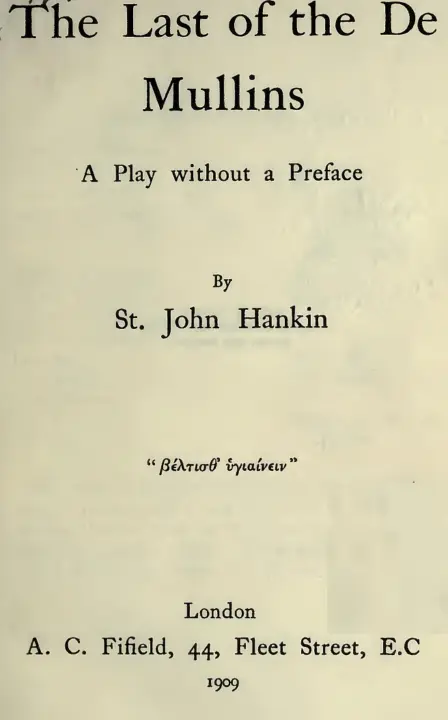
The Last of the De Mullins: A Play Without a Preface
St. John Hankin
THE CLASSIC COLLECTION · 1901
"Mr. Punch's Dramatic Sequels" by St. John Hankin is a collection of humorous theatrical sequels written in the late 19th century. The work is a playful exploration of famous plays, such as "Hamlet" and "Much Ado About Nothing," where Hankin humorously imagines what might occur after the curtain falls on these classic tales. Through wit and satire, he captures the characters' quirks and societal norms, presenting a rich tapestry of post-play life that adds depth and amusement to the original narratives. At the start of the work, the author introduces a series of theatrical pieces beginning with "Alcestis," where the titular character is brought back from the dead by Heracles, only to bemoan the annoying aspects of married life with her husband, Admetus. This light, comedic tone sets the stage for the ensuing stories, blending classical themes with modern issues of marriage and societal expectations. The opening passages feature clever dialogues and character interactions, setting a playful atmosphere as the characters grapple with their circumstances in exaggerated and humorous ways, inviting readers into a whimsical reflection on drama and life.
Introduction adapted from the source catalogue; source summaries may be automatically generated.
Free to read · English · 24,647 words · No account needed
MAKE TIME FOR A GOOD BOOK
On by default. Untick to stop anonymous reading totals. Each page counts after 10 seconds in view. How this works.
Anonymous counting is on unless you have switched it off.
My dear Claude, that woman! Mr. Smith kept a greengrocer's shop. 'Tis true he made a great deal of money by his contracts to supply the armies of the Republic with vegetables, but they are not gentlepeople!
[In his most Byronic manner.] What is it makes a gentleman, Pauline? Is it to have a cousin in the Peerage----
Partly that, dear.
[Refusing to be interrupted.] Or is it to be honest,
simple, kind----
But I have no reason for believing Mr. Smith to have been more honest than the general run of army contractors.
[Continuing.] Gentle in speech and action as in name?
Oh, it is this that makes a gentleman!
And Mr. Smith, although he kept a shop,
May very properly be so described.
Yes, I know, dear. Everybody calls himself a gentleman nowadays, even the boy who cleans the boots. But I am not going to give in to these unhealthy modern ideas, and I am not going to visit Mrs. Smith. She is not in Society.
[Off again on his high horse.] What is Society? All noble men----
[Objecting.] But Mr. Smith isn't a nobleman, Claude.
... And women, in whatever station born,
These, only these, make up "Society."
[Patiently.] But that's such a dreadful misuse of words, dear. When one talks of "Society," one does not mean good people, or unselfish people, or high-minded people, but people who keep a carriage and give dinner parties. Those are the only things which really matter socially.
Pauline, Pauline, what dreadful sentiments!
They show a worldly and perverted mind.
I grieve to think my wife should utter them!
[Very sweetly.] I wish, Claude, you'd try and give up talking in blank verse. It's very bad form. And it's very bad verse, too. Try and break yourself of it.
[Off again.] All noble thoughts, Pauline----
No, no, no, Claude. I really can't have this ranting. Byronics are
quite out of fashion.
[Relapsing gloomily into prose.] You may laugh at me, Pauline, but
you know I'm right.
Of course you're right, dear. Much too right for this wicked world. That's why I never can take your advice on any subject. You're so unpractical.
[Breaking out again.]
The world, the world, oh, how I hate this world!
Now that's silly of you, dear. There's nothing like making the best of a bad thing. By the way, Claude, didn't you say Mrs. Melnotte was coming to call this afternoon?
Yes. Dear mother, how nice it will be to see her again!
Your reading position is saved on this browser. Take it to another device with a library code. Reading pages adapt to text, rather than matching a printed edition.
BEHIND THE BOOK
This eBook is for the use of anyone anywhere in the United States and most other parts of the world at no cost and with almost no restrictions whatsoever. You may copy it, give it away or re-use it under the terms of the Project Gutenberg License included with this eBook or online at www.gutenberg.org. If you are not located in the United States, you will have to check the laws of the country where you are located before using this eBook. Read the source licence.
The original source file, including credits and licence, is retained by this library. Request an original-format copy at no charge. Please include the book title and Project Gutenberg identifier #47792.
KEEP YOUR CURIOSITY GOING
Maurice Baring
W. B. (William Butler) Yeats
Edward Martyn

John Brougham & Charlotte Brontë
Marguerite Merington
Leonid Andreyev